Flight Training - N2S Stearmans, SNJ/AT-6 'Texans' and "Twin Beeches"(the D-18 in civil life)
Coming to Navy flight training from war zone, via Port Lyautey, the Azores, Goose Bay Labrador, & NAS Patuxent River, Maryland.
An overseas flight was just the beginning of a flight training journey. Rail coach cars, a Terraplane, a ferryboat, and "tourist homes."
Copyright 2014 Franklyn E. Dailey Jr.
- Barnstomers and Early Aviators
- Budget Flying Clubs
- Aviation Records
- VFR to IFR
- Early Airline Development
- Flight Across the Atlantic
- P-40s to Iceland
- Alaska Based Navy P2Y-1's
- Buckner Goes to Alaska
- Ship-to-Ship Battle
- Naval Flight Training
- NAS Instrument Training
- Aleutians Anti-Submarine Warfare
- Search & Rescue
- Gyros and Flight Computers
- Baseball Team Lost in Flight
- Tomcats and Boeing 777s
Context: Instrument Flight, vs.Flight
Contact Author Franklyn E.Dailey Jr.
One major goal of the multi-engine aviation training program was to acquire pilot skills in instrument flying. We did not become fully instrument-qualified pilots in the Navy training program .(we were given 'red' instrument cards and would have to wait for experience to gain a 'white' card) At the very least, we hoped to become useful eyes and ears in a cockpit.
A fact of military life is travel.
And not just the military person. Wives and babies, too. Some wives would pack up and travel to the port their husband had been sent for debarkation. Hoping that he would return to that port. A forlorn hope, rarely achieved. But for going from base to base in a sequence of training bases, a wife and child often did catchup up with their military man on orders.
I have been cross country in my native land in a Southern Pacific troop train. Those that made that journed on the Santa Fe fared better. I have been crosscountry in my won car with a wfie and one child, the wife and three children, the wife and three children plus and infant. I have been cross country in a MATS DC-6 crowded with military families. I have been cross c ountry in a civilian airline with seven of our own children plus a nice little girl traveling alone that American Airlines asked us to chaperone. Back to flight training late 1944 and early 1945. Coach train or private car.
The airbases student pilots would be sent to would be punctuated by travel from one base to another. The war was still on so "travel" still meant overloaded rail coach trains with a mix of uniformed men with civilians of all ages and both genders. The U.S. was on the threshold of a huge expansion in air travel so the war years were a last look at a nation connected by a myriad of interconnected railroads that soon disappeared at a pace so swift that most citizens did not even have time to reflect.
There would be many intermediate hurdles. I began Navy flight training totally devoid of flying skills but many in my phase of the flight program came with some flying skills. I finished "primary flight training" and would be authorized to check out a Stearman and fly to another airport, all before before I had a valid driver's license. I am going to take some lines here to tell readers something about my fight training experience. Some of this is in the book pictured above left.
Pictured next is the first plane I would learn to fly in "Primary" phase flight training at NAS Ottumwa, Iowa..
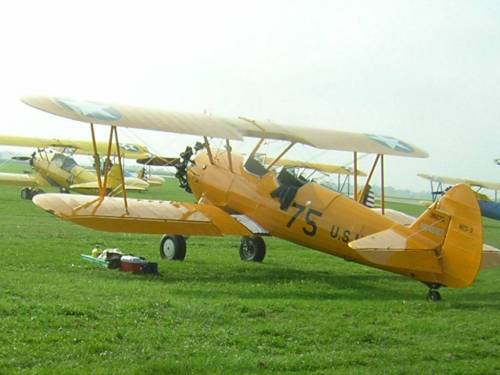
Navy N2S-3 primary flight training aircraft of WW II, a "Stearman," configured pretty much as it was when I was a student pilot in 1944. In this view, shown at a 'fly-in' at Galesburg Illinois, the photo is provided by Malcolm Barker, who found these pages, and realized that he and I went through pilot crew training in Navy PB4Y-2 Privateer aircraft at about the same He reported to a sister squadron (VP-107 for me, VP-122 for him) at NAS Whidbey Island, Washington, in 1946 . These squadrons rotated deploymens to NAS Kodiak , Alaska.
Learning to solo.
We did have grass outlying fields, but the main student training field at NAS Ottumwa Iowa consisted of two asphalt paved mats.
Every pilot has some treasured memories of his first solo flight. We were first issued a copy of the famous book, "Stick and Rudder." At NAS Ottumwa Iowa, after my 'official' photo was taken in winter flight gear in the ready room in October 1944, my first instructor, a veteran pilot named Verschoyle, took me out to a Stearman and did a walkaraound, pointing out the essential control features of the plane. He then helped me get into the rear seat, showed me very carefully how to get strapped in, and adjust my seat height. He then got into the front seat. With the help of an aviation mechanic on the ground, who 'pulled the prop through' coordinated by hand signals from instructor Verschoyle, who also 'talked' this procdure to me through the voice tube ('gosport') that was my sole communication (one-way, from instructor-to-student) in the rear seat. The various steps involved getting the prop to spin after the magnetos were switched on, and varied depending on use of an air pressure start, or hand start.
There was no air-ground radio, All communcation was visual. A wind tetrahedron dictated direction of landings and takeoffs, red or green lights from the tower would confirm 'yes' or 'no' to pilots, and 'custon' use dictated traffic pattern for circling and landing, at Ottumwa Naval Air Station, dependent also on whether a student's assigned 'flight' was offa 'north' or 'south' 'mat.' Whichever mat was in use, the student with or without an instructor could expect seven or eight Stearmans taking off or landing at once. My first PPC in VP-107 operating out of NAS Kodiak Alaska was ordered to Ottumwa for shore duty as an instructor, in late1946. In his first flight as an instructor in the N2S, this veteran of wartime flying out of Dunkeswell England had a student pilot in another N2S "land"on top of him; on the North Mat. He survived and later piloted "Connies" on the dewline. But both N2S aircraft were 'totaled.'
At Ottumwa, there was a runway off to the side, used only for 'admin' flights in planes like a Howard or a Cessna twin engine "bamboo bomber."
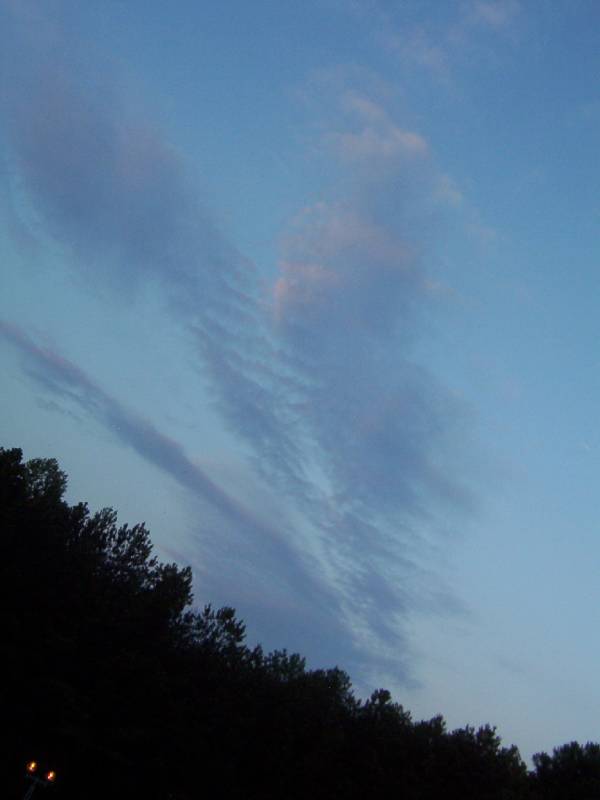
Just before dawn, the sun has begun to tinge the sky, and the Naval Air Station Aerologist can affirm that yesterday's (Nov. 1944) cold front has passed, and primary flight training can resume. The North Mat flies in the morning. Student pilots go to their planes and are joinied by their instructors.
On that first flight, my instructor namedVerschoyle did all the piloting. We went up to maybe five thousand feet, and over to a 'uncluttered area,' and he demonstrated stalls, spins, and banking in controlled turns. He had a reassuring voice and I enjoyed the learning experience. Flights were about two hours in Primary Stage. After a few flights, I was getting confident as I learned to take off, and to get into the approach for landing, without yet making the actual landing. Then, instructor-pilot Verschoyle was ordered back to his home state of Texas and I was assigned a new instructor. I won't name him. He was known as a Screaming Eagle. I faltered in progress, then had the audacity to ask for a new instructor. I got one immediately. He was a young Marine, almost as new to aviation as his students, and good for me. (That first instructor, last-named Verschoyle, had 10,000 flight hours when instructing me. He was a civilian when I first knew him, but later was given a commission. In my entire Navy flying career, I did not get that many flight hours. In the early days of e-mail, Julie Verschoyle gave me seome input on that family.)
I soloed in about 15-20 hours and though there were a lot more 'dual' flights with an instructor, muich of a student's training was self training. And some of it proved fatal to a couple of guys in my 'flight.' Much more of this is in the book. But let me note a couple of thoughts not in the book. The Stearman is a formidable airplane compared with the trainers used then for CPT training, Civilian Pilot Training. Pipers and Taylorcrafts, even today's Cessnas, are much smaller and lighter. Doesn't mean they are less effective as trainers. Probably better. Our Stearmans had Lycoming or Continental 220-horsepower radial engines. Gravity fed the gas. And our final stage cross country flights were taken solo in Stearmans, with a canopy! While night flying found us still solo in the back seat, for that one cross country curricula flight, we flew the front seat. And given maps and knee pads and ways to figure 'drift.' How I circumvented the use of those 'aids' is covered in the book. We left Primary after a bout 100 hours in the Stearman, and graduated to the SNJ, aka the AT6. I might note here that military flight students today begin flight training in larger aircraft, often directly in jet aircraft.
The Navy required two years sea duty before fight training orders would be considered.
At the time of receiving orders to flight training, I was stationed aboard a busy gunfire assault destroyer off Southern France. The full transition from surface destroyer, as a qualified Officer of the Deck Underway, to PB4Y-2 Privateer copilot, took about 20 months. I had been serving my nation in war for the first 27 months of my officer career, bridging the years 1942-43-44, on the Navy destroyer, USS Edison DD-439. Edison was a 340-foot ship of the Benson/Livermore class that went into service in January 1941. For my last year aboard ship, 1944, I served as Edison's Gunnery Officer. Edison, one of the nine destroyers in Destroyer Squadron 13, had inshore gunfire support assignments during a series of World War II assault landings, the first at Fedala near the North African port of Casablanca and then at Sicily (Licata), Salerno, Anziio and Southern France, in the Mediterranean.
To be very candid, an application for assignment to Navy flight training was my answer to an extended period of being put in jeopardy by German gunners and bombardiers and submariners. I figured that a change of venue might be good for my morale and for my survival chances at age 23. Personal fears have led to two key decisions in my life. Both have had rewarding results that have been mixed with pangs of conscience over the internal acknowledgement that I sought a retreat from danger.
Lest mention of my age be inferred as an attempt to elicit a reader's sympathy for youth, I need to point out that most all of the aviator aspirants in the primary flight training class in which I eventually found myself were very young men. I was one of the fleet transfers, both officer and enlisted, in my flight group. We were about four years older than the aviation cadets (AVCADs) and we had combat experience. We were in a minority. The only good reason for the Navy to bring us back from overseas for flight training was investment for the future. As far as winning the World War II in progress was concerned, it is clear to me now that these slightly older yet still neophyte pilots were likely not required. In fact, if our presence denied a billet to a prospective young aviation cadet, that denial was, in the short term, counterproductive. Youth needed to be served, and for the most part it was served in the young men called up for flight training in World War II. The preponderant youth contingent in our flight class had already marked our small shipboard transfer group as "seniors." As it turned out, the advent of the Japanese Kamikaze pilots in the Pacific war justified our orders to flight training.
Most of us in this small transfer group from fleet duty had already seen plenty of aviators, British, American, German and Japanese. Those aviators flew single engine fighters and fighter-bombers, twin engine bombers and night fighters, and two and four engine patrol planes. Well, we had at least seen their flying machines and each of us had some vision of what those pilots looked like. Some of us had seen the agile single engine Focke Wulfs and Aeromarine Spitfires and North American Mustangs and Lockheed Lightnings and marveled at the ease with which they moved rapidly through the air. Others had seen the Zeros and Bettys and a number of other Japanese aircraft. I now know that the pilots of some of those craft arrived in the combat area by applying their knowledge of terrain and sea. They used ground references like railroad tracks, bridges and population centers, lakes and rivers, and of course the sea and its coastlines. Only later in our nation's great mid-west heartland, in my own first efforts at cross country flying, would I encounter the term, "section lines."
The planes that harassed our Mediterranean destroyer at night with their flares and bombs, torpedoes and pilotless weapons, and the friendly night fighters that attempted to interfere with those unfriendly forays, arrived in our sea patrol area by adding skills to the day flyer's terrain-based knowledge to achieve an advanced skill called "night flying." Further, among those night flyers, there were some that had achieved an even more advanced skill known as "instrument flying."
I had not made such speculations while shipboard ship. I was not able to project my thoughts into those cockpits or even appreciate the apprehensions that might exist there. My immediate sea-bound combat worry, very personal and almost completely self-centered, was whether we on our destroyer could get a peek at an enemy night air marauder sufficient to lay a gun on him and then shoot at him without giving away too much. You needed a clear sense of advantage before you fired ,because, if you missed, you left that plane commander with an enhanced knowledge of his opportunity. He still had to apply his flying abilities to a successful return to his base but his welcome there would be much sweeter if he left some serious damage behind. His tools were torpedoes, bombs, and radio controlled bombs and glider bombs.
Our ships were rarely defended by friendly, night fighter, aircraft. Night flying was relatively new; just a few years of experience had been gained. Even the concept of fighter control in the daytime was new. Combat air patrol, CAP, in a fully coordinated and controlled sense, was in its infancy. Air defense, with friendly night fighters, of important land based installations against enemy air raids was "a work in progress." When three land based searchlights could triangulate on one high level enemy bomber, they could hold him and track him and get a fire control solution, and often shoot him down. Friendly fighters had to stay away from the enemy planes or they too would be subject to air-burst, AA shells. A ZI, for Zone of the Interior, was defined around each important land based defensive perimeter. Any plane in the darkness, friend or foe, was going to be shot at in that zone. Any attempt by an aircraft to assist in the defense of a convoy at night, especially a convoy with surface escorts capable of AA fire, was fraught with danger for the defending aircraft. At sea, there was no inter-service protocol, not even something like the ZI over land installations. The ships at sea could not see and identify who the marauders were. (The electronic system,IFF-Identification Friend or Foe, was just being born.) The whole subject of night fighting, aircraft to aircraft, was just too new. For these reasons, the defending air cover, if there was one, usually withdrew at sunset. Even then, some courageous Beaufighters of the British Air Force would often hang around after dusk and do what they could to disrupt an enemy air attack on a convoy.
I have digressed into my war story only to remind myself, and inform the reader, that World War II force-fed tremendous advances in the art of flying and in the technology of flying, especially instrument flying. My ignorance was such I did not even know, that when World War II began in 1939, instrument flying was a relatively new skill.
An application for flight training required a flight physical exam. I obtained this physical from an Army Air Corps flight surgeon at the 15th Air Force in Naples, Italy in the summer of 1944. As soon as that flight surgeon discovered that I was not going to dilute the capability of his Army Air Corps, he became quite lenient, almost cooperative, in his more relaxed pursuit of physical factors that would compromise my ability to fly.
With John Perry of the Naval Academy Class of 1944, I left the USS Edison, DD-439, on October 1, 1944 at Oran, Algeria. I had orders to report to the Naval Air Station (NAS) Ottumwa, Iowa, one of the bases operated by the Naval Air Primary Flight Training Command. Aviation became much more meaningful as soon as I left the ship. I had made all my transatlantic trips on a destroyer and now would make one in an airplane. And events moved faster than I anticipated. A group of Japanese pilots were just becoming known. These were the Kamikaze pilots.
Early leg of the journey from Gunnery Officer in the war zone to student pilot in back seat of a Stearman.
My conveyance back to the U.S. in October 1944 was a C-54 (Douglas DC-4 in the civil aviation world; the Navy called this aircraft the R5D). Pilots under contract from American Airlines flew the plane that returned me from 27-months of combat duty. Its route was from Port Lyautey in Morocco, to Lajes on Terceira Island in the Azores, thence to Goose Bay in Labrador, and finally to my port of entry to the U.S. at NAS, Patuxent River, Maryland. Later I realized that my return trip to the United States was a primer on flying the North Atlantic rim.
Five of us in the combination passenger/cargo hold of that Douglas-built plane kept warm in floor blankets while envying a Navy Captain and a Navy Commander, both line officers, and a Navy Lieutenant in the Medical Corps, those three being passengers occupying the three MacArthur chairs up forward. (Shaped something like a lawn chair, with prominent arm rests and elongated, sloping backs, these leatherette-covered chairs were anchored to the flooring and set aside for the comfort of senior passengers on long flights. I do not know how this type of chair got its name.)
During our lengthy airborne hours, I speculated many times how nice it would be if it would occur to one of those MacArthur-seat occupants to offer his seat to one of us in the rear. How we would have appreciated an hour or two of relief from the cold bulkhead and unyielding floor of the cargo hold. Those men never even turned their heads around to see us huddled there.
The trip otherwise: Lajes in the Azores was dark and cold with heavy rain. We alighted briefly. The North Atlantic was gray, dark underneath the overcast, lighter between stratus cloud layers. Snow was on the ground in Labrador. For some reason, perhaps impatience as I was approaching home and reunion with Peggy, my wife of just six months, the flight from Labrador to NAS Patuxent River, Maryland seemed interminable. It was made even more so by the thunder and lightning that put our pilots to due diligence in a long approach over the Chesapeake Bay. After landing, there was much confusion about baggage and transfer to a C-47 (a DC-3 "Gooney Bird" operated by the Army Air Corps; the Navy designation was R4D) for a flight to the Norfolk Naval Air Station. Those Army Air Corps pilots did not go up into the still boiling storms with any of the circumspection of our American Airlines contract pilots. The DC-3 was obviously overloaded, standing room only, and passengers were hanging onto overhead straps like a New York subway train. We lurched down to Norfolk and I could see that we were on VFR (visual contact with the ground below) flight rules, tracking the western shore of the Chesapeake Bay occasionally visible in the lightning flashes. The landing was rough. I called Peggy and she borrowed a car and came down Hampton Boulevard to a glorious reunion. It had been worth the wait. Please overlook the liberty I have taken in using terminology that I really only learned later in flight training. "Between stratus cloud layers..." is just one example.
As noted at the beginning of this page, my next duty assignment was in the Naval Air Primary Flight Training Command and the specific location was NAS Ottumwa, Iowa. I arrived there, with Peggy, on a Burlington Zephyr train from Chicago, in mid-October 1944.MIddle of the night. Peg and I were the only ones to get off. No greeting committee. Twenty months later, now at Pensacola, Florida, I would be ready for fleet assignment as a pilot. The "change of duty" in a fleet operational sense was from a Navy line officer on a destroyer, a "permanent duty," assignment that ended on 1 October 1944. My next duty as a line naval aviator in an operational Navy patrol squadron began in June 1946. In between, leaving out the short leaves and in-transit periods, the aviation training period consumed about 20 months which consisted of a series of relatively short "temporary duty" assignments that took me from one U. S Navy air training base to another.
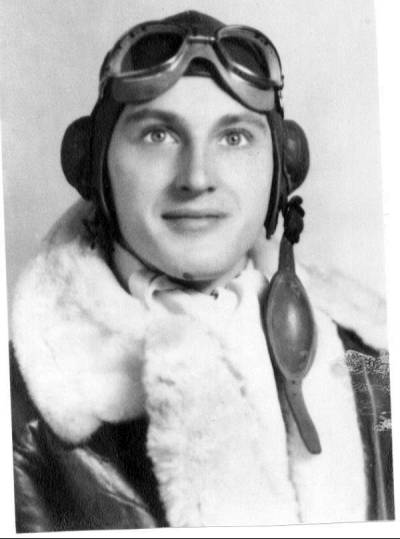
Long before you could actually fly, an NAS Ottumwa Iowa photographer had you looking like you were a qualified pilot..
When the photo above was taken, I had not yet stepped out of the 'ready room' or approached an aircraft on the ground.
he military pilot cadre from World War I that chose to go into reserve components or completely back to civilian life was the root strength of the early World War II aviation instruction programs in the United States. Many of these aviators had already furnished the backbone for a program of civil pilot training in the United States known as Civilian Pilot Training (CPT). CPT began at Fayetteville, Arkansas in 1939 and was the most ambitious program undertaken in any nation to prepare its citizens for the aviation era. A significant number of the primary flight instructors that I encountered in 1944 and 1945 had had their own introduction to aviation in CPT. Student pilots in the 1940s most often encountered a second pilot-generation of U.S. civil aviation pilots as their instructors.
Some of those student pilots entering military pilot instruction programs in World War II also had some CPT training. Those who had CPT training were in a pool forming the backbone of third pilot-generation in the U.S. The war took some of them. Many of those who came back from the war elected airline pilot opportunities. The enormous air transport industry build-up after World War II was made possible only because of these cadres of pilots trained in the military or in CPT or both. To this training, these pilots had added many combat flight hours.
Another cadre of instructor pilots came from the military's own training commands; the Navy's, which also produced Marine Corps' aviators, and the Army Air Corps' pilot training programs.
A unique contribution to U.S. aviation existed in a program at Embry-Riddle Aeronautical University now located in Daytona Beach Florida. Founded in 1925 in Cincinnati, Ohio, its basic mission was to train pilots. This university became an important center for setting training standards in civil aviation. Embry's program evolved to a core aviation education and training program, to include engineering studies, meteorology, navigation, power plants, airfrrames and electronics. For those with money and dedication, Embry provides today, as it provided before World War II, excellent preparation for civil and military aviation careers. Many students today in programs like those at Embry-Riddle University have already marked themselves for Air Reserve military duty.
The civil airlines that were formed in the U.S. after World War I made full use of the early pilot and ground operations skills developed during the training of military pilots. The skill levels were not uniform by any means. It would take commercial airline business success in the 1930s plus World War II to begin to move the standard skill-set ahead for a greatly enlarged cadre of pilots to a level that would sustain U.S. progress in aviation for the second half of the twentieth century. Physical skills at or above a defined norm, an even temperament, a desire to learn, and an alert intellect are all requisites for a good pilot. It is then necessary to provide standardized ground and air training.
This background information was little known to most flight students reporting to NAS Ottumwa, Iowa, in late October 1944. Suffice it to say that the military flight training bases that had sprung up in the United States beginning in 1940 and 1941 had their instructor sources in a resource pool drawn from U.S. civil aviation. The flight trainees at Ottumwa plunged into a demanding, concentrated, and as far as most of us knew, a mature program. It never dawned on most of us that such programs had not been going on for decades. It was only after puzzling out this background that I could see that those military flight training programs were in some ways just one jump ahead of their student pilots.
Ground school for one half day and flight school for the other half day. October in Iowa. The weather was rapidly turning cold. Open cockpits with no heaters. The Red Cross ladies knitted woolen headpieces with eye, nose and mouth slits. Fitted over the head and under the helmet, and giving us the appearance of the KKK, they saved us from certain frostbite. We were told to read Stick and Rudder, a well-known and well-written book by author Wolfgang Langweische. The ground school and flight activities filled all available hours and a student pilot was hard pressed to keep up. I did not read as much of "Stick and Rudder" as I should have. I did read selected parts after this or that flight event had occurred and then wished I had read the book first.
One of the very first activities I can recall took place in the student pilot ready room just before we were scheduled to take off on our first familiarization flight. A photographer came in to shoot our pictures in our flight suits. We had been issued a tan, full-length, flight suit with pockets in the legs just below the knees. A fleece-lined leather helmet and jacket, goggles, white scarf and calfskin gloves completed the outfit. That scarf was the feature of the photo, with the leather jacket and its sheepskin collar forming the frame. Oh yes, our faces with goggles on our foreheads made it into the center. All that remains in my possession is that picture and the leather flight jacket. The jacket's leather is cracked and worn because a couple of my sons appropriated it after I had come down out of the sky for good. In Ottumwa, Iowa, it was open cockpit, single engine sky. The sheepskin lined leather jacket was a lifesaver.
I thought it was odd that the first main event on our flight line was picture taking. Seemed more like part of a graduation schedule. In the next few weeks, we lost several young men in our class in flight accidents that occurred during their early solo flights. It dawned on me later that all a family or wife might have had from the young man's aviation experience was that picture.
Student pilots were divided into two "wings", North and South. The North Wing used the North mat for flight origin and destination. The South Wing used the South mat. A mat was a large glob of flat asphalt on the ground in a kind of rounded square. The two mats were close to each other. Depending on the wind direction, one mat would use right turns to a landing while the other used left turns to a landing but usually only one mat would be in heavy use at a time. For station utility aircraft, there was also a runway to use. Sometimes you flew in the morning and went to ground school in the afternoon and other times it was the reverse. The wings alternated the use of the ground training facilities and ground school instructor personnel.
More on instructor Verschoyle.
I was assigned to the North Wing. My first instructor pilot came from Dallas, Texas. He had over 10,000 hours of flight time, unusually high in any aviator group in 1944. He was an excellent instructor and I made good early progress. He could make that Stearman do things that I never mastered. His name was W. Rowe Verschoyle.
Verschoyle is the only instructor name on the first entry on the first page of my first pilot logbook. From a web search she made in July 2001 that took her to the first web version of this story, my first instructor's niece, Julie Verschoyle, found my e-mail address and sent me an e-mail. Her e-mail helped me recall the rest of my first instructor's name. He was "Walter" to his students. Then in a series of e-mails from Julie and from her cousin James, Walter's son, I learned that in civilian life, my first instructor went by the name, W. Rowe Verschoyle. I add this detail to properly identify a man whose career in civilian life, in flying, and in the Navy represents a vital thread, in calendar years and in pilot skills, for this story.
W. Rowe Verschoyle began flying in 1927 at age fifteen. That year marked the historic flight of Charles Lindbergh, and it represented the passage of a half generation of U.S. life after World War I. By the time Rowe Verschoyle instructed student pilots at NAS Ottumwa Iowa in 1943-44, he was then a half generation older than his students. The end of one war and the beginning of another, spanning the period 1918-1939, marked one full generation. W. Rowe Verschoyle was a transition pilot in that passage of time. He carried the aviation torch between the two war generations. Had there been no wars, he surely would have had a beneficial impact on aviation. But, there were two wars, and the second of these two war-generated surges of U.S. aviation activity benefited enormously because civilian pilots like Verschoyle provided a bridge from the World War I cadre of aviators to the World War II generation of aviators.
Even if one believes in astrology, it was not the juxtaposition of the planets that brought skilled pilots like Verschoyle into the training commands during World War II. The Verschoyles were a family of Texans. The state covers a lot of geography so these folks do not visit with each other every day. They do "stay in touch." A lot of Texans fly light planes. Those who don't fly, seem to drive Mercedes, as high speeds. After World War II, I visited the "oil patch" in Texas frequently on business. One of my customers serviced oil rigs. He thought nothing of loading drill rig parts into the back seat of a Mercedes and driving 600 miles to deliver the parts to a site. At any time of the day or night.
Julie Verschoyle, the family genealogist, lives in one Texas city. James, her cousin, is an attorney in another and Rowe, another son of my WW II instructor pilot, is a marine underwriter in still another Texas city. In just a few hours of e-mailing with Julie and James, July 9-10, 2001, I was able to put together this mini-biography of W. Rowe Verschoyle.
Born in 1912, this man took his first flying lessons at Dallas' Love Field in 1927. Based on his extensive pilot experience, he received a direct Navy commission as Lieutenant (junior grade) at the outset of U.S. involvement in World War II. To get his Navy wings, he was still required to complete primary flight training at NAS New Orleans. It has occurred to me that his "instructor" at NAS New Orleans might have wondered if he should have exchanged seats with his "student pilot." One more stop along the way found Verschoyle and his family moving to Ottumwa, Iowa. Let James Verschoyle pick up this family miniature.
"Flying was a lifetime hobby of Dad's. Over the years he owned a series of Stinsons, Tri-Pacers and Cessnas. He maintained a multi-engine commercial pilot's license until he died in 1974 as the result of leukemia. Some of my earliest memories involve our family's move from Dallas to Ottumwa to be with him in those days. During his business career my father served as Vice President of Traders & General Insurance Company, and later as Vice President of the Hillcrest State Bank, both in Dallas."
More on aviation strengths that the U.S. called on as the nation ramped up its capacity.
The civilian aviator, just as the civilian soldier and the civilian sailor, were our towers of strength in the prosecution of WW II. Verschoyle completed his Naval Reserve aviator career as a Lieutenant Commander. James Verschoyle concluded one of his e-mails to me with this: "Toward the end of the war Dad became a Senior Check Pilot. When my parents married back in 1936, Dad had a new Ford V-8 and a 40-HP Taylorcraft; he always said the Ford could outrun the Taylorcraft!"
During the latter stages of my own Ottumwa days, I can recall a three-man Standardization Board coming to our flight lines. These boards consisted of Senior Check Pilots. They gave standardization flight checks, not to the student pilots, but to their flight instructors. A number of flight instructors disappeared from our flight schedules during these Board visits because they did not pass those check flights. Although the Verschoyles of military flight training were personally important to their students, their greatest influence came from the standards of piloting and pilot instructing they set for the thousands of flight instructors hurried into the flight training commands. Here now, some 57 years later, I give a belated thank you to my Navy's instructor-pilot oversight effort in World War II.
As noted earlier on this page, my student pilot good luck streak in the fall of 1944 soon ran out. Walter Verschoyle was transferred to another command. And the Flight Standardization Board that might have made my life easier had not yet arrived.
My second flight instructor.
I was then assigned one of those flight instructors who had taken up the wrong employment. He, like Mr. Verschoyle, had come from civil aviation. I believe that he interpreted his Navy commission to mean that he not only had skill seniority but also rank seniority over his students. He had not counted on having a fleet officer as a student. I was already a Lieutenant USN. This man seemed unprepared to teach flying to a man almost his age, especially a man, me, who had no particular aptitude for flying.
In the Stearmans we used gosports for pilot to pilot communication. The gosport consisted of a plastic voice tube connected to a mouthpiece on the instructor's helmet and connected on my end where my ears met my flight helmet. The instructor sat in the front seat and I was in the rear seat of our Stearman aircraft. This biplane, designated an N2S by the Navy, was often improperly called a Yellow Peril. Our Stearmans were painted yellow. The term Yellow Peril had already been pinned on the Navy-designed N3N, a plane almost identical to the Stearman unless you knew aircraft and could see the fine distinctions. A few of our Stearmans had cockpit enclosures for cross-country flight but the early student stage N2S trainers all had open cockpits. Some had metal propellers and some had wooden propellers and those more skilled than I could tell the difference in flight. Lycoming or Continental built the 220-hp radial engines and the propellers came from Hamilton Standard.
My new instructor was known in the flight training trade as a Screaming Eagle. He yelled constantly into that voice tube which led directly into my ear. I could see reasons for his nervousness when we were one of perhaps fifteen Stearmans in various stages of takeoff from the north mat of NAS Ottumwa. With me partly in control (I could feel his hand on the stick and his feet on the rudder pedals at all times.) our wings would wobble and the plane would bob up and down and our airspeed needle was never steady. Later, during the same flight, at a comfortable altitude and with few planes in our vicinity, he still yelled. All the early progress I had made with instructor Verschoyle began to melt away as my confidence waned. I fell behind my class and had to ask for an extra flight period. The onset of severe Iowa winter weather exacerbated the Mediterranean cough I had brought back to the States. In desperation, I went to Sick Bay for a few days. "Cat" fever was the immediate diagnosis. That was a "standard" diagnosis at Navy medical facilities, no matter what the patient had. I learned later with some relief that Cat was an abbreviation for "Catarrhal." (And much much later I learned through my discharge X-ray that I had a blotch of TB in one lung from those Mediterranean days. Fortunately, it is encased in calcium and dormant, but I cannot pass a TB patch test. )
A sick bay stay would entitle a student to an extra flight training period. I knew that would not be enough to save my quest for Navy wings. I got up my courage and asked for a new instructor. My request was quickly granted which surprised me.
A third instructor in Primary Flight Training.
The new man, my third instructor, was a brand new 2nd Lt. Marine. He had just obtained his "wings" along with a few extra flight hours in the same Navy flight-training program that I was undergoing. His name was Johnson and his first objective was to land the Stearman going backwards. He almost made it happen one windy day at an outlying grass field with the wind gusting to 45 knots. Thankfully, his second objective was to get me qualified.
While not typical of the student resource pool best suited for military flying, student pilot Dailey was able to take advantage of a war-forced change that affected all primary flight students in the Navy programs in late 1944. Our combat ships in the Pacific sea war recoiled from the fatalistic vigor of the young Japanese Kamikaze pilots.
The students in a military flight-training program have a way of knowing when local check flight success/failure rates are undergoing change. It was clear to the later stage student pilots in mid-1944 that a program had been in progress in the Navy's primary flight training program to thin out the student ranks. The war had been going favorably and the over production that military programs always generate had become evident. Student pilot washouts were the order of the day.
That attrition program was suddenly canceled. The pace of training picked up and many of us who had been mired in A-stage then quickly progressed through a solo check flight and were allowed to solo. B-stage training, for recovery from spins and stalls and learning how to avoid them, was accomplished in short order. The Kamikaze pilots had saved my aviation career. But, they did not bring the earlier washouts back into the program. The Armed Forces have never found a way to go back and level out inequities.
In my group, as experience was gained, wing tip scrapes on the mat became less frequent. (At Ottumwa, many of our yellow Stearmans were fitted with curved wooden struts. Made out of plywood, these struts extended below each lower wing tip to protect the wing fabric when the student would land and swerve into a groundloop or otherwise cause a wing to go down and scrape the ground. Interestingly, snow was welcome because then the wing would scrape snow and no damage would result.) Even with the unannounced lowering of student attrition rates, the dreaded C-stage was almost my downfall. For me, flying "figure eights" around two pylons on the ground with a strong wind aloft almost eliminated the goal of Navy wings. Again, the pressure of those Kamikaze pilots was transmitted to our instructors to mean that we were permitted to continue in the program even though our figure eight might be a little bulbous or elongated. I was definitely uncomfortable though, in all my later flying, when I had to "wrap it up" into a tight turn.
For the "seat of the pants" aspect of flying, the lesson from Primary Flight Training that I found most useful in later flying was the instructor demonstration, followed by student practice, of 'slips to a landing' and 'crabbing' to a landing. Both are designed to keep you flying down the imaginary downwind extension of the runway centerline as you approach the runway in a crosswind. Slipping involves dipping the wing into the crosswind and holding a little top rudder. It gives a higher sink rate, sometimes useful but can be harmful if not checked at the end, and it increases the speed at which a plane will stall. Crabbing keeps the wings level and the plane's heading cocked into the wind. Both techniques keep the plane down the centerline. At the point of touchdown, to avoid torquing the landing gear, the crab maneuver heading is swung back to runway heading and a sort of combo effect is the result, with the upwind wheel touching a bit before the other.
One association that became a treasure for me for many years was renewed at NAS Ottumwa Iowa. At the U.S. Naval Academy, W.T. "Barney" Rapp and I had been good friends in the original 12th Company of the 4th Battalion. Each of us was surprised and pleased to discover the other in the same flight class at NAS Ottumwa. We took our primary flight training together, arriving at Ottumwa the same day and leaving the same day. Barney quickly adapted to flying while I had a struggle with learning to fly.
In summary, primary flight training in the Navy was done in five stages, A, B, C, D, and E
At the end of A-stage, the student pilot was permitted to fly solo on some training flights and to my surprise, not constrained too much on what he might do. He was given an area in which to fly and a minimum and maximum flight altitude but otherwise, just check your wristwatch and come back in the prescribed time.
B-stage was for spins and stalls and progressive stalls. The "falling leaf" was a maneuver in which the plane was successively stalled, first to the right, then to the left. One student apparently got so intrigued with this sequence that he neglected to check the approaching ground underneath, and met his death as a result. Instructors thought it funny to take you up high and invert the Stearman and then tell you to adjust your seat height. Of course, it fell to the stops and you felt you were on your way out of the plane while the instructor was laughing up a storm. Those instructors sure trusted the mechanical latches of that seat. Or perhaps they were trusting the student's ability to use the parachute in the seat pack we sat on at all times when airborne.
C-stage was for aerobatics. I could do the snap rolls and Immelmans and loops and wingovers and even the chandelles without difficulty, but as noted, the figure eights on the pylons almost put me out.
D-stage was for a flight check on everything to date.
It was the dead of an Iowa winter now and for the E-stage cross-country flights, they gave you a Stearman equipped with a canopy. We had to show that we could plan and execute a flight away from our home base. Charts were provided for Visual Flight Rule flights to a choice of several optional towns or cities. My first cross-country was a round robin flight with no stopover, to Mt. Pleasant, Iowa thence to Iowa City and back to Ottumwa. My final check flight was a stopover flight to Moberly, Missouri and return. Moberly had a nice field and I drew a fine day for the flight. As a born conservative flyer, I chose the Moberly option because the city was on the same North-South section line as Ottumwa. Section lines occur in the regularly spaced midwest farmlands where one farmer's north-south fence meets the next farmer's land and fence. I did check all the check points, railroad tracks, rivers and road intersections on my knee pad chart but must admit that the section lines were my "security blanket." I got down to Moberly, landed, gassed, and came right back. I was only gone about three hours for the round trip. My log shows that in the Primary Flight Training program I accumulated 100.2 hours of which 58.6 hours were recorded as "solo."
So, a combination of forces entirely remote from Ottumwa, Iowa, plus good instructor pilots had seen me through. I certainly had some luck and on one occasion, Barney Rapp did not. We were in the same flight for night qualification in our yellow N2S biplanes. We had soloed for day flights by that time and an instructor check pilot went along while each of us made one night landing with check pilot aboard, he still in front with the student in the back seat. The point of landing was defined by a square of four flare pots. Except for the rotating beacon at NAS Ottumwa's tower, there was no other light. The night was overcast, no moon, no stars, very black. With obvious relief, those check pilots exited the front seat as fast as possible after that first landing. The student secured the harness in the rear seat and climbed into the front seat. I was then alone.
There were two sections to the flight. The upper section aircraft circled while the lower section planes made four landings, each into the square of flares, and then the sections traded positions.
I was in the upper section for the first half of the evening. We were supposed to fly loose wing on each other as we circled the base. The base airport was next to the city of Ottumwa. The city had a hotel at its center. The hotel had a red warning light on its eighth story roof. Without realizing it, I "flew wing" on that roof for about 15 minutes before I realized that the other planes were circling over the landing flare pots at NAS Ottumwa. Hastily I joined them, chagrined at my error, and hoping that nobody had noticed.
Then our section descended to the landing pattern for our four tries at the flare pots. At the 180-degree point (abreast the beginning of a landing runway but on the reverse heading), heading downwind, just before turning in to the flared square, we were supposed to "cut gun." This meant retarding the throttle. We were to show how we had learned to trade air speed for altitude and land just like a carrier pilot. I plopped my Stearman in the flare-square the required four times. One time, I was off heading, got it into the square of flare pots OK, poured on the throttle to climb out and as the nose went down I could see that I was heading directly for the fire truck whose occupants were leaping off in all directions. I lurched into the air and over the truck wondering if I'd botched it. After the last landing, we were all to taxi back to the parking apron. It was still pitch dark with no horizon, no stars, just overcast. A station crew had left a truck parked in a vulnerable place and Barney Rapp's plane nipped the truck in the dark before he could see it. As his penalty, Barney had to go out and re-qualify again the next night with four more perfect landings. I assume the powers that be, in deference to the fire truck crew, decided it was best to give me an "up" after that first night. No sense testing fate again for those in the fire detail.
William T. "Barney " Rapp became a Vice Admiral in the U.S. Navy. He is gone now after an illustrious career. He was a fine father, husband and family man. He was a natural born pilot from beginning to end. Barney's career included command of patrol squadrons in the North Atlantic. These were home based at NAS Brunswick, Maine and deployed on operational patrol tours to a U.S. Navy base in Iceland during the Cold War.
Barney and wife Kathy always managed to have a car. I did not even get a driver's license until after I was flying Navy planes. Barney was more than generous with that car as we shall see later in this story. Beginning right at our first flight training base at Ottumwa, Barney picked me up and took me to the base every morning and took me back to the room Peggy and I had rented each night.
I recall two pleasurable events that relieved the intense ground school and flight school routine at NAS Ottumwa. Tour groups were booked in for an evening's entertainment. One evening I was able to take my wife Peggy to a dance. The bandleader was Frankie Carle. (His obituary at age 93 appeared in our local paper in early March 2001) His band was quite well known in the 1940s and its stature was enhanced by Mr. Carle's ability to play the piano. The other event was a visit by the Harlem Globetrotters. I believe a man named Reese Tatum was a headliner of that group. Those events helped relieve tension and I appreciate to this day all those who contributed to those troop entertainment tours.
Exit Basic "Primary" Flight Training: Go to Pensacola for Intermediate Flight Training.
At the completion of Primary Flight Training at Ottumwa, Barney Rapp and I and many in our primary flight class were then ordered to our advanced flight training base at Naval Auxiliary Air Station (NAAS), North Whiting Field, in Milton, Florida. Ot was the nconsidered and 'outlying' field for NAS Pensacola. Peggy, now pregnant with our first child, left Ottumwa ahead of me to catch a visit to her home in Virginia. I put her on the Burlington Zephyr to Chicago and a change of trains to the Norfolk and Western Railroad there.
I departed Ottumwa on the Missouri Pacific Rrailroad, from whose loud speakers I learned of the death of President Franklin D. Roosevelt at Warm Springs, GA, in April, 1945. I was on my way to Rochester, New York, to pay a quick visit to my family and buy a car, my first.The next leg of my travel to earn my Navy Wings involved driving my 'new' car, new to me from Rochester NY to Norfolk VA to pick up Peggy and drive on to Pensacola, find some housing, and begin Intermediate Flgith Training. I am going to leave a few lines blank here, a placeholder for that car trip to Norfolk from Rochester. It involved a totally unplanned episode, quite humorous. If the magazine I submitted it to does not print it I will put it here. If the magazine does print it I will need their permission to insert it here.
Space set aside for a car-ferry Travel Episode in World War II.
I will jump ahead to the beginning of Basic Flight Training at Pensacola to let you see the plane I would now fly, and attend to other preliminaries.
One of the first Navy duties at Pensacola was to become qualified in the water to improve survival chances in case of a ditching at sea. There were a number of tests for swimmers to pass in the NAS Pensacola pool, a large pool which I now surmise was "Olympic" size. The only tests that we were nervous about were swimming a mile, and the Dilbert Dunker. Most of us had passed preliminary swimming tests at Ottumwa. The mile swim was made easy because we could use any stroke and take as much time as necessary. The Dilbert Dunker was another matter. The device was the pilot's section of a single engine aircraft's fuselage. In full gear, strapped in and canopy closed, this contraption was sent down a steep rail into the water. Once in the water, it immediately rotated to the upside down position .The occupant had to get his canopy to slide back, and with water rushing in, had to get out of his seat straps and his parachute harness. At the outset, he had to mentally coach himself that he was upside down. Then, go down first to clear the sinking plane, then to the side and then up to the surface. For those with Red Cross lifesaving experience, it was not too difficult but some men who had passed all the checks of primary flight training failed this test and were "washed out."
Those who preceded us in this next phase of Navy flight training, known as "basic training," had trained in the SNV aircraft. The V was for Vultee, but the students nicknamed it the Vultee "Vibrator." My class was lucky to be assigned the SNJ for training. The Army Air Corps (as that service was then known) called it the AT-6, the "Texan." The SNJ was a single engine, two seat low wing monoplane built by North American Aviation. It was an all metal plane and had retractable wheels. There are some SNJs flying in our new 21st century. Recall that we had then all just come from the Stearman, a fixed landing gear trainer. Many of the SNJ instructor pilots had also just come from instructing in Stearmans.
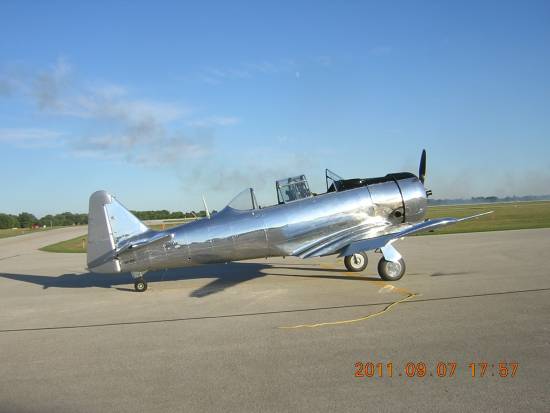
The SNJ Navy trainer of World War II, an AT6 "Texan" to the Army Air Corps, photographed at Galesburg Illinois
Again, I am indebted to Malcolm Barker for this photo of a long lived plane ,now still flying in civilian duty
One night, waiting for our night flying turn at North Whiting Field at Milton, Florida, we saw an SNJ coming in for night landing, flare out for touchdown, and land in a shower of sparks, just like Halloween. An instructor with student aboard had landed with the landing gear up. We were of course sorry for the student but very likely had little sympathy for the instructor, who really needed it.
There is an oft-told story about the SNJ. When the air speed fell below a pre-set number, for example when the plane was coming in for a landing, a loud horn would sound if the landing gear were still up. This was to warn the pilots to get the wheels down. At the preliminary hearing which followed one 'gear up' landing, the tower operator made it clear that he had yelled at the pilot continuously while the plane was on 'final' approach, telling him to get his landing gear down. The pilot's response at the formal proceeding was, "I knew you were yelling at me but I could not hear what you were saying because that damn horn was making so much noise."
I recall that one of North Whiting's outlying fields that we used for practice landings and takeoffs was a grass field called Pace Field. I marveled that the training command would risk their brand new silvery SNJs in the hands of student pilots for landing practice in a cow pasture. In this stage of our training, we were also introduced to formation flying and felt briefly like fighter pilots.
Multiengine and instrument flight training.
This will be brief because my book ,at the upper left top of the page is on the subject of instrument flight.
At the conclusiono of this next and final stage we got our wings. I found a photo of the 'twin Beech,' a wonderful plane that later was a lifesaver for me and Commander Ed Hogan on a flight from NAS Brunswick GA to NAS Anacostia, Washington DC. But, that is another story for another time. Now, to 'multi-engine and instrument flight training' in the Beech.
Barney Rapp and I then received our first multi-engine instrument flight training in SNB Beechcrafts at NAS Corry Field in Pensacola. The Beech, a D18 in civilian life, had two radial engines, a low frequency radio range receiver and a radio direction finder (RDF) to home in on low frequency radio transmitters. There was also a navigator's station with a basic plotter and drafting board. Some of these planes even had a little astrodome so that we could learn to use a bubble octant instead of the sextant we had used for celestial navigation on board ship. Barney and I flew our first "twin Beech" cross country together to Houston, Texas, landed, gassed, and came back feeling pretty good about ourselves. An instructor pilot named Warren Swinney had given us tremendous confidence by cutting one engine in all sorts of situations and making us learn to get back to a field and land on one engine. Turn into the good engine and center the ball in the "needle-ball" insturment was the right answer. When the left engine was cut, the student pilot ended up making a right-handed landing approach for which his position in the right hand seat was ideal. Those were sweat jobs, not only because of the "engine out" challenge, but because Pensacola was a hot and sweaty place that summer of 1945.
At Corry Field, the ground school introduced us to the Link Trainer, a device that could simulate flight on instruments even to the point of "crashing" if the pilot failed to grasp the idea of flight through instruments. In actual flight, instrument training involved a "hood" that was placed on the student's head. The hood denied him windshield vision and restricted his sight to his instrument panel. Hooded flights, even if the pilot under the hood has become accomplished, are dangerous because half of the visibility arc in the cockpit is lost. The age-old dictum of "see and be seen" finds part of that duty compromised. Of course, "age-old" dictums were an oxymoron for aviation in 1944.
Each morning that I returned to Corry Field from our apartment at 821 East La Rua Street on the L&N (Louisville & Nashville) railroad tracks, I had to put on a flight suit still soaked from the day before. Fabric would not dry overnight in humid Pensacola. The Beech became a lifelong friend. She was a sturdy little plane and in it, I survived some of the most violent storms of my flight career. If there is space later in this story, I will relate one such flight with Ed Hogan, one of my Alaska skippers and a marvelous pilot himself, as co-pilot. Ed had flown the 4-engine PB2Y, the Coronado seaplane, and had had a full tour as Commanding Officer of a Gulf of Mexico hurricane squadron. The two of us almost met our fate together in a JRB out of NAS Brunswick GA many years later. The JRB (just another version of the SNB) was one of the many Navy variations of the twin Beech.
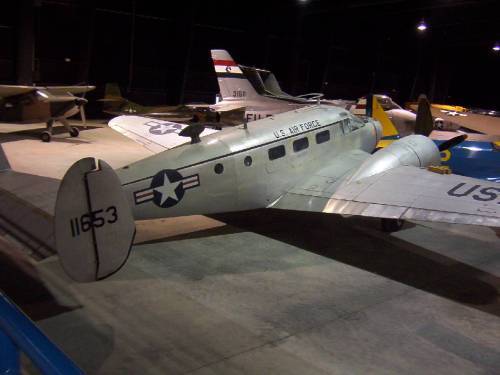
A D-18 'twin Beech' shown at Warner Robins Museum in Macon GA about 2009. aka SNB for Rapp and Dailey
Two older pilots hadjoined Barney Rapp and me during the latter phase of the "twin Beech" instrument training at NAS Corry Field. These men had crash-landed their PV-1 (Lockheed) Vega Ventura on the Kamchatka Peninsula in Siberia sometime in 1943. They had been on a bombing mission to Paramashiro, Japan. According to their briefing, since their gas load and the current weather meant that there was no chance for them to get back into Adak, Alaska, they were to head for a Russian crash landing or a ditching at sea once their bombs had been dropped. They did as instructed and were interned by the Soviets in marginal conditions and were confronted each day by hostile captors. The Russians finally released them to the U.S. The Navy flight training command was trying to move them on a fast track back to flight duty. The men were civil to us in all respects but extremely withdrawn. They could fly just fine but they reminded me of soldiers I had seen in the rest camps in North Africa, men who were physically fit but would never fight again. Combat had taken too much from them.
With about 50 others, Barney and I received our wings on the tarmac at NAS Corry Field on October 16, 1945. A resplendent Commodore Lester Hundt USN, in full white service, as were we, pinned on our wings.
Except for the training commands, I never had warm weather duty. That graduation was perhaps one of the two or three times I ever wore an officer's white service uniform.
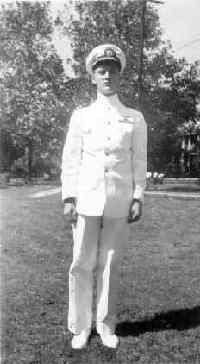
Illustration10 -Pensacola grad with wings
My wife Peggy gave birth to our first child, a boy, just two days before I received my wings. The Navy hospital at Pensacola had told us to go out and walk up and down the beach because Peg was not quite ready to have that baby. We walked and we walked and finally reported back to the hospital ready for Frank III to come. I sat in a tiny waiting room. There was no sound proofing. Over the wooden wall came wave after wave of wailing pain from the ten or so ladies in labor. Frank III was a big ten-pounder and looked a little the worse for wear with one ear up forward and the other way back on his head. It all got straightened out and he was the first of eight wonderful children that Peggy has given to this family.
Graduation was followed by a short stint in a Bachelor Officer's Quarters (BOQ) at Cocoa Beach in Florida where we were quartered while assigned to flight duty at NAS Banana River, Florida in PBY-5A "Catalina" flying boats. This short assignment occurred in the Air Bomber Training Unit (ABTU). We did not fly the aircraft. We were in the back, next to the gun blisters. Our objective was to learn to use the APQ-5, and then the newer APA bombsights.
We had one series of flights in the Catalinas where we manned binoculars instead of twiddling cathode ray tube dials. Barney and I, along with most of our ABTU class, participated in the search for a flight of five Navy TBM (single engine Grumman torpedo planes, originally designed by Grumman as TBFs, and later built by General Motors as TBMs) aircraft that had left NAS Fort Lauderdale on Dec. 5, 1945 and never returned. One of Barneys's and my Naval Academy classmates, a new pilot just as we were, was lost in that mystery-flight disappearance.
"George William Stivers, Captain USMC, already a World War II combat veteran of the 2nd Marine Division at Guadalcanal, while attached to NAS Miami and on a routine training flight on the afternoon of December 5, 1945, was lost in the vicinity of Fort Lauderdale, Florida."
That quote is the official announcement. Subsequently, it could not be ascertained that the flight ever made it back to the Florida peninsula. Our search flights covered a broad stretch of the Atlantic. Other searches covered the Gulf of Mexico. Fuel starvation would finally have forced those young pilots down at sea, one by one.
Home | Joining the War at Sea | The Triumph of Instrument Flight