Aviation Records 1927-31; speed, a Robin's endurance, airmail. Lindbergh, Doolittle, the GeeBee. National Air Races 1931. Aviatrixes-female pilots.
Copyright 2014 Franklyn E. Dailey Jr.
- Barnstomers and Early Aviators
- Budget Flying Clubs
- Aviation Records
- VFR to IFR
- Early Airline Development
- Flight Across the Atlantic
- P-40s to Iceland
- Alaska Based Navy P2Y-1's
- Buckner Goes to Alaska
- Ship-to-Ship Battle
- Naval Flight Training
- NAS Instrument Training
- Aleutians Anti-Submarine Warfare
- Search & Rescue
- Gyros and Flight Computers
- Baseball Team Lost in Flight
- Tomcats and Boeing 777s
We have noted that Lindbergh's crossing of the Atlantic in 1927 could be viewed as the climax of an aviation era. Some thought that he was just very lucky. The word "lucky" was actually used occasionally when Lindy was mentioned. He had courage but did not depend on luck.
The events of 1929-1931 in aviation removed all doubts that the operative term, performance, had become relevant to aviation. It was an exciting period during which the progress of aviation's first years would be transformed into performance numbers. There was no calculated plan to do this and no pre-defined agreement that this or that measured characteristic was essential. But it turned out to be a period of taking stock of the subject of aviation.
The year 1929 began and ended with auguries for aviation's future in transport. Pilots of an aircraft named the Question Mark took off at the Los Angeles Metropolitan airport on an endurance flight on the first day of January and landed there on January 7, 1929. The craft stayed aloft over six full days, having been refueled in flight by another aircraft which flew overhead and gravity fed the endurance plane through a fifty foot hose. Thus had a heavier-than-air machine beaten a flight endurance record previously held by a lighter-than-air machine, a dirigible named the Graf Zeppelin.
On February 5, 1929, Captain Frank Hawks, in a Lockheed Vega monoplane named the Air Express, landed at Roosevelt Field, Long Island, just eighteen hours and twenty one minutes after leaving Mines Field, Los Angeles. That is elapsed time from takeoff to final landing. He refueled along the way. February 1929 also found Orville Wright accepting Distinguished Flying Crosses on behalf of himself and his brother Wilbur for the historic flight they had made December 17, 1903, at Kitty Hawk, North Carolina.
Plans were drafted in 1929 to put a floating airport, 1,200 feet long and 200 feet wide, midway between New York and Bermuda. If getting to Bermuda rapidly was the passion for the east-coast jet set of the 1920s, an air transport operator was going to take them there, even if it meant a stop along the way.
On March 11, 1929, Major H.O.D. Segrave of England set a new automobile speed record of 231 miles per hour on the beach at Daytona Beach, Florida. The interplay between flight speed records and land speed records continued in the news for several years with the aircraft gradually pulling ahead. Investors in land racing vehicles and their record-smashing drivers finally yielded the headlines to aviation progress.
The American Air Transport Association published data showing that scheduled airlines were flying 42 daily trips, involving 102 cities and over 33,000 route miles by early 1929. Two years earlier there had been no scheduled daily passenger flight trips in the United States.
In May of 1929, Reginald Robbins and copilot James Kelly landed the monoplane Fort Worth at Fort Worth, Texas after an endurance flight of 172 hours, thirty one minutes, beating the record of the Army-sponsored Question Mark, with its three engines, by nearly a day. On July 6, 1929, Roy Mitchell and Byron K. Newcomb landed their single engine monoplane, The City of Cleveland, at the Cleveland Airport, having been aloft an hour and a half longer than the Fort Worth. In that same month, pilots L.W. Mendell and R.B. Reinhart closed out a 246 hour, 43 minute flight, at Culver City, California, in their aircraft, the Angeleno.
A Curtiss Robin aircraft piloted by Dale Jackson and Forest O'Brine, stayed aloft in the St. Louis area, accumulating 420 hours and twenty-one minutes, July 13-30, 1929. Manufactured by the Curtiss Robertson Aeroplane and Motor Company of St. Louis, Missouri, the Robins had wooden wings and a steel tube fuselage, all covered with fabric. Configured at first with OX-5 engines from World War I, as aircraft production ramped up, the Robins were later fitted with Wright radial air-cooled engines. "Wrong way" Douglas Corrigan's 1938 solo flight across the Atlantic was made in a radial equipped Robin.
It took nothing away from the earlier endurance flights that the Key Brothers, Fred and Algene, flew a Curtiss Robin J1 Deluxe for 27 days at Meridian, Mississippi from June 4, 1935 to a landing on July 1, 1935. (See Add-ons to Flying Book for reader Robert Hayes correction to endurance flight records.)
What these flights had done, beyond confirming pilot stamina and the skill and novel ideas of the in-flight fueling teams, was to attest to the airworthiness of monoplanes like the Robin. Just as important was the confirmation beyond all doubt of the reliability of radial, air-cooled, engines. The three flights, in May, June, and July 1929, that set a succession endurance records for refueled flight, were all accomplished in single engine airplanes! The St. Louis Robin was powered by a Wright Challenger, 165 horsepower (hp) engine. The Angeleno and the Robin J1 Deluxe were each powered by Wright Whirlwind 220 hp engines. Wright engines were setting a standard.
While engine test stands were used to prove that engines could perform reliably over long periods, these flights attested to engine reliability when aloft. The pilots could only do minimal support such as adding gas and oil. The pilots, the airframes and the engines were all being tested. Pilots earned recognition for endurance records. Aviation benefited far beyond any one record flight.
With new levels of performance established, the airplane improved rapidly in both endurance and speed. Aircraft flown by all the world's air carriers from the late 1930s, right up until the conversion to turbine power, were designed using flight performance data derived from these earlier record-breaking flights. Each endurance record and each speed record also added to the store of confidence that both investors and the flying public needed before transport aviation could "go commercial."
For direct bearing on the subject of instrument flying, the most far-reaching event of 1929 in aviation did not capture wide public attention. Major James H. "Jimmy" Doolittle of Cleveland, Ohio, cooperating with the Guggenheim Flight Laboratory, demonstrated on September 24, 1929, a complete sequence involving blind flight from takeoff to landing at Mitchell Field on Long Island. The gyro was certainly involved, but no other details are given in the references available. The lack of corroborating data on the flight does not detract from the central fact that in cooperation with a recognized flight research laboratory, an experimental flight was conducted by a prominent pilot that supported the premise that blind flying was an operational possibility.[Update: A 'safety pilot' was also aboard, presumably able to 'see out.' What was being demonstrated was an autopilot controlled airplane. Lawrence Sperry had demonstrated this capability many years earlier. See next paragraph.]
The promise of the gyro in aviation had actually been introduced to the public in 1914 when Lawrence Sperry won a prize for the design of an aircraft fitted with gyroscopic control. The printed commentary under the caption, "Gyroscopic Robot" of a photo in the Standard Quarterly Review of January 1930 emphasized control of an airplane under "all conditions of weather and darkness."
"Blind flight" was the popular term of the times to express what was later called instrument flight. Specific numerical values would eventually define the ceiling and visibility conditions that would apply to flight phases. A pilot would be given ceiling and visibility numbers that represented the local takeoff condition, expected cruise flight conditions, and a forecast of the destination-field conditions.
In the 1920s, pilots were contracted by the U.S. Post Office Department to fly the U.S. mail. Eventually, these flights operated both day and night. The pilots encountered weather and figured out how to get around it in order that the mail might go through. Occasionally they had to land at one of the emergency fields cleared for the purpose along the way , while they waited for the weather to pass. While airborne at night, they used the nation's new lighted beacon system.
In one disastrous period for early aviation in the United States, a dispute arose between pilots flying the U.S. mail on contract with the federal government. Active duty Army pilots were assigned the additional duty of airmail service flying. The 1934 replacement was abrupt, and the military pilots had no time to gain proficiency for this service. Many perished.
The Post Office Department of the United States had become serious about transporting mail by air in 1918. The federal government, between 1926 when the Department of Commerce took over responsibility, and 1930, installed nearly 14,000 miles of lighted pathways in the sky. Night or day, from elevated platforms, a 24 inch searchlight rotating at 6 rpm, containing a 1000 watt lamp, swept the sky. This system cast a one million candlepower flash every 10 seconds, lasting one tenth of a second. One of these beacons was installed every 10 miles. If there was no commercial airfield at a defined interval along the path, a bare bones intermediate landing field was prepared to make sure that a safe landing option occurred within 30 miles of the previous landing opportunity. These basic fields each had their own airfield beacon, boundary lights, approach lights and obstruction lights. At some there was a lighted wind cone to tell the pilot the local wind direction. During night hours, there would often be caretakers to assist a pilot with communication, transportation, meals, fuel and repairs. The details for the light beacons referred to in this and the next paragraph were found on a website. The full text, copyrighted by Charles Wood, was found at www.navfltsm.addr.com.
The 10-mile interval airways light beacons produced a pencil of light in a beam about 5 degrees wide and could be seen about 30 miles in average visibility. Underneath the main searchlight beacon were two 500-watt flashing course lights-one pointing forward along the airway and one pointing 180 degrees opposite. Every third beacon had a green course light indicating presence of a landing field. The intermediate two beacons had red lights. These course lights flashed Morse-coded numbers from zero to nine. The code for five (five dots, no dashes) indicated the plane was on the fifth beacon in a 100-mile stretch of the air highway. The pilot had to keep track of the onset of each 100-mile set because the system simply repeated itself. These airways had principal terminal cities, and those cities' name abbreviations became airway names. Chicago-Omaha was CO, and San Francisco-Los Angeles was SF-LA.
The light beacons were the beginning of defined airways. According to the "The History of U.S. Flight Inspection," quoted from AvStop Magazine Online in the next paragraph, airways began as a concept, with no actual routes specified for flying the mail and no continual means for the pilot to determine his navigation position. It was up to the pilot for a given trip on a given day to get the airmail through.
"There were no aeronautical charts, no radio capability for weather, communication or navigation, much less anything resembling air traffic control. There was no civil aviation authority at either the federal or state level. There were no flight rules, nor, at that point, a real need for them. ...With the lack of effective aeronautical navigation, operations were limited to daytime flights in good weather, obviating most of the advantages held by the airplane as a transportation medium. The mid-1920s saw the beginning of federal navigation aids as efforts were made to provide lighted airway beacons along the airways to allow safe nighttime navigational assistance."
Light beacons quickly became obsolete as newer resources heralding the instrument flight age came into being in the 1930s. Just as the last of the light beacon installations were being put in service, the introduction of the first low frequency (low hundreds of kilocycles) radio range stations began. These radio aids became the navigation resource for en-route airways flying in clear and in clouded weather. These new radio facilities were also used for aircraft letdown and runway approach patterns in limited ceiling and visibility conditions. Fixed emplacement of low frequency, non-directional radio beacons also came into use as distance checkpoints along airways and along airport approach patterns. Leroy, New York's rotating light beacon along with the nation's entire network of light beacons quickly faded into aviation history. The light beacons left an important legacy. They had established the concept of airways in the sky.
Many, but not all, of the low frequency radio aids of the 1930s were in turn superseded after World War II by higher frequency installations. The new spectrum allotments were in hundreds of megacycles instead of hundreds of kilocycles. Radio-wave emitting installations known as "omni-range" (the OR in VOR, where V was used for anything involving aviation) and "localizer" facilities came into being. Another important aid was DME for Distance Measuring Equipment. Electromagnetic wave emitters from the aircraft would trigger the receiver-transmitter (transponder) equipment on the ground. The pilot of the aircraft was able to be constantly informed of the distance to the position of the ground equipment.
The changeover for aircraft and ground installations dedicated to communications and navigation, from hundreds of kilocycles to higher frequencies, in the hundreds of megacycles, that occurred during the years of interest here, constituted an advance in degree but not in kind. The earlier advance from light beacons to radio beams was the real steppingstone to uninterrupted position determination while flying on instruments.
Airport control towers continued to use light signals to communicate with local flight traffic well into the 1940s, especially at military primary training bases. With the onset of an air transport industry, voice radio communication between pilots and tower operators or ground controllers or air traffic control personnel became a necessity. More and more aircraft came equipped with appropriate voice radio receivers and transmitters.
In 1929, even with light beacons, it had not yet become accustomed practice to fly passengers at night. Aircraft system developers and ground equipment developers were still making darkness their priority objective, as the solvable impediment to scheduled flight. All-weather flight had not yet become the priority on the agenda of requirements for revenue passenger flight. Although "all conditions of weather" remained a goal, flight in darkness was the immediate objective for the air passenger transport companies that were formed in the late 1920s. The onset of darkness caused the aircraft operators of a number of rail/plane transportation partnerships to land their aircraft and transfer their passengers to the passenger train.
The year 1929 brought a rush to commercialize in aviation. New air carriers entering service that year were:
- National Air Transport, New York-Chicago, using the airmail route via Cleveland and Toledo
- Boeing Air Transport, Chicago-San Francisco, following the air mail route west of Chicago
- Transcontinental Air Transport (TAT), New York to Los Angeles and San Francisco via St. Louis, Dodge City and Las Vegas; this began as an air-rail setup using TAT in the air by day and the Pennsylvania and Santa Fe Railroads at night
- Colonial Air Transport, on New York-Montreal and New York-Boston routes, carrying passengers and air mail
- Others that joined or announced plans to join this air passenger business race were Pitcairn Aviation, flying between Atlanta and Greensboro, and Western Air Express operating from Los Angeles to the Missouri River and Denver to Los Angeles.
The year 1929 found Europe's Imperial Airways announcing London-Bombay service which was to originate in London with an 18-passenger plane called The Great Argosy, flying by day to Switzerland, where its passengers transferred to rail at night which took them to Italy. The Great Calcutta, a giant seaplane, took over at Genoa, flying south to Rome, where it was to "stop an entire day to enable the passengers to rest." Frequent changes of vehicles became the highlight of that lengthy route plan.
As the United States' border neighbor to the north, Canada's efforts in aviation were of direct interest to U.S. citizens. In July 1929, Canadian Airways entered into a contract with their government to connect Montreal and Detroit, initially for airmail only. One flight left Montreal and one left Detroit each morning, arriving at the other country's city each afternoon by four o'clock. Cities served along the route were Toronto, Hamilton, London and Windsor. Canada, with a population of 9.5 million, had 262 registered aircraft in 1929 and forty-three airports. Canada's aeronautics authority recorded a roster of 191 private pilots, 241 commercial pilots and 234 air engineers in 1929. For 1928, the U.S. Department of Commerce reported that 4,346 aircraft had been manufactured in the U.S. These included land, sea, and amphibians.
Lieutenant Herbert Fahy established a new solo endurance record in May of 1929. At Los Angeles, he made a non-refueled, solo flight of thirty-six hours and fifty-six minutes.
Refueled endurance flight records, sometimes with two pilots, are noted in my book, "The Triumph of Instrument Flight," whose cover appears at the top left of each page in this folder of this website. My recognition of endurance flight records brought an unexpected acolade from the St. Louis MO area in which so much early aviation breakthroughs occurred. The next illustration came from a cociety of aviation enthusiasts who illustrated their plaque of recognition for my book with the a Curtiss Robin. I have lost the letter of transmittal but viewers may recognize the originating association's plaque.. Before instrument flying would make sense, a piloted aircraft maintaning flight aloft sufficiently long to move a payload from one point to another would become the early basis for commercial air travel.
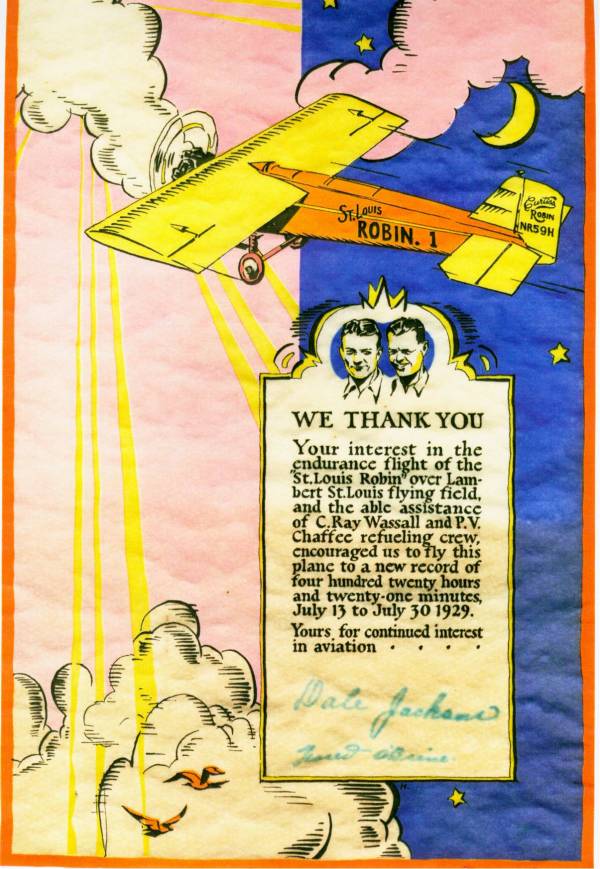
Above,
an award plaque honoring the 1929 air-refueled endurance flight of the "St. Louis Robin" working out of Lambert Field. St. Louis Missouri.
At Leroy NY airport in 1930, where I made my first flight (in a Stinson Detroiter) I saw orange-colored Curtiss Robins parked on the field. I tried to find a photo of a Robin at the Curtiss Museum at Hammondsport NY but the only one on display had an OX-5 engine and I wanted the engine in which the Robin had made so many records. So, thanks to the plaque above, I have at least a Robin in sketch.
Further down this page readers will find a link to another page on this website that covers a dispute on endurance flight records.
In the midst of a summer of flight endurance records, on June 13-14, three Frenchmen flew from Old Orchard, Maine to a landing on the beach at Comillas, a fishing town near Santander, Spain. This flight was the sixth straight Atlantic crossing if we begin the count with Lindbergh's historic solo flight in 1927. The French crew's destination had been Paris, but a stowaway from Portland, Maine, may have caused slightly increased gas consumption, forcing a premature landing. Their plane bore the name, Yellow Bird. This Yellow Bird took a route slightly to the south of east, making landfall in the Azores before turning northward toward Paris, and falling just short of that city by 500 statute miles. This flight is notable because by means of regular radio contacts with landmarks and ships along the way, the flight crew adjusted its course based on its fuel remaining, the weather ahead, and alternate airport options. With air-to-ground or air-to-sea communication, flight course could be adjusted along the route. Weather could be avoided.
The series of flights over the Atlantic between the U.S. and Europe, along with the domestic U.S. endurance flights, demonstrated to the potential passenger that flight reliability had been attained. Not just engines, but other aircraft systems were advancing in performance. Over water flights for land-based aircraft demonstrated that short intervals between intermediate airports for possible emergency landings might not be a requirement for safe flight.
U.S. Navy Lieutenant Apollo Soucek broke the flight altitude record in May of 1929 with a flight to nearly 39,000 feet, and just two weeks later, German aviator Willi Neunhofen broke that record by reaching nearly 42,000 feet. While flight at high altitudes was undertaken first by military pilots testing new frontiers in military aviation, in the longer view it meant that high altitude commercial air traffic could fly clear of the low altitude clutter of planes in the air, with the added benefit of lower fuel consumption for point to point flights.
The third anniversary of the aeronautics branch of the U.S. Department of Commerce was celebrated on July 1, 1929. Commerce had taken over aviation rules making and facilities provisioning from the Post Office Department. Thirty thousand air route miles were now being flown domestically, with ten thousand of those miles served by light beacons. First half 1929 totals of passengers and of mail in pounds equaled the totals of all of 1928. 5,830 aircraft were registered in the U.S. in mid-1929. California was way ahead with nearly a thousand, and Alaska had nine. Airline operators, that time 45 in number, had 400 aircraft in their operating inventories.
Charles Lindbergh and President Juan Trippe of Pan-American Airways opened a new passenger route from Miami, over the West Indies and Central America in September of 1929. Havana, and Parambiro, Dutch Guiana, were outbound stops, with Central American stops on the return to Miami completing the route structure. Mrs. Lindbergh and Mrs. Trippe accompanied their husbands on the maiden flights.
In September of 1929, nineteen women participated in the Women's Air Derby from Santa Monica, California, to Cleveland, Ohio. Thirteen completed the flight and Marvel Crosson suffered a fatal crash the second day out.
At Hasbrouck Heights, New Jersey, on September 13, 1929, the first of a planned manufacturing run of twelve Fokker F-32 aircraft made a flight demonstration. Designed for 32 daytime passengers or 16 at night, this plane cruised at 150 mph and was poised to begin service in the transcontinental plane-train system of the New York Central Railroad and Universal Air Lines. There were four engines in two nacelles of the F-32, with the rear engine in each nacelle configured as a pusher engine. In the flight demonstration, first the two rear engines were idled with no loss of altitude, and then the forward engines were idled, with the plane again maintaining stable flight. Passengers sat four abreast, with an aisle between. Tall passengers did not have to stoop down. Two washrooms and one kitchen were installed.
By 1930, the U.S. Department of Commerce was reporting 10, 215 registered pilots nationwide with California leading with 2,076 and New York second with 1,007. In California's total pilot count, there was a subclass of 903 who were designated as transport pilots. Alaska had seven pilots, five in the transport classification.
An airline flying to South America bankrolled a conversion of the Navy's PY-1, a seaplane, for passenger use with space for 20 passengers. Igor Sikorsky was at work in Connecticut on the world's largest seaplane intended for commercial passenger flight with an announced customer, Pan American Airways. Boeing Aircraft pioneered the famed and successful four-engine seaplanes that became known as Boeing Clippers.
The U.S. cross-country speed records for single pilot and dual pilot, refueled (stopping at an airport, en route) and non-refueled flight, were changing hands every month in 1930. Lt. Apollo Soucek regained the world's altitude record at 43,166 feet. Amy Johnson flew solo from Croyden, England to Australia. A monoplane, the Bellanca Columbia, round-tripped nonstop, New York-Bermuda, putting the floating island airport further into memory's recesses. Lt. Col. Roscoe Turner set a new east to west record, for flight with a single stop, using less than 19 hours in the air.
With two French pilots, the aircraft Question Mark made another record. They flew from Le Bourget Field in Paris to Curtiss Field on Long Island. The aircraft landed with 100 gallons of fuel remaining and the motor "needing only a new rocker arm and grease and oil." A French woman taking off from Le Bourget just hours after the Question Mark departed set a new woman's record of 37 hours for solo, non-refueled, flight. Captain Hawks set a new Los Angeles to Curtiss Field on Long Island speed record of just under 12 ½ hours. This was accomplished in a Travelair low wing monoplane with a Wright Whirlwind engine, averaging over 200 miles per hour for the 2,510 mile route. Dale Jackson and Forest O'Brine regained the endurance record with a 647 hour flight in their original Robin now emblazoned with the name, Greater St. Louis. Only a crack in the crankcase brought them down. O'Brine determined that this was the difficulty by crawling out on a catwalk during the flight. (The foregoing statement claiming the 647-hour endurance record for Jackson and O'brine is challenged by Robert Hayes of Sparta Illinois who has done research from information sources dated later than my sources of information, which had terminated publishing. Erratum #4 for the published book can be found in Add-ons to Flying Book. I am indebted to Robert Hayes for catching this error.)
While engines with liquid cooling were the engines of choice for the automobile industry, it became evident that the air-cooled radial engine was winning the contest for reliability in the air. With Burbank, California as the objective, departing from her native New York City, Ruth Nichols set a new (actual flight time) cross country east-to-west U.S. record late in 1930 in a Crosley-Lockheed-Vega monoplane. That plane was powered by a new 450 horsepower radial engine.
The 10th west to east flight over the North Atlantic was completed on October 10, 1930. Ex-military pilots Boyd of Canada and Connor of the U.S. flew old reliable Columbia from Newfoundland to a beach landing on one of the Scilly Isles off the southwestern tip of England. They had gas left but their gas line became fouled, forcing a premature landing.
The non-refueled flight of a Bellanca powered by a Packard diesel engine broke the endurance record for non-refueled flight by staying aloft for nearly 85 hours. Though the period of use of the diesel engine in flying was short, it exceeded that of the nuclear powered plane later in the 20th century which never quite made it past the drawing board.
Germany's Do-X, a twelve-engine flying boat, made several successful flights in 1931, one to South America. This was a huge aircraft, with only the Howard Hughes seaplane after World War II rivaling it in size. The twelve engines of the Do-X were in six nacelles above the high wing of this huge monoplane, six pulling and six pushing. The "Do" derived from Claude Dornier who designed many successful warplanes for Germany's Luftwaffe in World War II.
A public demonstration was made at Houston's Municipal Airport on May 31, 1931 of one plane whose flight was automatically controlled by a pilot in another plane. A transport pilot was aloft in the plane to be controlled because of a government regulation that there be a licensed pilot aboard any experimental plane flying over an "incorporated city." Control was surrendered for about fifteen minutes to the pilot with the "master key" in the control aircraft.
The National Air Races at Cleveland, Ohio, opened on August 28, 1931. Never before (and never since) had such a large group of the world's leading names in aviation gathered together. Russell Boardman and John Polando had just flown nonstop from New York to Istanbul, Turkey to set a new world distance record for non-refueled flight. They came to Cleveland along with Lt. Al Williams, holder of the U.S. landplane speed record. Also there was Major Ernst Udet, the German war ace of World War I credited with 62 kills.
The major event of the National Air Races was the race for the Thompson Trophy. It was won in 1931 by Lowell R. Bayles of Springfield, Massachusetts in the Granville Brothers' Gee Bee, which set a new record for a closed course race of 236.2 mph. Their chief rival, Major Jimmy Doolittle, was forced out in the seventh lap by an overheated engine.
There was money to be won at the National Air Races in 1931. Major Doolittle was the top money winner with $10,000. Bayles was next with $9,300. These prize winnings were followed by other aviators and aviatrixes who rounded out the top ten money winners:
- Mae Haizlip of St. Louis with $7,750;
- W.J. Wedell of Patterson, LA with $5,800;
- Phoebe Omline of Memphis with $4,250 plus an auto she won, worth $2,500;
- John Livingston of Aurora, IL with $6,280;
- Florence Klingensmith of Minneapolis with $4,300;
- Maud Tait of Springfield, MA with $4,250;
- Robert Hall of Springfield, MA with $3,150.
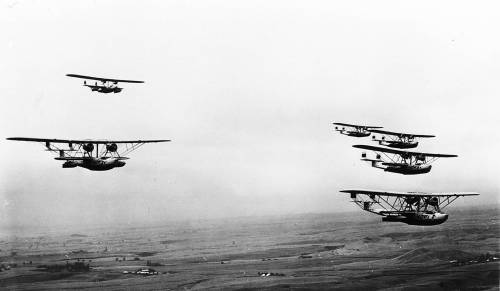
On September 29, 1931, Britain's G.H. Stainforth set a new speed record of 408.8 mph. The engine was a Rolls Royce liquid cooled inline engine that used a refined gasoline containing additives of ethyl and wood alcohol. The engine generated 300 more horsepower than had ever previously been demonstrated, though in its early years this engine had a short maintenance cycle. These inline engines powered most of the land based Allied fighters used in the early years of the battle for Europe in World War II. Though their cooling systems were vulnerable to enemy fire, the Allied fighter and fighter-bomber aircraft could match the flight performance of the counterpart German planes. The U.S. Navy and the Japanese Navy stuck with radial air-cooled engines for their carrier-based fighter planes in World War II. The U.S. Navy also configured their seaplanes, flying boats, with radials. See P2Y-1s next.
The aircraft in the next photo would not win air races but they could fly long distances.
A flight made in 1931 by Wiley Post and Harold Gatty in their aircraft Winnie Mae had long-term implications for both commercial passenger flight and for military flight. Powered by a Pratt & Whitney Wasp engine developing 525 horsepower at 2200 rpm and taking eight days and sixteen hours, the aircraft flown by these two men left New York on June 23. They piloted and navigated their plane around the world in its northern latitudes. Here is a list of the places they put down for fuel. Some of the place names may send the reader to an atlas.
- Harbor Grace, Newfoundland;
- Chester, England (near Liverpool);
- Berlin, then Moscow, then on to four landings in Siberia at cities just above or below the 50th parallel, at Novosibursk, then Irkutsk, Blagovyeshchensk and Khabarovsk;
- then, flying north of east to Fairbanks, Alaska;
- next, flying south of east to Edmonton, Alberta;
- thence, to Cleveland, Ohio;
- arriving back at their original takeoff point in New York City on July 1, 1931.
There was not a great deal of night flying on this route. These two men flew their route in northern latitudes just after the summer solstice for their "round the world flight." The North Atlantic crossing was 2,195 miles and the North Pacific crossing was 2,500 miles. Edmonton to Cleveland was about 1,600 miles and Moscow to Novosibirsk was about 1,100 miles. The rest of the flight segments in Siberia were relatively short, though a forced landing in the mountainous area between any of those stops would have been a concern.
At the end of July of 1931, Hugh Herndon and Clyde Pangborn piloted a flight intended to track the Post/Gatty round-the-world route and break the Winnie Mae's record. One of their flight segments led to a situation of political import. Their Bellanca plane named Miss Veedol proved too slow and they could not make up sufficient time by shortening the rest and refueling stops. In mid-Siberia, recognizing that the Winnie Mae's record was beyond their grasp, they changed flight plans and landed, without permission, in Japan. They were interned, and released only after paying a fine of $1,025 each. When the Japanese newspaper Asahi offered a prize of $25,000, the two opportunists then made preparations for a Japan to United States nonstop flight. Over Dutch Harbor, Alaska, their plane was nearly forced down by the accumulation of ice on its wings. The plane was slowed considerably but did not stall, and the two men landed Miss Veedol at Wenatchee, Washington on October 5, 1931 after a 41 hour trip from Samushiro, Japan. This time they had a record. No one had flown that 4,458 mile route before. Their Japan to Wenatchee, Washington record may still stand.
An Asahi press representative was on hand at Wenatchee to present them with their check. One feature of their Bellanca helped the flight through its icing problem in the Aleutians. They dropped their landing gear when they got out to sea shortly after leaving Japan. Miss Veedol had been equipped with reinforced-steel flooring so that it could make a landing without wheels. The jettisoning of over 300 pounds put them in position to make it to U.S. soil and undoubtedly helped keep the aircraft above its stall speed with its ice accumulation near Dutch Harbor, Alaska. The flight is a reminder of the mixture of opportunism and meticulous planning that made aviation's early record-breaking flights possible. After landing, the pilots confided to newsmen that their arrest and internment had been for taking pictures of Japanese fortifications from the air on their way to their landing in Japan, and they speculated that the influence of the newspaper must have helped get them a permit to leave Japan. Their commentary during the interview after their feat does not include any admission (or denial) that they had actually taken those pictures.
Charles Lindbergh made the national news again in 1931. He and Anne Morrow Lindbergh, daughter of the U.S. Ambassador to Mexico, whom Lindbergh had married in 1929, left North Haven, Maine, on July 30. Their aircraft was the 600 horsepower Sirius, a low wing, two cockpit, two-pontoon seaplane. Their destination was the Orient. Anne Lindbergh, a gifted writer, chronicled their flight in her short, excellent, book, titled, "North to the Orient." Their route was north and west over Canada and the Northwest Territories, to Pt. Barrow and Nome, Alaska, then south and west to Kamchatka, the Chishima island group, to Hokkaido and Tokyo, Japan and finally into China. On this flight, Anne was radioman and co-navigator. Always cognizant of the weather, Lindbergh elected not to overfly the option to use visual flight rules for landings in lakes or bays. In one exception that occurred along the Chishima group, an offshore low cloudbank moved in over the shoreline underneath them while higher clouds ahead foreclosed staying on top of the weather. According to Anne Lindbergh's book, they turned back, and her pilot husband made repeated, steeply banked, attempts to slide the aircraft down the side of the mountainous coastline trying to find clear water for landing underneath, finally making it on a third try. (See particularly pages 85-88 of the Harcourt Brace & Company's Harvest Book imprint, first Edition 1967, of "North to the Orient.")
There were no local radio aids where the foregoing event took place. The Sirius was equipped with only the most rudimentary direction finder, and Lindbergh did not have the aircraft instrumentation that was needed to make a controlled wings-level letdown to see if he could find a clear space with a sea horizon under the clouds. He had to hang on to that land, because he needed to know where it met the sea.
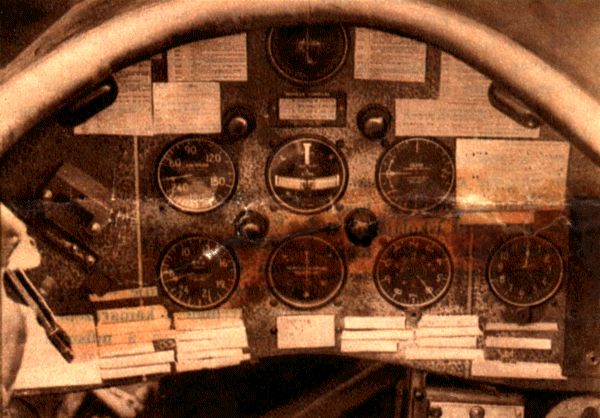
After Lindbergh's Sirius was returned to the U.S. on the British aircraft carrier Hermes, the couple planned their next survey flight, a survey of the Atlantic rim with a side excursion deep into Europe and Russia. For this trip, their Sirius had a new engine fitted that increased power to 710hp, which would be needed for the heavier load aboard. A Sperry gyro horizon and directional gyro were added to the instrument panel. The flight's initial stages took them across the North Atlantic rim. Return was via Southern Africa to South America. This trip was made in 1933. Compare this panel above ( add mentally the two new instruments), with the Lockheed Electra 10 panel, Illustration 3, in the chapter ahead, entitled "Early Airline Development."
An open sea landing out to sea was not an option for Sirius even if his aircraft had appropriate instrumentation. We will return to Sirius with an important update , and will for reader convenience repeat the photo, later in this page.
These are just a few of the highlights from aviation's second great age, a preparation age in the years 1929-1931. What those pilots and designers accomplished in so many first-ever flights set the stage for aviation's air transport era. Many of the names that made the news were dashing young men or women standing next to or sitting in the cockpits of their astonishing aircraft.
There was glamour. But, steadily improving engine and aircraft reliability were the enduring accomplishments. Flight through instruments was at hand.
Most of the pages in the flying book excerpted here are devoted to actual experiences from all sectors of aviation. Readers are brought into the cockpit. This is not a "how to" book. In the few instances where technology is pivotal, the author keeps it simple.
The published book contains some errors. Below, find a link to the errata detected so far ,with credit given to sharp-eyed readers.
For Dailey International Publishers' flyiing book corrections, additions, and amplifications up to and including June 30, 2010; see Add-ons to Flying Book.
For: The Triumph of Instrument Flight: A Retrospective in the Century of U.S. Aviation ISBN 0966625137
Home | Joining the War at Sea | The Triumph of Instrument Flight