(1) U. S. Navy Aircraft lead U.S. Submarine to Air/Sea Rescue in 1946 Aleutian storm.
(2) Flight 19 out of NAS Ft. Lauderdale in 1945 not so lucky; U. S. Navy Search Aircraft fails to find 5 TBMs off lorida, Dec. 5, 6, 1945.
This author participated in both searches. The value of good information overcame storm odds i n Gulf of Alaska rescue.
Copyright 2014 Franklyn E. Dailey Jr.
- Barnstomers and Early Aviators
- Budget Flying Clubs
- Aviation Records
- VFR to IFR
- Early Airline Development
- Flight Across the Atlantic
- P-40s to Iceland
- Alaska Based Navy P2Y-1's
- Buckner Goes to Alaska
- Ship-to-Ship Battle
- Naval Flight Training
- NAS Instrument Training
- Aleutians Anti-Submarine Warfare
- Search & Rescue
- Gyros and Flight Computers
- Baseball Team Lost in Flight
- Tomcats and Boeing 777s
For closely related material, go down the left column to:
Aleutians Anti-Submarine Warfare
or just hit these links. These are all about Alaska and the Aleutians, and contain both U.S. Army and U.S. Navy stories.
Author's Note: When I was early in my active pilot career in the 1940s, this subject was short-titled ASR. ASR meant Air Sea Rescue. Sometime after mid-Century, the branch of government that took over this function when U.S. waters and/or U.S. personnel were involved was the United States Coast Guard. Many readers have seen those dramatic rescues at sea on TV, often a helicopter lifting survivors into the air. Techniques, equipment and human skills have dramatically improved. So have our means of recording such heroic endeavors by dedicated and highly trained men and woment. We almost take these rescuers for granted.
Flashback to the 1940s. The need for rescue was just as prevalent. The means were primitive. Regular duty personnel who had regular missions to perform were called aside to perform an ASR mission. The "structure" for executing rescue was created on the spot. The equipment, aircraft, personnel, were assembled in short order, crews given only rudimentary instructions if any, and told to "take off" as soon as the airplane was ready. Latitude and Longitude, to the best anyone could estimate, were the essentials provided . What to do when you got there, if you got there, would be made up by the rescue crew based on what they discovered. In the two rescue efforts detailed below, the 'base' you departed from was your only source of new information and in both of the ASR efforts I was sent on, no base information ,beyond what you had when you departed ,was ever received. Just think about what men did in the 1940s, with no TV to bring their skills and daring home to the public, and senior military officers who took outstand ing performance for granted, men who were "just doing their duty."
Finally, as an example of how millions military personnel lived these life situations, it never occurred to me that it was remarkable at all that I participated in two such rescue efforts in less than a one year period of my 91 year life!. That is, until now.
(1) Aleutian Williwaw Tears Barge Loose into Gulf of Alaska, with Three Army Soldiers Aboard. (This story was also published as "An Aleutian Sequence" on the U.S. Naval Academy Alumni website in the Class of 1943 section. Later, that Academy website was redone, and according to the excuse they gave me, the USNA Class sea stories were 'lost' to those holding access links. I resolved to recreate "An Aleutian Sequence" here.
An Aleutian Sequence
Two days in November 1946 provided an experience that will always remain vividly in memory. Those were November 4 on which we flew 5.8 hours from NAS Kodiak, Alaska, to the U.S. Army's airbase at Ft. Glenn on Umnak Island. And then November 5, on which we flew 9.9 hours, all south of the Aleutian chain, ending back at NAS Kodiak. All of the 5.8 hours on the 4th were instrument. 8.0 of the 9.9 hours on the 5th were on instruments, or above 10,000 feet of solid overcast. Our flight concluded with a night landing at NAS Kodiak. I should note that in 1946 there were no surface-based radio navigation aids for flights south of the Aleutian chain.
Both segments of our PB4Y-2 mission were code Z flights, in Navy Flight Symbol language, standing for "Flight not falling within any of the above classes, but which are required by the exigencies of the occasion." One of "the above" classes that the keeper of the logbooks passed up was code W, "Emergency or relief work." Using long hand, under Remarks, our log keeper had written "Search and Rescue" to cover those two days in November 1946.
Here is a photo of a PB4Y-2. It is a 'made over' Liberator, famous for missions in WW II. This is not the plane we flew that day.
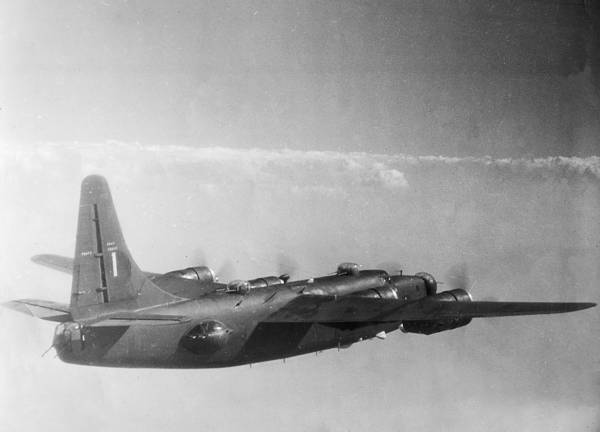
Our secondary mission at all times while in the Alaskan/Aleutian area was Search and Rescue (S&R). (Our primary mission was ECM, Electronic Countermeasures.) The U.S. Coast Guard now has the station at Kodiak but was not there then. Those two days involved our full crew, eight in all, using PB4Y-2 serial number 59643, in the search for three men in a self propelled barge (BSP) that had broken from its moorings at Ft. Glenn on Umnak Island, and was drifting helplessly in a williwaw, rapidly propelling it downwind in the Gulf of Alaska. The storm that had broken over the Aleutian chain was one of the most vicious ever experienced in an area of vicious storms. The barge had broken loose from its moorings with no warning while its occupants were asleep. Whatever the propulsion system was, that caused the barge to be labeled 'self-propelled,' its engine never functioned to our knowledge during the entire period of terror that three Army men experienced.
Five of our flight crewmembers formed the core strength for this flying mission. These were the Pilot, the Navigator, the Radar Operator, the Radioman and the Plane Captain. Our radar was the APS-15, "centimetric" radar, as the British called it during WW II, "x-band" to us. It was a close technology cousin to the SG radar aboard many Navy surface ships in the latter years of World War II. Its small antenna required only a small radome. A radome is a faired bulge usually on the lower side of the fuselage. Ours was never a drag on the Privateer aircraft in flight. While not great in range, perhaps 50 to 60 miles reliably, APS-15 was a precision radar that could detect the smallest objects that could reflect electromagnetic energy. Submarine periscopes were susceptible to centimetric radar detection.
Our flight to Ft. Glenn on Umnak Island had been hurriedly arranged and the briefing was short. We knew where the barge had departed from but in no way certain of its drift rate. Weather would be our major challenge for the entire mission. We took off about noon for Ft. Glenn in order to use that base as the launch point for our actual search assignment.
Enroute to Ft. Glenn, westbound out of Kodiak, over the west end of Unimak Island, with early darkness already upon us, the outside air temperatures plunged at our assigned airways flight altitude of 7,000 feet. We were crossing the cold front that generated the storm. Cylinder head temperatures plunged in response, despite snugging down our cold-weather-modified cowl flaps. Number One Engine went below 100 degrees and began to lose power. Pilot Hugh Burris put down half flaps to slow the plane down and managed to keep cylinder head temperatures on all engines at 100 degrees or above, with the engines "putting out" thrust.
Pilot Burris made a difficult radio range approach to the landing field at Ft. Glenn. We had been advised to keep our barometric altimeter setting frequently updated and to cross check wherever feasible with our radio altimeter. An Army Air Corps Colonel, as local Ft. Glenn lore had it, made the exact same approach we needed to make at Ft. Glenn. The story was that he had rolled his wheels unexpectedly on a hilltop during the approach and made an emergency pull-up. He then discovered that the altimeter setting was not 29 point something, but 28 point something. Plunging altimeters, even below 29 inches, occurred often in the Aleutian weather picture. After the Colonel's near miss, the weather broadcaster's voice procedure would prefix a "28 point something" altimeter setting, with the words, "Red, Red." Burris made an "at minimums" approach and landing at Ft. Glenn. Weary, we checked in, had a hot meal, and went to our assigned bunks for a short rest.
Up early, well before dawn, we finished our preflight, checked with the weather man, and received an "open" over water clearance with no fixed destination listed. A flight with no destination was a rarity and this is the only one in my pilot history that I can recall. This is not a flight plan that would ever be accepted stateside by Air Traffic Control! We took off in the dark and headed southeast out over the North Pacific Ocean. Our flight crew was attuned to this challenging mission and all of our training at NAS Whidbey Island Washington, and at NAS Kodiak, would be put into play this day.
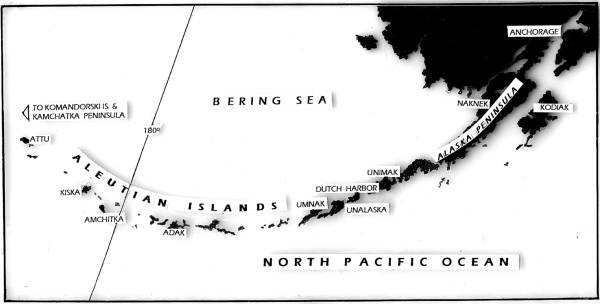
Let me go over the geography once more. Our Privateer took off from Kodiak Island, jumped over the Alaska Peninsula to Naknek and flew north of the Aleutian Island Chain on airways, to Ft. Glenn on Umnak Island. Note Adak Island west and bit south of Umnak almost to the International Date Line.
NAS Adak had been busy on this search too. Lt. Walter Munk USN (He was Maximilian Walter Munk when I knew him in the class ahead of me at the U.S. Naval Academy. Most of his class of 1942 classmates at the Naval Academy called him "Max" but I always knew him as "Walt.") was flying for a Navy PBY-5A squadron based at Adak, Alaska, slightly south and west of Ft. Glenn. He and his crew had been airborne on the search the night before while we were enroute to Umnak Island. I had known Walter Munk slightly at the Naval Academy, then a bit more at Whidbey Island where his PBY-5A squadron had been home-based. My Oak Harbor, Washington, "Victory Home" overlooked the Saratoga Passage on which the waterborne PBY-5s had originally been home-based. With the advent of wheels for the PBYs, the seaplane base had been abandoned and newly configured VP squadrons with PBY-5As were then stationed at Ault Field right next door to our PB4Y-2 hangars. In 1946, the Munks lived close to us on that Oak Harbor hill.
For background on the presence of U.S. Navy air effort in the Aleutians, I am indebted to Leonard DiNapoli, an aircrew member in a U.S. Navy seaplane squadron based at Sitka Alaska in 1937. Leonard supplied the next photo, and .Jack Riech corrected the first identity I had used, P2Y-2 aircraft, to P2Y-1 aircraft. (the tipoff is that the 2-model had its engines faired into the wing and the 1-model pictured below had them hanging by struts as in this photo)
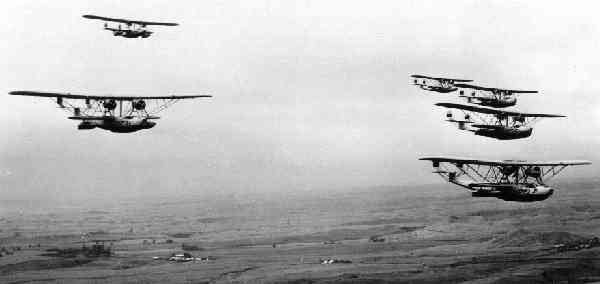
Pictured is a flight of Sitka-based P2Y-1 aircraft in the 1930s. About four generations of Convair designs later, came the PBY-5As
Walter (Max) Munk and his crew made the first aircraft sighting contact with the barge. The barge was a BSP in shorthand, and it had drifted rapidly south and east from Umnak. This sighting was a near-miracle sighting even in professional Search and Rescue lore. The visual contact was made at night in restricted visibility, under a very low overcast, with a driving wind and rain and driven seas. Those seas can present a haze of water particles in the air. Even in the extremely poor nighttime visibility, Lt. Munk and his crew could see that the men were alive in the barge but that its freeboard was already dangerously low. It was taking water. The PBY-5A could do little for the barge but offer hope and headed back to Adak for fuel.
Note: Here is a photo of a PBY-5A of the type Lt. Munk was piloting. I am indebted to Janis Kozlowski, working for the U.S. government in Alaska, who searched archives for this photo and obtained permssion for me to use it in this story.
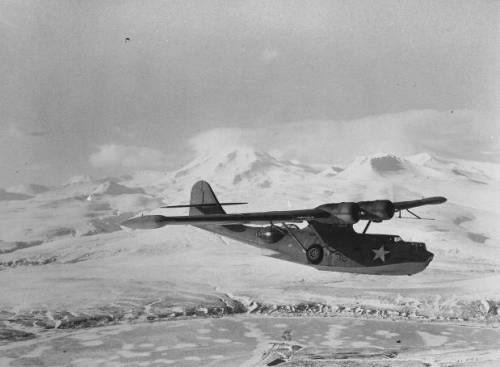
An Alaska based PBY-5A 'Catalina' flying over water near mountains in the Aleutian chain. This would be similar to Lt. Munk's aircraft.
Walter Munk's crew knew that their Loran fix data on the barge was fundamentally in error because they had determined that their electronic Loran equipment was out of calibration. Wisely, Munk did not attempt to change the calibration when he discovered it out of specified norms, but went back to his base, gassed up, and headed back to sea, now in the early hours of the 5th of November. He set out to find the barge again, using the Loran data he had recorded earlier, with his Loran equipment still uncalibrated.
Our Privateer flight from Ft. Glenn got airborne about the time Munk's PBY-5A, allowing for rapid surface drift, regained contact with the barge! This time, Munk's crew had a raft and a Gibson Girl (emergency radio) to throw overboard as close as he could drop them to the barge. They came close, but there was no way the barge occupants, drifting helplessly in a raging sea, could bring aboard either emergency device. The barge would therefore remain out of touch radio-wise, while its freeboard would continue to shrink. Significantly though, for the men on that barge, was their recognition that Munk's aircraft and crew has made a second visual contact with them. Those Army men knew that the Navy was trying hard.
We in PB4Y-2 59643 had overheard much of the voice radio traffic that Munk was broadcasting back to his base as he returned there so we had an updated picture of the situation soon after our takeoff from Ft. Glenn. NAS Adak also sent us the best barge position coordinates they could calculate based on the PBY-5A crew's successive visual acquisitions of the BSP. The PBY-5A cruised just under the low overcast on its search. Not as well equipped with engine power as our Privateer, the Catalina turned that into an advantage with an aircraft crew that knew its plane and its capabilities.
The overcast extended from a few feet above sea level to just above10,000 feet. Our first APS-15 radar "contact" with anything on the surface came when we were above the overcast using sun shots for navigation. It was not where we felt the barge had to be. We descended anyway, just to make sure we checked every contact. We broke out about 400 feet over mountainous waves with streaks running northwest to southeast. There we discovered an all-white Liberty ship headed for Siberia. The Soviet Russians were still taking supplies to Siberia in what had once been a U.S. Lend/Lease "bottom." Ironic that our basic Alaskan ECM mission was to be looking at them with suspicion. Back to 10,000-feet we went because we needed maximum range to the radar horizon to help detect radar targets and find that barge.
A descent through several thousand feet of solid overcast to find some visibility "underneath the overcast" is not a trivial exercise. Approaching an instrument-equipped, manned, airfield with full tower facilities, pilots are given a succession of barometric altimeter settings for the landing field. When settings are received, both pilot and copilot reset their altimeters. The worldwide convention is that a setting of 29.92 inches of Mercury is assigned as the "standard" sea level reading. When it varies from that, and it almost always does, all air stations, knowing the height of their field above sea level, issue new altimeter settings. Presuming the setting is correct, when the plane touches down, its pressure altimeters should read the height of the field above sea level. Our Privateer was also equipped with a radio altimeter. These too needed to be kept in calibration and this was done by making sure that their reading matches that of the pressure altimeter when the latter is corrected as just noted.
Now, the plane takes to the air and goes to sea, and there is no control tower, and no surface weather station to provide pressure altimeter corrections. So, for these letdowns at sea, one looks to the radio altimeter and is more confident if that instrument has been recently calibrated. If the radio altimeter reads 500 feet and the plane is still 'in the soup' and needs to go down further to examine a radar "contact," the pilot shallows his rate of descent and goes down 50 feet at a time and looks hard for a cloud opening. How far down to go before calling it off? It is up to the pilot and the extent of the need. For all these over-water missions we streamed our trailing wire antenna to get extra range on our radio communications equipment. This wire had a "pig"(a cast metal weight) on the end to make sure the wire streamed fully and did not just flap around outside the plane. The pig, and its connecting wire, stream behind the aircraft, and down. If the radioman under these circumstances discovers that he has lost his pig, one conclusion is that it hit the water and was jerked off. The plane is then below safe minimums and should certainly ascend at once. No one would recommend a descent on instruments to such a level but it has happened and the plane involved has pulled itself up from this dangerous altitude.
Almost too much time seemed to have passed before our second radar contact. We descended again and discovered a surprise, not the barge, but a United States submarine, the USS Bugara, SS-331. She had been diverted from a Seattle destination, as we soon learned, to join the search for the barge. Bugara, a modern fleet sub of that time, tossed uncomfortably on the roiled surface.
Here is the Bugara as she looked after conversion to a modern 'guppy' configuration in the 1950s. This photo was supplied by crewmember John Craggs. Bugara was a late WW II 'fleet sub,' in configuration, when we spotted her dim outlines in boiling North Pacific seas in 1946.
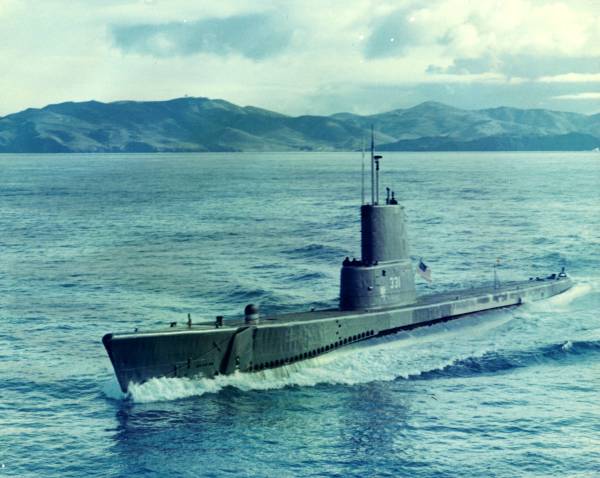
USS Bugara, SS-331, after 'guppy' conversion in the 1950s. Photo supplied by crewmember John Craggs
Aided by our radioman, our Patrol Plane Commander(PPC), Lt. Hugh Burris USN, quickly established direct voice contact with the Bugara. Navigator, Ensign Orville Hollenbeck USNR, came forward to the pilot's compartment. He asked me (I was the co-pilot) to estimate the true heading of the Bugara for him. I did. Now, Orville, while on top of the overcast at 10,000 feet, had put into service his bubble octant, the sun and moon navigation tables, and the single weak Loran station available. He had kept an accurate position of our aircraft moving forward. He had also used the best estimate from the Adak PBY-5A squadron's information of the BSP position at their last sighting and had advanced that position according to his estimates of BSP drift. Munk's calculations, first sighting to second sighting, were Orville's primary input on the 'drift rate' of the BSP.
Orville Hollenbeck quickly informed PPC Burris that the Bugara would be unlikely on her present course to come anywhere near the barge. Orville suggested to Burris that he recommend a course change to the Bugara!
In the annals of ships and aircraft (and I served both), I can tell the reader confidently that ships always felt they had the better of the navigation skill and often they did. A Navy pilot's air navigation training was diluted by pilot training. A shipboard navigator would hold his billet for up to three years doing little else. In addition, Navy ship navigators usually have skilled Quartermasters, rated petty officers, on their team. Ships almost always gave heading vectors to aircraft, not the other way around. Still, Burris did not flinch. He immediately contacted the Bugara on voice, and recommended that she change course 19 degrees to port!
The submarine had been 'in the soup' for days without any celestial readings. Hollenbeck had been "on top and in the clear" for long enough to get good data. The sub skipper, and I give him great credit, did not hesitate and immediately made the recommended course change. Burris, along with Hollenbeck, then established our present position as a new hub for the search, and climbed back to altitude on a course different from the one Orville Hollenbeck had recommended for Bugara. No need to duplicate search sectors. It was clear to me that this one aircraft and this one submarine were the only hope, the slimmest hope, for three men on a sinking barge in a raging North Pacifuc sea.
About two hours passed and our Privateer was now moving eastward to a point due south of Kodiak. The weather suddenly cleared and at 10,000 feet, daylight receding to dusk, we could see in all directions. We were about 1 1/2 hours south of NAS Kodiak.
We then received an electrifying voice radio message from the USS Bugara: "We have spotted the barge. (A pause) The water is almost to the top of her gunnels. (Pause) We are closing. The seas are moderating. (Pause) We are taking three exhausted men aboard."
Our PB4Y-2, for that mission BuNo. 59643, with its own tired crew, approached Kodiak, from a rarely flown sector due south of the island, on a northerly heading, and made a routine night landing with local lights visible for miles. Also, very rare. Our Ensign pilot/navigator, Orville Hollenbeck, had kept two navigation tracks going, and had given perfect advice under less than perfect circumstances. Our aircraft equipment, notably the APS-15 radar with its skilled operator, and our radio altimeter, worked flawlessly. One weak Loran station had confirmed the other navigation sources. Our radioman provided essential communication. Two men, the pilot of an aircraft, and the skipper of a submarine, believed the advice given by an Ensign aviator and an aircrew working under challenging conditions. Pilot Walter Munk and his PBY-5A crew out of Adak made two precision flights without which the whole effort would likely have failed. The Navy at its best! End Part 1.
Notes: The foregoing rescue story was certainly a highlight of my first tour of duty in the Aleutians. For all the rescue personnel participants, just 15 in the airborne operation, it came about as the result of good training and then experience. For a copilot like myself on his first operational tour in an aircraft squadron, I could be thankful that I had been assigned to a crew headed by Lt. Hugh Burris, veteran of ASW combat ASW missions against U-boats, in the Bay of Biscay, flying from Dunkeswell, a south England airbase.
Sadly, I was never able to contact Orville Hollenbeck so that he could read my story. His first name, inerestingly, is relevant because I know he came from North Carolina. Navy squadrons rarely recomended medals in peacetime. Pilot Burris knew I was determined to write this story. He and I communicated when I wrote "The Triumph of Instrument Flight," a 2004 publication still available at Amazon and other booksellers. See cover at top left of this page. I tried to get this rescue story to Walter Munk but he passed in late 2011 and I never found out if my relay person had been successful, as he had passed too by early 2012. My friend and radio communications officer Lee DiNapoli also passed in late 2011 without being aware of his contribution. Jack Reich, PBY contributor from that plane's birth, also has passed. John Craggs, Bugara crewmember, is still with us but his later contribution to the story after it first appeared on the U.S. Naval Academy website, has been lost in that 'website conversion' or whatever term they are using for many sea story dissappearances, not just this one. (I really feel like saying "Shame!" to USNA website personnel for letting this happen.)
Part II. Flight 19: Extensive search by PBM, PBY-5A, and PB4Y-2 a/c fail to find 5 TBM a/c off coast of Florida
Foreword Note: On pages 196 and 197 in my book, "The Triumph of Instrument Flight: A Retrospective in the Century of U.S. Aviation," ISBN 0966625137, I briefly covered the event of the loss of Flight 19's 5 TBM aircraft, including 14 men in the flight crews, on Dec. 5, 1945. The entire crew of a PBM Mariner aircraft were also lost in the search. Invitations to participate in the annual memorial service conducted by the NAS Fort Lauderdale Air Museum have led to deeper reflections on how a flight of five aircraft could be lost on a simple over water training flight in good weather. A bookend for this tragedy occurred May 10, 1946. The later event is discussed on page 201 of my book. I will here supply more detail on the Flight 19 loss, and then offer a conclusion that relates two U.S. Naval Air Training command tragedies. The two losses occurred in the nine month period after the end of World War II.
Author Background: I am Captain Franklyn E. Dailey Jr. USNR (Ret). As a Navy Lieutenant, I participated in the search for Flight 19, lost on a training flight over the Atlantic. I was at the time a relatively experienced Naval officer, navigation-wise, having spent 27 months on a destroyer engaged in five Mediterranean landings in WW II. I was an inexperienced Navy pilot, having been awarded my Navy wings on October 14, 1945 at Pensacola, just weeks before the loss of Flight 19.
As I experienced it: On December 5, 1945, the date of the loss of Flight 19, I was in training at the Air Bomber Training Unit (ABTU) at NAS Banana River, Florida. Our training was bombsight training, not pilot training. My log book shows that on Dec. 6, and 7 of 1945, our training was set aside. ABTU student-pilot Lt. W.T. Rapp USN, and I, were assigned to man the 'blisters' of a PBY-5A, with 7x50 binoculars, as our aircraft flew assigned search patterns over the Atlantic Ocean, hoping to locate life rafts or debris from five missing TBM aircraft. I manned the starboard 'blister' and my U.S. Naval Academy classmate and friend, "Barney" Rapp manned the port blister. We never found a trace, and in fact found nothing but blue water. (The blister was a faired, clear plastic shroud protecting and aircrew gunner firing a waist gun defending the PBY-5A from enemy intercept planes.)
The next photo shows ABTU students and their instructor group, taken in a hangar at NAS Banana River, about December 4, 1945. This training unit was called the Air Bomber Training Unit, ABTU, and the inflight portion was conducted in Navy PBY-5A aircraft or Navy SNB aircraft. The latter was a Beechcraft D-18 in civilian life but extensively used by the Navy for training pilots. This photo is taken in front of the Beechcraft.
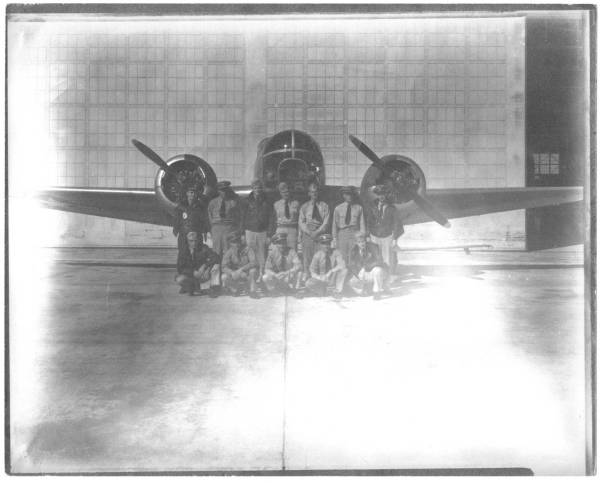
The three pilots standing in the back row, center to right are, centered Lt. Franklyn E. Dailey Jr. USNA '43, then to his right Lt. W T. O'Bryant USNA '42, and on the right end, Lt. Donald C. Richards, USNA '42. Also, center, front row, kneeling, is Lt. W. T. Rapp USNA '43.
Except for the instructor pilots, most of this group had come from WW II combat ships and had just received their wings at NAS Pensacola, FL on October 16, 1945. I was paired with Bill "Barney" Rapp and our flights inolved learning to operate bombsights over ocean and river targets, in a PBY-5A Catalina. Sometimes we used the Banana River for landings and takeoffs, and sometimes the runway at the Air Station. This station was the predecessor to Patrick Air Force Base.
On December 5, 1945, the Navy base at Banana River received word from NAS Ft. Lauderdale that a flight of five TBM aircraft had failed to return from a training flight over the ocean. Two PBM Mariner aircraft from NAS Banana River went out that evening to search, and one never returned. A witness reported seeing an explosion with white flame over the water. Our PBY-5A training crews began searches the next day. Instead of manning the bombsight, Lt. Barney Rapp had 7/50 binoculars in the left blister, and I was similarly equipped in the right blister of the PBY. Search flights were 4-5 hours. We never sighted anything, not wreckage or flotation rafts or life vests. Nor did any other of the extensive searches undertaken from other points of origin in those succeeding days. Every available Banana River plane and crew were recruited to search. At least fifty flight personnel were involved.
I have since participated in three of the memorial events conducted every Dec. 5 at Ft. Lauderdale's Memorial erected for this sad event. I learned several years later the identity of the pilots and crewmembers. One pilot was Capt. George Stivers USMC, , a Naval Academy Class of 1943, a classmate of mine. His first service after graduation had been taking Guadalcanal from the Japanese, a Marine Corps triumph, begun in August 1942. Capt. Stivers went to single engine Navy flight training just before I entered the Navy's multi-engine pilot training program.
Stivers' loss and that of the other men in the flight of the TBMs was a tragedy and an unnecessary one. The armed forces were in the middle of dynamic shrinkage, as most of the men of World War II returned to civil life. In Navy air, at any base, men with sufficient 'points' could declare their intention to 'go home.' And millions did .In the service, once you had the points, a simple declaration, and you went home. Any time of the day or night.
Only one radioman was available to make that 5-TBM flight on December 5, 1945. Radiomen were crucial to point to point navigation for those carrier type aircraft. That 'seat' was essentially vacant in four of the five aircraft. A radioman was in fact the 'navigator' assistant to the pilot in those carrier aircraft. A multitude of commercial and military radio stations were broadcasting at the time and the TBM had the radio equipment to receive them.
Shorebased personnel too, such as those at NAS Ft. Lauderdale, could simply declare they were going home. Flight support facilities, and ready room personnel on board air stations, could be undermanned on any shift without prior notice. So, both the flight capability, and the ground support capability, could be compromised in that period of unburdening from war. Sundays were days most likely to be shortmanned with men leaving the service in large numbers. Dec. 5, 1945 was a Sunday.
An NAS Ft Lauderdale pilot was actually aloft near the base on that fateful Sunday afternoon, and had direct radio contact with the Flight 19 flight leader, and actually gave him very good advice; the result was still tragic. I do not take a position that it was exclusively pilot error on the part of the flight leader though I must conclude that his actions certainly contributed. There should have been enough redundancy in the five aircraft, and in the resources of a leading Naval Air Station, to at least mitigate some failing on the part of one member of the flight if , and only if, all had been functioning at full operation capabiliity.
Captain Stivers was, on Dec. 5, 1945, a Marine Aviator who received his wings just a few months earlier. Stivers, and two of the other Flt. 19 pilots were in the Marine Corps; these three almost certainly had less actual navigation experience than Naval officers who, like me, had had considerable seaborne navigation experience before being ordered to flight training. The navigation training received in my Navy flight training program supplemented and complemented my shipboard experience. But, Navy flight training was strictly chart reading and point to point overland navigation for single engine pilots. Multi engine trainees got final operational overwater training flights, for example in PB4Y-2s with navigation tables, octants and astrodomes to take sights, plus extensive radio equipment for navigation, like direction finders and Loran. The pilots on Flight 19 had none of this training and that goes for the flight leader.
I have been invited to Ft. Lauderdale several times in recent years, to participate in the annual memorial ceremony for Flight 19, held annually on Dec. 5 of each year. I was invited to speak Dec. 5, 2010, but declined due to hip replacement. I have heard many talks there that have had as their objective insight into this tragedy. The talk that has impressed me the most was one given by an officer who examined the forecast winds for that day and noted changes from the forecast wind patterns. Most of the other commentary has Flight 19 leader, Lt. Taylor, involved in questionable navigation decisions in what was planned as "dead reckoning" navigation training. (Subsequent to my original writing for this story, I did give the central talk at the Dec. 5, 2012 memorial ceremony, and was able to make these points. )
The reader should know that as the result of my participation in the search, and subsequent contact with personnel of the Ft. Lauderdale Museum dedicated to keep this tragic event in memory, I was invited about 2005 to participate in a History Channel program which combined several tragedies into a program that was broadcast with the term, Bermuda Triangle, in the program's title.The story was dealt with by the History Channel in a Bermuda Triangle series, and I was interviewed and presented in one segment of the actual TV broadcast episode. I have never subscribed to any of the mystery losses attributed to that "Bermuda Triangle" sector of the Atlantic Ocean . To me, the FLight 19 episode was simply a Navy that was not functioning at its best.
Naval Aviation trainng readiness on Sunday, December 5, 1945: Here are some brief reflections on the U.S. Navy of that period, particularly U.S. Naval aviation training. Officers and enlisted men were leaving the naval service daily, based on 'points' accumulated for their service time. When a man announced he had the points required for release, he often had belongings packed."Points" got you out, in many cases 'right now.'
Lt Taylor, this training flight's leader, is reported to have arrived at the Flight Office of the NAS Ft. Lauderdale, that Sunday, proclaiming that he did not feel good, and requesting that he be excused. From personal experience in many squadron flight offices, I can aver that such a request would be taken seriously. No responsible authorizing officer wanted any person, particularly with a flight training responsibility especially with students, to lead a mission if that person reported a condition detrimental to the conduct of such a mission. There may not have been in that Flight Office that Sunday an experienced officer. The office could have been manned by an officer lately assigned to such duty. Despite backup plans, the Navy, especially in training units, was undergoing compromised readiness situations in all billets in those days of 'points.'
Lt. Taylor is reported to have had a record of experience in point to point flight ,where he had familiarity with check points frequently seen, and a dependence on such navigation. This is known as Dead Reckoning. Over the ocean, leaving a known position of land, and then experiencing 'speed, time, and distance' over water with no visible check point for a period before an identifiable land mass could be identified, may not have been part of Taylor's experience to that date in his life. There exists the question as to why he would have been assigned to lead this flight exercise. Early conclusions trickled out that the Navy believed Taylor erred in his training flight leadership duty; his family asked for a different conclusion, and the Navy closed the subject with a 'no conclusion' as to cause of this loss.
From the 14 casualties posted for all crew in the five planes, each of which is normally flown with pilot, radioman, and ordnanceman, one learns that only one aircraft had an aviation radioman aboard, and he was in Taylor's flight crew. In addition, some personnel in the three-man crews of the five aircraft were aboard for 'flight time.' Here again, a question persists as to why crew manning, especially the radiomen shortage, would have been permitted. If anyone besides the pilots could assist in navigation or navigation correction, it would be a radioman with access to low and mid-frequency radio stations, including commercial broadcast stations, and especially Navy radio range stations which were plentiful along the coast of Florida. This crew manning question, along with the health question of the Flight Leader, would normally be addressed in the Flight Office or the Operations Office of NAS Ft. Lauderdale. before the training flight could be cleared. But, these were not 'normal' times.
In short, the TBM crew calls for pilot, aviation radioman (ARM), and aviation ordnance man (AOM. The TBM was well equipped for that era in radio and radio navigation equipments. Four student pilots had no ARMs aboard. An aviation radioman would fill not only a communication responsibility, but could assist in a TBM pilot's navigation! A possibility always exists that unforeseen weather could separate planes flying in formation. (There is no record that this occurred.) Single aircraft navigation is always a possibility. This flight was totally unprepared for such a situation.
Flight 19 in progress.Ttransmissions intercepted show that one or more of the other pilots questioned Taylor's decisions and that Taylor himself had become confused. Taylor's radioman came in for no mention in voice transmissions intercepted. Unfortunately, none of the other pilots could have presented a point of view based on information from an aviation radioman that would have lent force to inquiries to the flight leader. There were no other aviation radiomen in the five-aircraft flight!
My thoughts go in one direction. Turn to the frequency of a commercial station in Florida. Does heading 'west' lead to greater radio volume? Moreover, the Florida coast had many Naval Air Stations with low frequency radio range transmitters! An east leg beam of one of those stations would have been crossed in the course of the northbound leg of this flight.
Was any plane carrying a chart showing origin points for broadcast facilities at frequencies that a TBM's radio equipment could easily receive. Was the treasure of the black boxes in any one of the aircraft ever used other than for voice transmissions? Dead reckoning navigation. Radio navigation. These are both navigation. This Navy training flight of five planes, 14 young men aboard, was shorted in a paramount skill, navigation. Lt. Taylor himself could have just looked at each aircraft's manning component, and have found there a sufficient reason not to depart!
Flight 19 went off on a 'dead reckoning' training flight, with no radio navigation backup planned, and none undertaken. Still, why did not one of those trainee pilots, on his own, 'crank in' a frequency based on mainland Florida? That had been covered in basic air training. And, when did the tower at NAS Ft. Lauderdale become aware of the developing tragedy?
Did the plans for the Dead Reckoning training exercise assigned to Flight 19 that day call for any backup procedure? What was discussed in the pilot briefing in the ready room that day? When a flight training exercise encountered distress, what was the backup plan at NAS Ft. Lauderdale? The record shows that an HF/DF fix on the flight was actually have been obtained around 1600 or thereafter.
Distress Facilities and Backup! By the end of 1945, the East Coast had powerful air search and ground search radars. Florida was a hub of wartime ASW effort. High flying flights of five aircraft could be 'seen' at great distances. Low flying flights of five aircraft could be 'seen' at moderate distances. And, important areas of the ocean could reasonably be declared void of flights of five aircraft. Such facilities would need to have been informed of the distress in progress. Other than HF/DF, not the best but better than nothing, I do not know if recorded tracks of aircraft were part of the flight tracking inventory of that day. It is worth the 'ask.'
I do not know when an 'emergency' was declared by NAS Ft. Lauderdale. I do know that NAS Banana River got off two PBM search flights by dusk (one of which never returned) on Dec. 5 to search for Flight 19. As noted earlier, by December 6, all ABTU PBY-5As were ordered out from Banana River to search. Malcolm Barker, a pilot attached to a PB4Y-2 unit at NAS Miami, has recorded that his Navy flight log shows that on Dec. 6, 1945, PB4Y-2 Buno. 59717 flew 8.0 hrs. on a search for the 5 TBM planes Freeman and Behl were the pilots, and Barker, although a pilot, was aboard as an additional pair of eyes searching, just as Barney Rapp and I had been doing out of NAS Banana River on a PBY-5A. There was no shortage of planes and personnel in the off-station search organized for Flight 19.
Did NAS Ft Lauderdale have an S&R detail with appropriate aircraft and crew on 'standby?' There was enough information to get an S&R plane aloft before Flight 19's TBMs would have run out of fuel. But, did that information get to a point where it was recognized as requiring a declaration of emergency, and were there aircraft and crew ready to respond immediately? Just getting an R4D or JRB airborne could have yielded an ADF bearing on the voice transmissions!
Conclusion
I believe there is a valid general observation to be made that covers the Dec. 5, 1945 loss of five TBM aircraft on a flight from NAS Fort Lauderdale, Florida. Naval Air Training was running on fumes! And, not just at NAS Fort Lauderdale. I offer a bookend, with a personal connection, even closer than the one I had as an airborne searcher for Flight 19. In my own final operational training at NAS South Whiting Field, Milton, Florida, on May 10, 1946, a scheduled training 'flight of three' PB4Y-2 aircraft, in which my plane would have been the third plane but for engine repair, lost its other two planes in the crash of two PB4Y-2 aircraft, with 27 fatalities, and no survivors. A mid-air collision occurred on a formation flight training mission, the wisdom for which I challenge in ""The Triumph of Instrument Flight," cited at the beginning of this discussion. The book's cover appears at the top of this page.
In a run-up to a world conflict like WW II, training operations are built quickly, and fatalities occur. Then, during the peak of training operations, fatalities occur but these are lowered to minimum levels by constant attention to aviation safety. When the active hostilities are over, a slowdown period occurs as training operations are lowered to peacetime needs. Operations are, for a period comparable to the run-up, weakened, because essential pieces and practices are no longer in place.
U.S. Navy flight training, in the period August 1945 to May 1946, was weakened as it downsized. Added to training unit depletion from personnel leaving the service, personnel who were staying on, officer and enlisted, were being ordered to operational units that were being formed to maintain operational readiness in the postwar period. This also weakened training command personnel strength. My own squadron, based in Kodiak just months later in 1946, benefited from plucking the last pool of experience from the aviation training units. Read again if you will, the first ASR story of the two on this page.
Home | Joining the War at Sea | The Triumph of Instrument Flight