Joining the War at Sea 1939-1945
- Draftees or Volunteers
- U.S. Military Draft and Pearl Harbor
- Warship Building
- World War 2 U-Boat
- Collision at Sea
- Operation Torch
- Sea-based SG Radar
- Attack Transports Sink
- Assault Landing
- Tiger Tank
- Darby Rangers Setback
- Eisenhower Needed Seaports
- Rohna Sinks; 1000 Soldiers Perish
- Death, Survival, and Leyte Gulf
- Annunciator Speaks!
- World War II Sinking
- British Rescue Ship Toward Sunk
- Self Inflicted Wounds
- No Abandon Ship for USS Ingraham
- Rohna Tragedy Tops Transport, Destroyer Toll
- Four Chaplains
- U-73 speaks from the depths
- Book Order Options
300 warships/transports in "Joining the War at Sea" listed alphabetically
Rescue Ship SS Toward Sunk
British ship rescued many in World War II
Convoys ON-67 and SC-118 aided. Survivor stories.
Copyright 2015 Franklyn E. Dailey Jr.
Pages 26-29 of the 4th Edition of the published book (see cover photo upper left) deal with the travails of Convoy ON-67 in the North Atlantic in early 1942. The U.S. escorts that joined Convoy ON-67 for the last half of its voyage westward to Halifax were commanded by Commander A. C. Murdaugh. He was assigned to this duty because he was the senior U.S. destroyer Commanding Officer present. He was then commanding the U.S.S. Edison, DD439. Murdaugh was Edison's first skipper. ON-67's losses were sustained in the period 21-24 February 1942.
In the 4th Edition pages noted above, the story recounts the aggressive U-boat attacks on Convoy ON-67 after the U.S. escort assignment began, and the tragic losses the convoy then sustained. My fuller appreciation for one of the most heroic performances of duty in ON-67 had come to me in an e-mail of 02/12/2000, followed by a mail packet from the United Kingdom postdated 02/17/2000. These communications came from Sue Peake, granddaughter of Gunner Philip Horne who lost his life on the Rescue Ship Toward as the result of a torpedo on 7 February 1943. I used "SS Toward" in my story and Sue refers to the Rescue Ship Toward, or R.S. Toward. Same ship.
Sue Peake's contributions to this web page were entered on 24 February 2000. Christine Smith's father, Angus Smith, served on Toward and survived her sinking on 7 February 1943. Christine Smith's e-mails, beginning on 10/19/2008, follow Sue Peake's contributions to this page, entered by the book's author on 10/25/2008. Ray Brown's contribution came just days after Christine's. Ray's loss is covered in his words and in his pictures which follow. This entry was made on All Souls Day, November 2, 2008. For Toward's story, as it unfolds, "stay tuned." I apologize for using a TV trivia expression, but I find it remarkable to be receiving these precious additions to the story of Toward.
Readers will find other pages about SS Toward and the courageous effort she made to save torpedoed sailors from Convoy ON-67. Until her own loss in February 1943, we can only infer that a number of convoys and sailors owe life-saving relief from their perils to Toward.
Herewith then are the materials that Sue Peake supplied in her post of 16 February 2000 to me. I made the entries on 24 February 2000, and followed them with some observations of my own, and some lines from Kipling that I felt appropriate..
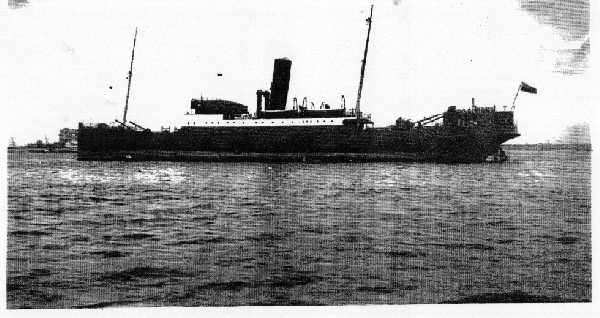
First , a photo of the Toward taken about 1936 or 1937, according to Sue Peake's note to me of 16 Feb. 2000. The Imperial War Museum could furnish no other information. Sue reports that the Ministry of Defence hired the Toward for the Ministry of War Transport. She was owned by the Clyde Shipping Co. and was built in 1923 by A. Stephens & Sons, Glasgow. She displaced 1571 tons, was 270 feet long, had a beam of 37 feet and drew 17 feet of water.
In this next photo. SS Toward shows two masts and a single funnel with no kingposts. Close examination of earlier generations of this photo reveal outrigging capabilities fore and aft. While on convoy duty in the Atlantic during World War II, U.S. sailors saw dozens of ships with counter sterns like Toward's stern.
Rescue Ship SS Toward
Here now, the three-page report Sue Peake unearthed from Britain's Shipping Casualties Section. This report covers the interview with Toward's Chief Officer, Mr. G.L. Campbell. This interview took place on 23 February 1943.
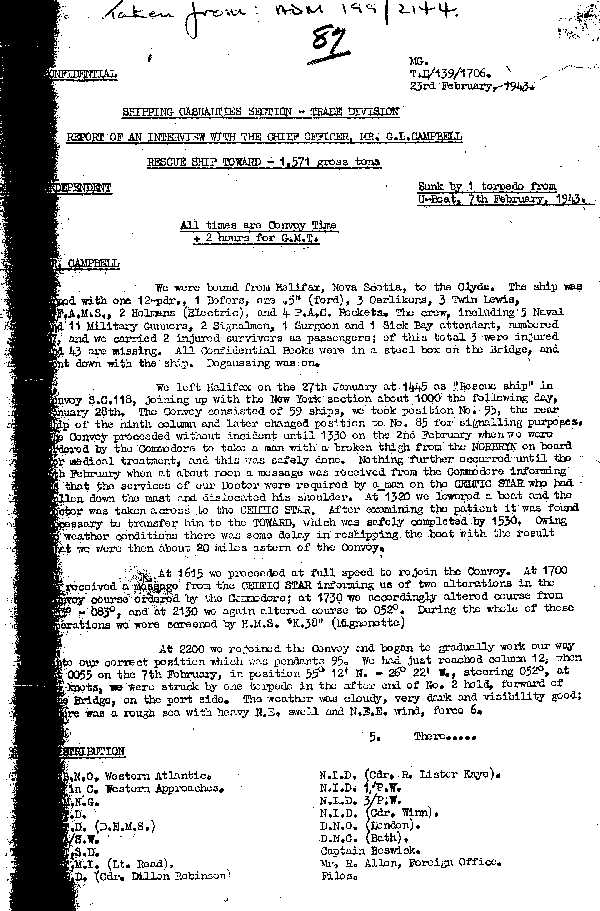
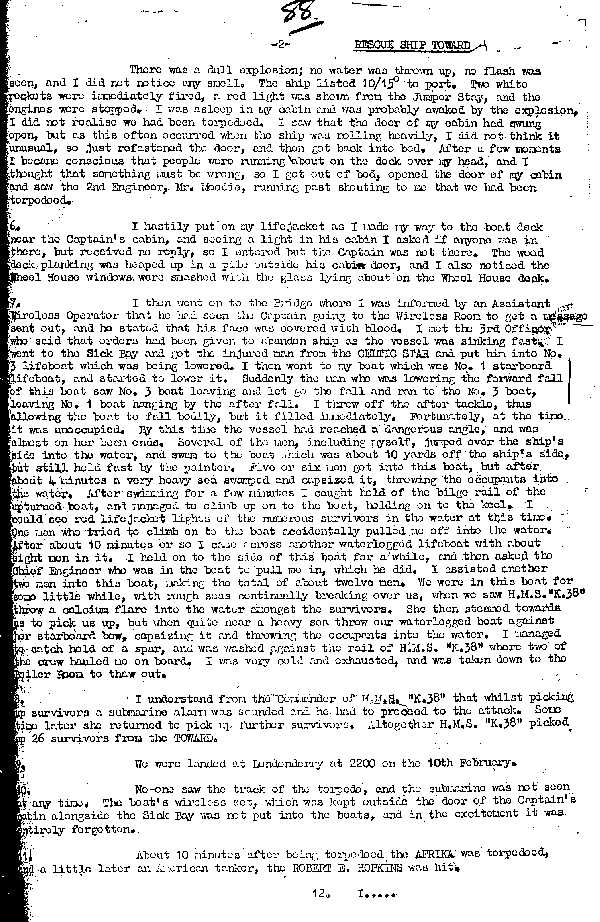
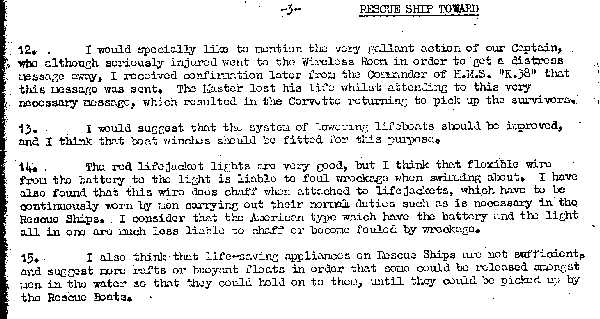
Author Franklyn E. Dailey Jr.'s comments on Sue Peake's contribution:
The three pages containing the report of the interview with Chief Officer Campbell obviously came from a bound volume. In reproducing those pages to forward to Sue Peake, the Ministry of Defence copy machine operator was not able to get a clear reprint all the way into the binding. The copy that Sue sent to me showed this unmistakably. In scanning the three pages to create this Appendix to the original story, "Joining The War At Sea 1939-1945", I left out most of the black vertical mark from the scanning field because it contained no information.
Who from the Celtic Star, or the Afrika ,or the Robert E. Hopkins are alive today to make this story more complete? Did Toward's 2nd Engineer, Mr. Moodie, survive? The report's Distribution names are intriguing. Campbell reported in his interview that the Corvette HMS "K.38" (Mignonette) picked up 26 survivors from the Toward. Very likely other survivors were interviewed. Whether any were on the distribution list for Campbell's interview, we do not know. But that Distribution List, even given the loss of information in the black streak due to the binding, still contains some interesting names. What role if any did Lt. Read, Cdr. Dillon Robinson, Cdr. R. Lister Kaye, Cdr. Winn, Captain Boswick, and Mr. W.H. Allen of the Foreign Office play in this fortune of war of 57 years ago? Finally, the fitting last disposition on the Distribution is "Files." That will remind any U.S. schoolchild in school during the first part of the 20th century of Files-on-Parade. Files' message in Kipling's poem "Danny Deever" certainly evokes the finiteness of life.
" 'Is cot was right-'and cot to mine," said Files-on-Parade.
"E's sleepin' out an' far tonight," the Color Sergeant said.
"I've drunk his beer a score o' times," said Files-on-Parade.
"'E's drinkin' bitter beer alone, "the Color Sergeant said.
Kipling's words for the Color Sergeant are likely intended as the final pronouncement. Most of us would predict a better than bitter outcome for heaven's beer than the Color Sergeant did. Not bitter, not sweet, but,..... beer. But here, bitter, may reflect Kipling's verdict on outcomes.
Franklyn E. Dailey Jr. February 24, 2000
I am indebted to Sue Peake and , and now to Christine Smith and Ray Brown, for providing information that furnishes the basis for this Appendix. These archived treasures are greatly enhanced when a daughter, or granddaughter, or nephew remembers, and shares them with us. This Appendix is not included in the published book as such, but may be downloaded by book purchasers to complete their file.
10/25/2008
From: Christine Smith
To: franklyn@daileyint.com
Sent: 10/19/2008 4:56:50 PM
Dear Mr Dailey,
I have just found you on the internet. I was looking for information on the ship Toward. My father was on this ship when it got hit and he jumped overboard and luckily was rescued. He had a glass of whiskey on the anniversary date every year until his death at 71. He was 17 years old when this happened. He was taken to a hospital in Ireland where he was treated by a czech doctor. My dad was from the Outer Hebrides and had "run away" to sea. His name was Angus Smith.
I wonder how I could get a copy of the transcript sent to you by Sue Peake. I would love to read it thoroughly but some of it is not legible.
Hope you can help.
Thank you,
Christine
Sent: 10/23/2008 3:47:27 PM
Subject: RE: 1903
Hi Frank,
Thank you for your response. I have tried again reading the log. (Refers to the Toward's log sent, by Sue Peake in 2000, reproduced in the first part of this web page.)I have made out most of it. I must say it gave me goose bumps as I remember my dad telling me that a ship came back to rescue the men in the water and then left. He thought that was the end for them and resigned himself to not being rescued, but as the log reads the ship returned and that was when my dad was picked up. I laughed too when mention was made of the life jacket lights; my dad told me his life jacket was on upside down and therefore the light was under water... "by his bum" in his words! He also mentioned that another guy who was with him, close by in the water, was pulled out of the water after him; they had jumped off the sinking ship together; he was hung by the rope that was pulling him to safety. The rope had twisted around his neck. My dad's injuries were very bad and he felt that he was lucky it was so cold in the water as this stopped the flow of blood. He had caught his arm on the propeller of the ship and had a big hole in his arm. We later found a "little black book" which my dad had kept for years and it contained names of lots or Irish nurses...he was a handsome devil. Funnily enough, he ended up marrying an Irish girl that he later met while on leave in Southampton. She had left Ireland to work in an ammunition factory in Southampton.
Thanks again, I look forward to hearing from you.
Christine
Ray Brown is the nephew of Harold Martin, lost when RS Toward was torpedoed. Ray forwarded a series of photos he took in a memorial complex in London honoring World War 1914-1918 losses, and World War II 1939-1945 losses. The plaque honoring those lost, when RS Toward was sunk, is in a wall of plaques too large to effectively show in just one photo. Here are Ray Brown's words in two October 2008 e-mails to the author:
"Frank
You may recall that we exchanged e-mails about a year ago regarding RS
Toward featured in one of your books. I am researching my late Uncle Harold
Martin who was killed when Toward was sunk, and your book has been
invaluable in my endeavour.
Last week I was able to visit London (UK) and sourced a plaque recording
Toward and all those who perished. The attached image is of the plaque (see below) which
I thought might be of interest to you.
Kind regards
Ray"
And from the second October 2008 e-mail from Ray Brown:
"The memorial is near Tower Bridge in sight of The Tower of London. It takes
the form of a building which records merchant losses for the 1914-18 war.
Behind that there is a memorial garden which records the losses for the
1939-45 war. The memorial is in alphabetical order of the ships lost. If I
had not learned of the ship Toward it would have been quite a long visit as
there are in excess of 25,000 names for (British merchant seaman lost in) World War 2.
I took quite a few pictures as the annual remembrance service for the
Merchant Fleet had taken place a short time earlier. The military
remembrance day in the UK is 11th November with services taking place on the
nearest Sunday in most villages, towns and cities throughout the country."
That number 25,000 Britsh merchant seaman lost in WW II in Ray Brown's second e-mail stretches the mind beyond comprehension. (Ray subsequently determined the number may be an undercount.) I followed the news each day (1939, 1940, 1941) in the pages of the Washington Post while I was a Midshipman at the U.S. Naval Academy until graduation on June 19, 1942, and then more closely followed the news of ship losses when I immediately was at sea in the North Atlanttic and Mediterranean on the USS Edison DD-439, a destroyer guarding convoys and bombarding shore defenses when our men went ashore. This is all told in my book, "Joining the War at Sea 1939-1945." I recall tankers sinking ,and our Atlantic beaches overflowing with oil. I recall sinkings in words, 'several per day.' Even then, the number of just the merchant ships the British lost, 5411 is the count in one archive, is simply hard to grasp even if one were a participant and observed some of them sinking.
Here is the Toward memorial plaque that Ray Brown photographed.
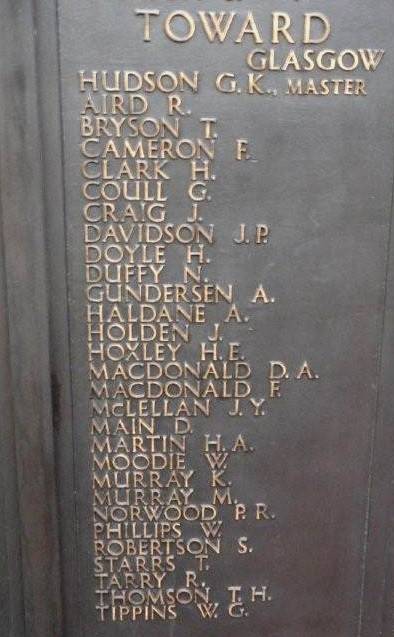
This web page update is occurring November 11, 2008. We remember Harold Martin and his shipmates.
In early 2012, I learned that Toward carried an active HF/DF equipment manned by experiences radio technicians. Before radar, HF/DF was the primary method of triangulating on German U-boat radio transmissions, so that in effect, they were giving awa;y their own position while they were transmitting particularly as they attempted to exercise wolfpack tactics.
Ray Brown also took a picture of HMS Belfast, a British cruiser of World War II, alongside a dock in the Thames River near the Tower. I saw her on a visit to London, probably in the 1980s, and I believe she was anchored out in the river at that time.
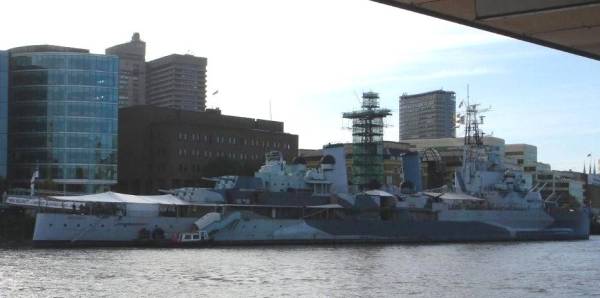
Ray Brown's photos let us remember both the merchant seamen, and the Navy seamen, that the British sacrificed in the effort to defeat powerful Axis nations in the second World War.
Let me (your narrator here, Frank Diley Jr.) close these revelatory contributions to WWII history with words I used in an e-mail to Christine Smith. "The Toward did magnificent work in the most desperate time for the ASW effort during the neutrality patrol days of World War 2. I certainly admire the sacrifice made by each and every crewman aboard those vessels. Their work really paid off and they performed under the most trying conditions of habitability, many on outdated ships, in the absolute thick of the U-boat menace."
I know I have left errors on these pages. My eyes are failing and it is time to say goodbye. Frank Dailey Jr.05/04/2015
Home | Joining The War At Sea | Triumph of Instrument Flight