Joining the War at Sea 1939-1945
- Draftees or Volunteers
- U.S. Military Draft and Pearl Harbor
- Warship Building
- World War 2 U-Boat
- Collision at Sea
- Operation Torch
- Sea-based SG Radar
- Attack Transports Sink
- Assault Landing
- Tiger Tank
- Darby Rangers Setback
- Eisenhower Needed Seaports
- Rohna Sinks; 1000 Soldiers Perish
- Death, Survival, and Leyte Gulf
Rohna Tragedy Tops Transport, Destroyer Toll
300 warships/transports in "Joining the War at Sea" listed alphabetically
WW II Destroyer Engine-room Throttlemen controlled 50,000 horsepower! When the Captain barked, the Annunciator bells spoke! Steam Turbines screamed.
"Bud" Cloyd was Editor of a leadning Indiana city daily paper and found himself scooped up into World War II as throttleman on a U.S. destroyer. He tells of this experience in Appendix A to the book, "Joining the War at Sea 1939-45. As the book's author, I had enough sense not to change a word.
Dont't miss Part II on this page to see how the History Channel's mistaken identity gives a rare look at another ship's launch.
Copyright 2015 Franklyn E. Dailey Jr.
(The links down the left column of the page take you to excerpt experiences from the published book, to which the author has been prifileged to add reader offered historical experiences stimulated by the book. )
In quotes below, is Bud Cloyd's letter dated January 15, 1999. He is the throttleman in this USS Edison DD-439 destroyer story of WW II. When a destroyer's bridge calls for an abrupt (e.g. five knots) change in the ship's speed, the signal to the engineering spaces (formerly known as the 'black gang' in the coal-fired days) is sent by a two handled "annuunciator' on the bridge of the ship, which produced a loud clanging sound, and is received in like fashion by the "throttleman" down below in the engineroom; the throttleman responded in kind, with a duplicate loud clanging sound device. The book that Bud Cloyd comments about in his first paragraph below is now in its 4th Edition 2009 (ISBN 0966625153-see cover photo) and there is a link in the upper left on the screen. Bud is now, as are most of his shipmates, deceased. Cloyd's remarks to this author were especially appreciated because in civilian life Bud was, before the war and after the war, the Editor of the Lafayette, Indiana, newspaper.
Editors are writers who began their careers writing, were recognized for their talent, and were promoted to edit responsibility. But war mixes things up. Bud Cloyd, without complaint, took his throttleman assignment, an enlisted man's role, and did his job and did not complain. I was a ship's officer, having arrived at the position by virtue of graduation from the U.S. Naval Academy. I wrote the book pictured at the beginning of this page. My prose could never match Bud Cloyd's letter recalling Edison experiences. I offer these remarks mainly to encourage readers to enjoy some first rate writing.
/s/ Franklyn E. Dailey Jr. Capt. USNR (Ret)
The following was.authored by Bud Cloyd, newspaper editor in civilian life, throttleman of a six combat -tarred destroyer of WW II.
" I planned to write in response to your absolutely marvelous book. I found that laying it down--even to eat--was a challenge. I laughed, I cried, I called my neighbors, I talked to Harry Russell (a wartime shipmate) for two hours on the phone, I wrote cards--I WENT NUTS! Damn--it was just great. My neighbor across the street served on an APA. His service included trips to Oran and Mers-el-Kebir among others, escorted by 1630-ton destroyers like the Edison. Another neighbor "flew the hump" with the Army Air Corps--so we three could appreciate every page to the utmost.
"Your almost casual approach in describing entry into service and the many experiences therefrom certainly parallel all those of myself and most all of the World War II vets that I have known. We never felt heroic, sacrificial or any of the assortment of other feelings as a result of our going to war. You expressed your feelings beautifully.
"Over a span of many years, I corresponded with the Edison's skippers, and regularly with Captains Al Murdaugh and Hap Pearce. I received quite a nice letter from someplace in Europe from Captain Caspari. I served only briefly with him, thank heavens, as we were approaching the Kyushu invasion with more than dread. All of us old-timers felt we would never make it from that operation. I left the ship at Saipan for transportation to the States on a beautiful, nearly new APA that had a soda fountain and NO water hours. What a treat that was. In one short letter, Captain Murdaugh apologized for not being able to attend one of the ship's reunions because of an impending hip operation. 'It might be that I'm seeking a miracle.' he stated, I have always believed in miracles since the occasion the German sub fired a torpedo at us --point blank-- and missed.' That is one of those offhand remarks direct from our little ship that will make the hair rise on your back after you have given it appropriate thought.
"Your book adds a new dimension to all my memories of the Edison in that they come from the viewpoint and experiences of the officer corps and many of your reports are somewhat different from those of the crew. You are well versed in much of the action that we were just not privy to-- especially we who were below decks in the engineering spaces. All that we were aware of was that we answered the bells and hoped for the best. Let me tell you that answering (Captain) Hap Pearce's bells could be a hair-raising experience. It was not at all uncommon to be steaming flank ahead at 294 turns and get a full astern port, which was our screw in the after engine room. How well I know as a former Edison throttleman. Hap could not only provide us with a great thrill occasionally; he could also occasionally scare the living hell out of a guy. Hap's abilities as a seaman almost became legend. In thinking back, after all these years, and reading your book that describes things from a wardroom standpoint, I have reached a shaky conclusion that maybe, just maybe, the Edison was not quite as lucky as the crew gave her credit for. Our good captain(s) and some officers quite possibly created some of the narrow escapes we were blessed with.
"It was my great good fortune to develop a treasured friendship on board with Joe Ouellette. While we rarely got a chance to visit aboard ship, several years later my wife and I spent a few days at Joe's home in Albany, NY, where we consumed great quantities of Jim Beam and held discourse far into the night on shipboard experiences. If we had a "Mr. Roberts" on the ship, Joe, of course, was it. He was a wonderful guy, who as far as I know, never put anyone on report and God knows he covered for a multitude of overleave drunks when he was doing his hitch as OD. Joe never saw a crap game or a poker game that he couldn't ignore and members of the crew owed Joe enough favors to last through three lifetimes. He was one of only many fine officers we were blessed with, however.
"The crew of the Edison enjoyed considerably more freedom than some of the destroyers did. I remember one, for instance, concerning either the Trippe or the Wainwright (we operated with both, of course). Their captain decreed the evening chow required uniform of the day and Friday field days--something unheard of on the Edison. You should also remember the Skipper never believed in Saturday (weekly, as provided by the "book") inspections but rather let us know that if we did our jobs as he expected us to, inspections weren't necessary. Let it be made a matter of record that NOBODY was allowed to let Hap (Captain Hepburn A. "Hap" Pearce) down. Our morale was extremely high and our performance exemplary.
"While Stan Craw (Pearce's Executive Officer) was somewhat "standoffish" from the crew (he had to be to enforce law and order) at the same time he was a darn nice guy in my book. He has written to me numerous times and I receive a Christmas card from him every year. I sent him a note calling attention to the fact that I must be the last remaining enlisted man from the World War II Navy to receive a Christmas card from his XO. How about that for morale?
"One little sidelight from our visit with Joe Ouellette concerned my wife who said later, "I thought all those sea stories I've been hearing for years about you guys and the Edison were a bunch of lies and big stories. Now, according to your favorite lieutenant, who told all the same stories, they're actually the truth!" Also, at my begging, Joe gave me a framed 11x19" photograph which I spotted in the basement while my wife was doing the laundry. It was the old cruiser U.S.S. Seattle, remembered by thousands of sailors as being tied up at Pier 92 in New York City.
"Getting back to some of those officers we shipped out with--some of them were really great guys in spite of some of the crap they had to put up with from a few bad apples in the crew. Hall, Dwyer and Hostvedt were fine engineering officers. Pearson was another great guy to work with. Everybody loved A. J. Waechter, master of the provender and scavenger extraordinaire who could smell a supply ship out like a 'coon hound. Always seeming to keep a low profile was Ed Meier, who after the war became a close friend and delightful correspondent. One day he came by my office here in Lafayette (Indiana) and we visited for two hours. Johnny Ward also showed up one day and I still have some of the pictures he left me.
"Speaking of Ed Meier reminds me when Captain Pearce (stoned to the gills and mad because someone did not honor his request for beer for the crew) decided to demonstrate to everyone in the MEK (Mers-el-Kebir, Algeria) basin how a true Ship of the Line could get underway with a flourish. In the after engine room, I was on pump watch, Renslow had the top watch, Tony Colpo was on the throttles and some newcomer fireman second was the unfortunate victim of an indoctrination experience as messenger of the watch that he would never forget. In fact, I don't think he was able to even recover his voice and composure for a week.
"We had been idling at the pier, singled up (the lines had been reduced from double to single) and spinning engines awaiting Hap's return from wherever captains disappeared to when ashore. The Edison was a picture of total serenity when someone yelled down the hatch, "Here comes the skipper and he's mad as hell?"
"Simultaneously with "Cast off" we got our first bell and engine order for one Third Ahead Port and immediately the stern of the ship left the pier. All of us in the engineers were so familiar with Hap's docking bells that once we received that first bell everything else fell into place automatically. None of us, however, had the vaguest notion of what was to happen when we floated away from the dock some 200 feet. The next bell was Flank Ahead Starboard and Full Astern Port and all hell broke loose. It is to be remembered in naval engineering this procedure is for extreme emergency, not routine getting underway. The Edison reared up on her fan tail, burner "batters' in the fire rooms became hysterical, safety valves chattered against their restraints, throttle men did a valiant though losing effort to keep from hurling boiler water directly into the turbines and it was surprising the main blowers didn't hurl unburned fuel through the stacks. What a mess?
"Within what seemed to be moments, though it had to be longer than that, we were headed for the sub nets (drawn across all harbor entrances) at flank speed. Two sub net tender crewmen dove over the side in a fruitless effort to get away from a destroyer run amok. Meier said he was nearly petrified as the ship headed out and appeared to be heading directly toward the shoals that lay at the foot of the well remembered cliff off to the starboard. Nobody questions the captain's orders, of course, so Ed said he surreptitiously managed to get the helmsman to gradually ease the ship a bit to port. The Edison's wake nearly swamped the net tender. Meanwhile back in the after engine room, we were trying to restore order which involved sliding the upended floor plates back into their regular position, checking for exploded gauges and retrieving the Joe pot, which had upended and rolled nearly to the bilges.
"It was often said that the reason the Edison turned out to be such a fine performing little ship was due to the commissioning cadre of outstanding Chief Petty Officers who really knew their seamanship. These men were also credited as great instructors for the largely boot camp crew that took the ship to sea on her early runs. I never was privileged to know the man but from the stories I heard about Chief Bos'n Carajohn, the old boats did everything but walk on water. The standards established by the first chief machinists for cleanliness and maintenance, not to mention the all-around physical effort on the part of the rates and strikers, resulted in the fact that the 439 could outrun every ship of her class. We all took great pride in that.
"Captain Pearce most definitely wished to keep a good crew together. The result was, getting promoted in rate was a tough proposition. Our transfers to new construction were scarce indeed and this led to some unrest among a few senior crewmembers but it eventually worked itself out. The reluctance to rate and transfer led to some strange situations at times. As far as I am able to determine, I may have been the only third class machinist in the Navy to stand throttle watch and my buddy Dick Braziel may have been the only second class metalsmith to do likewise. Where we got a second class metalsmith was always a mystery.
"One humorous exception to rare promotion involved one "Salt Spray Ray." He was a seaman first with over ten year's service. Perhaps you will recall him because he was one of the ship's "characters." In all his long service, no one had been inspired to rate Ray who was becoming a little long in the tooth for a plain seaman. He never was a striker for anything, coxswain, ship fitter, radioman or gunner's mate. To find a place for the guy, our bos'n first at the time, Galensky (famous for his clean snow-white cap daily) assigned Ray to the paint locker with the admonition to run it to the best of his ability. Strangely, "Salt Spray" loved the place and became an acceptable mixologist for whatever paint the Navy had available at the moment. Everyone considered Ray's case now satisfactorily closed--all except Hap Pearce and Stan Craw. They decided that Salt Spray's assignment was akin to durance vile and that he should be accorded recognition. Thus it came about that Salt Spray Ray was "promoted" to Painter's Mate Third Class, a rate created on the spot especially for Ray. Salt Spray was directed to wear a shipfitter's badge from thence forward.
"As a member of the No. 3 gun crew and handler of those five-inch projectiles with hours of experience (those dudes could be darn tricky) I was one of the culprits who smashed those white pine crates on the deck of that little non-descript coastal freighter you referred to. When us guys picked up the first half dozen boxes and slammed them on that steel deck, those foreign crewmen took off running like their butts were scalded. I don't know where they thought they were going but we guys got a big laugh out of the incident. Those men couldn't communicate with us and we had no way of telling them the projectiles were harmless until fuzed. Notwithstanding, when those same projectiles were thrown in rough weather from the ready room racks and rolled and tumbled for hours on end, it was unnerving. If it wasn't the projectiles loose, it was the depth charges rolling and bouncing loose on the fantail. Also, while trying to get a couple hours of sleep, it was most disconcerting when the midships slip joint decided to tune up and squawk away for hours. That slip joint was a vital deck accessory to prevent the ship from splitting in two in heavy seas.
"My wife and I are in the photo of the Ship's Party taken in the Crystal Room of the Hotel Ritz-Carlton in New York City. I have a couple of originals here in my stuff. Hell's fire, Frank, I've kept everything. In our family room, hangs and 11x14" of the Edison in color (the one passing under the Brooklyn Bridge). It is framed in white oak and on the frame is the "U.S.S. Edison" nameplate from the telephone system in the electrician's shack. Ted Rykowski got it for me in the Philly navy yard when the ship was there for scrapping.
"I certainly have enjoyed your notes, thoughts and loved the book. All the best in the world to you and if you ever pass through or near Lafayette, Indiana, we're easy to find in the phone book. Sincerely and very best wishes An old shipmate, Bud Cloyd."
Part II. A Case of Mistaken Identity in a History Channel episode provides those interested in the history of the USS Edison DD-439 a look at her when first launched. Story Below.
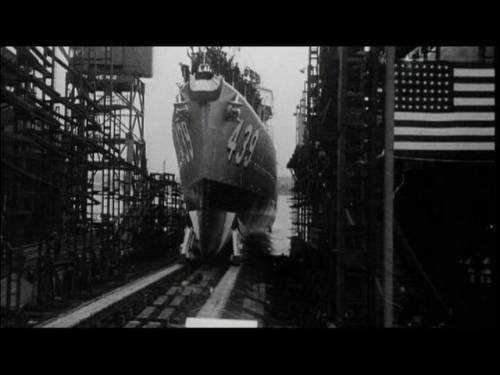
The USS Edison, DD-439, sliding down the ways at Federal Shipbuilding and Drydock in Kearny, N.J. in November 1940. Sister destroyer, USS Ericsson, DD-440, was built right beside her.
Claud M. "Mickey" Mick III, son of Claud M. Mick Jr., a USS Edison DD-439 crewman in 1944, contacted me after viewing a TV broadcast labeled, Segment 4, in the Military Channel TV series, "Quest for Sunken Ships." The photo above is from a clip that appeared in Segment 4, which dealt with events in the life of the Navy's World War II destroyer, the USS Murphy, DD-603. Mick's attention became riveted on the launch scene in the film, and he realized the ship being launched was not the Murphy, but his Dad's ship, the Edison. Mick contacted the TV producers, who obligingly supplied him a DVD of the Segment 4 broadcast. The sequence likely came from Navy footage of Edison's launch, and then was used as Murphy's launch. Who would know the difference? TV viewers in late 2007 or early 2008 would have found the series in local TV schedules. Count the stars in the flag.
Up on the launch platform, Thomas Alva Edison's widow, has just completed smashing a champagne bottle on Edison's bow. She had been assisted there by her son Charles Edison, who had just resigned as Secretary of the Navy and was running for Governor of New Jersey, an election he would win.
Edison was commissioned at the Brooklyn Navy Yard and went to sea in early 1941. She served in the ASW screen of convoys before and after the U.S. entered the war. Edison was a key gunfire support destroyer in all five North African and Mediterranean amphibious landings, Casablanca, Sicily, Salerno, Anzio, and Southern France. She earned six battle stars in Atlantic/Mediterranean actions and moved to the Pacific in 1945 for the final year of the war. Edison was mothballed at Charleston in 1946, then scrapped, back again in New Jersey, in 1971.I was her last Gunnery Officer to fire salvos in anger, and retrieved Edison's museum artifacts, the ship's helm, her bell, her flags, and a torpedo gyro, for storage in the Museum aboard the
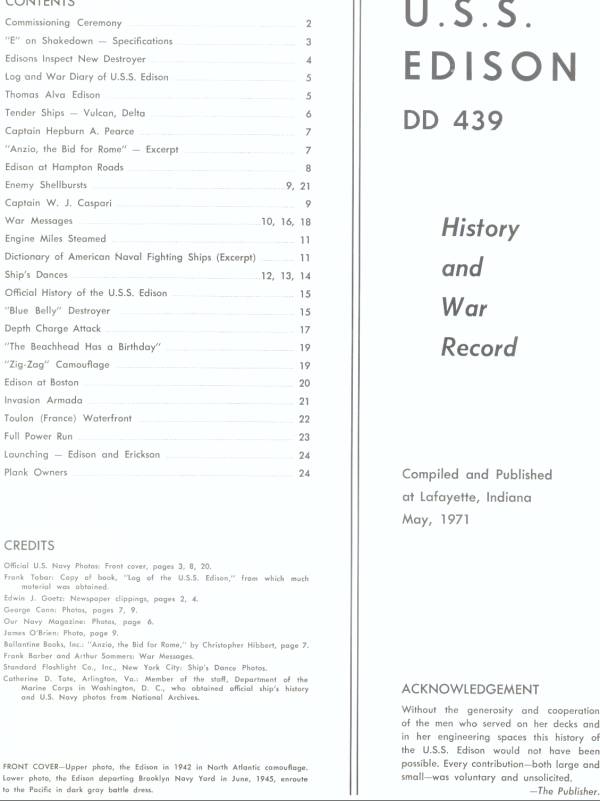
Bud Cloyd did not give up Edison watchstanding when that ship was laid up in the reserve fleet at Charleston SC. In 1971, he edited the "History and War Record." Here are the cover sheet and the 'credits' page, in that order. Here are Exhibits TWO, THREE and FOUR.
Exhibit TWO
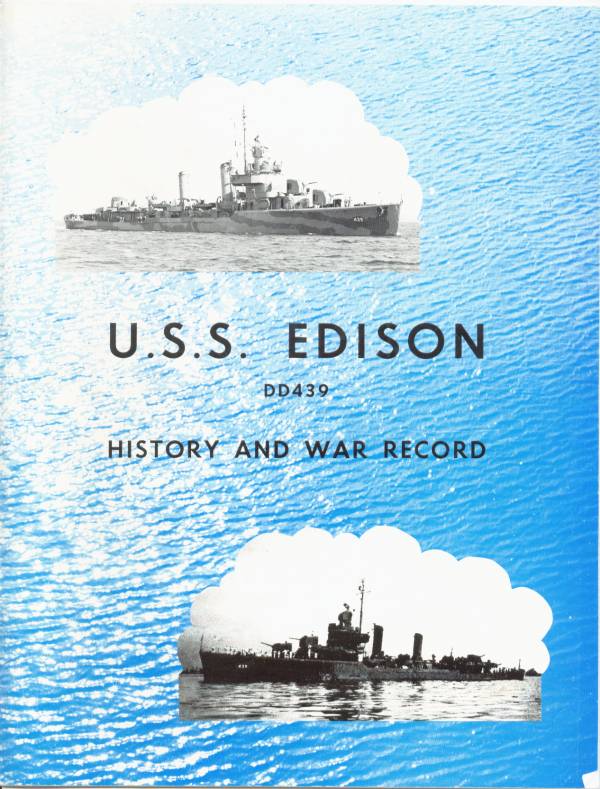
Exhibit THREE
This is the 'credits' page of Bud Cloyd's publication, cover shown above.
Bud Cloyd also became the creator and first Editor of the U.S.S. Edison Newsletter. Bud edited this newsletter which appeared several times each year for many years before the entire Newsletter effort became Jean Whetstine's responsibilty. Jean, of Byron, Michigan is the widow of Edison Torpedoman, Larry Whetstine. Jean has carried on the Bud Cloyd's tradition of writing and editing of this regular appearing newsletter.
Exhibit FOUR is the front page of Jeans' 12-page July 2010 edition. So, Bud and Jean share Exhibit FOUR but the full text of the July 2010 issue was created and edited by Jean Whetstine as have been hundreds of Issues that preceded it..
Exhibit FOUR
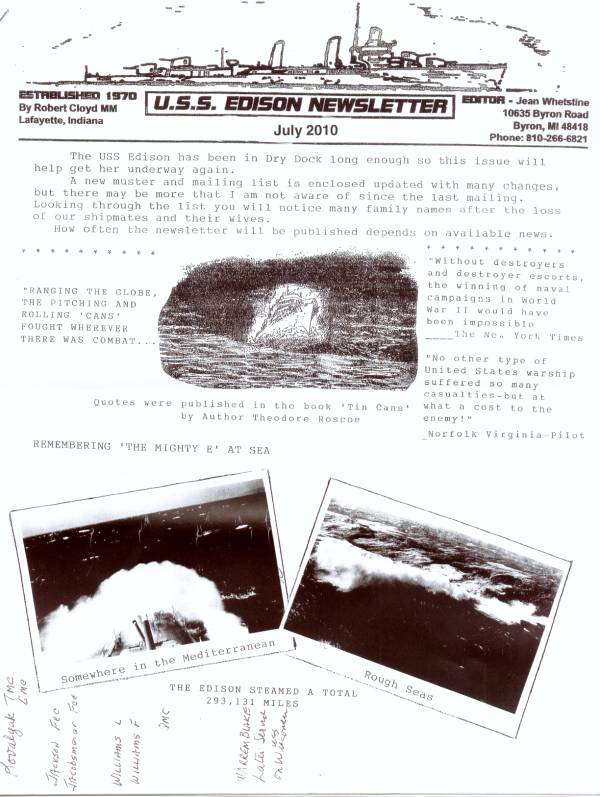
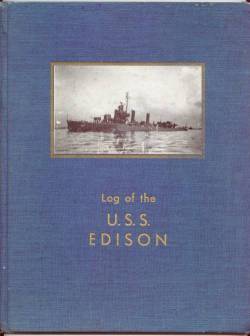
Exhibit FIVE-Russ Rossell's "Ships Log" Russ Explains its origin: We include one of his inside pages after the cover.
"We were in Seattle when I was approached to have the Ships Log made and it was a good deal as the government was paying for the printing. All I had to do was furnish pictures, history, and names of the crew etc. As a result I started taking candid pictures of the crew at work and play and also asked for copies of any pictures members of the crew had. John Ward did the Log which took him some time as he has to go bck through the actual ships logs to get the data and information. about the ship.
"I had the pictures of the crew taken in Adak, Alaska i.e. each Division. They were all taken the same day and it was cloudy and cold. The 35 mm camera I used for the pictures was a lot of fun as I got my film over at the Navy yard in Charleston which was from the left overs of full reels of new film. I measures the length of a 35mm roll of film in a cartridge with a string and then woould then pull that length from the bulk roll and put it in the 35mm cartridge to fil it up. So I didn't have to buy film for the pictures. There were a few pictures that had perforated holes in the film that I didn't know about and I got pidtures with holes in them
"The art work, layups and final dummy copy was made in Chaleston for the final draft and printing. I might add that I was fortunate to get it all done by February 1946, as I was transferred to the U.S.S.Steinaker (DD 863) and picked her up in Guantanamo Bay Cuba in early March. Capt. Samuel A. MacCornock, USN was from Iron River MI. I was not only the Mess Treasurer ,having has previous experience on the Edison, but also the Ship's Bard. But that is another story waiting to be told.
/s/ "Russ"
The Russ of the e-mail quoted above is Russ Rossell, who has given us the best chronicle of the USS Edison in the Pacific for 1945 in the waning months of World War 2. His "Log," cover reproduced below, also contains the only serious effort to photograph and give a name to, all crewmembers of the Edison during those last months of the war, and the postwar until the Edison was 'laid up' in the reserve fleet in Charleston, SC in 1946. Russ took the care to have a credits page in this hard cover, slick paper booklet, to creidt those who assisted in the publication. All the Commanding Officers are listed as are all the Chief Petty Officers who served, along with the officer list for the time in the Pacific. Earlier officers, almost all long detached from this ship, are not listed. Russ shows himself to be just as serous and thorough an editor as Bud Cloyd and Jean Whetstine have demonstrated for the periods they covered.
The USS Edison, DD-439, a Livermore class DD with four 5: 38 cal guns, 10 torpedo tubes in two mounts, stern and K-gun depth charges, and 50,000 shaft horsepower, driving two screws, has been memorialized in print as well as any ship that servied in WW II,
Herewith, a photo of the hard cover of Russ Rossell's "Log of the U.S.S. Edison." This mini-book contains 22-pages of crew photos and roster names of those who served on the USS Edison DD-439 during its Pacific cruise in WW II in 1945 which was the last full year of steaming for this Livermore class foc'sle deck destroyer.
What follows is a sample page in the Log above:
C Division USS Edison DD-439 in her Pacific service in World War II Courtesy Russ Rossell, Editor "Log of the USS Edison"
(Russ Rossell served aboard the USS Edison as an officer during her Pacific Cruise)
Standing: Towne, Pola, Akin, Earnhardt, Ligman, Giovanucci, Holcombe, Mr. Ward.
Leonard, Gooding, Waters, May, Migliaro, Fedoryshyn, Allen, Sullivan, Sommers, Carmichael, Remley, White, Munn, Meyers, Mitch, McCauley, Reagan, Couch.

The USS Edison cruise of 1945 in the Pacific bracketed war and peace. From Russ Rossell's log I have selected the page containing the C Division photo above.
EXHIBIT SIX (based on two photos)
Discovering the the USS Edison was going the shipbreakers in 1971, two of her original crewmembers obtained permission from the Navy to go aboard and retrieve some artifacts. Among them were a torpedo gyro, an annunciator for a poison gas attack, flags from the ship's flagbag, the ship's helm and the ship's bell. These physical artifacts recovered from the Edison were installed in a Museum built for that purpose alone by another Edison sailor, a Machinist Mate named Signore. He obtained a "Quonset Hut" and installed the items for viewing . When Signore's (2nd)wife decided to move to Florida after his death, she contacted me to give me a heads up that she planned to tear down this museum prior to sale of her home. With one of my; sons, Paul Dailey, and his sons Nick and Josh Dailey, we went to this informal Museum and retrieved these Edison artifacts. We then went to Fall River Massachusetts and contacted two volunteers who worked on the USS Massachusetts and the USS Joseph Kennedy, tied up there for viewing, and these men agreed to have the Edison artifacts stored aboard the Joseph P. Kennedy. Some years later the Edison annual reunion was hled there and these artifacts were brought up for display for Edison crewmen and families attending the reunion.
Here are two photos containing the Edison's helm and her bell.
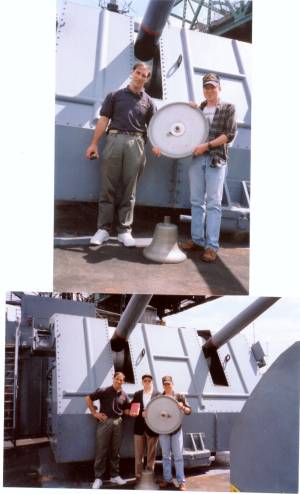
Taken about May 2000, I, Frank Dailey Jr., am the center one in the lower photo. The backdrop is the Joseph P. Kennedy's dual 5" AA mount.
I am Franklyn E. Dailey Jr. Capt. USNR (Ret) and you are reading this is on a website I created in the 1990s, with the help of partner Morris Rosenthal. The cover of my own record of the North Atlantic U-boat war, and the five amphibious landing operations that Edison supported in the Mediterranean, 1942-1944, follows in EXHIBIT SEVEN.(This is the cover of the Fourth Edition 2009 of that book.) The publications pictured on this web page constitute a record of the service of the USS Edison DD-439, built and launched at Federal Shipbuilding and Drydock in Kearny NJ, before U.S. entry into World War II. This Gleaves class foc'sle deck 1630-ton destroyer was christened at her launch by the widow of Thomas Alva Edison assisted by her son, Charles Edison . shortly to be the Gpvernor of the State of New Jersey. The published artifacts shown on this web page, less the two photos of EXHIBIT SIX, will be sent to the Edison-Ford Museum at Ft. Myers, Florida before the end of 2012 and will be available for perusing in that Museum's library.
EXHIBIT SEVEN
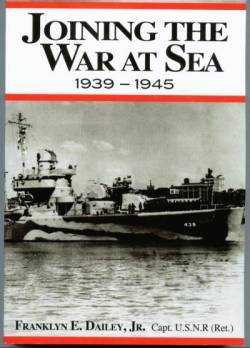
This is the cover of the 457-page Fourth Edition which issued in 2009, with its 47 page Index by Dutch scholar, Pieter Graf. Order information is at the beginning of this page. This book's actual measurements are 6" x 9" by 457- pages. On the cover, the USS Edison DD-439 had just passed under the Brooklyn Bridge going upstream in the East River.
Home | Joining The War At Sea | Triumph of Instrument Flight