The new Fourth Edition with 44-page Index
Joining the War at Sea 1939-1945
- Draftees or Volunteers
- U.S. Military Draft and Pearl Harbor
- Warship Building
- World War 2 U-Boat
- Collision at Sea
- Operation Torch
- Sea-based SG Radar
- Attack Transports Sink
- Assault Landing
- Tiger Tank
- Darby Rangers Setback
- Eisenhower Needed Seaports
- Rohna Sinks; 1000 Soldiers Perish
- Death, Survival, and Leyte Gulf
Rohna Tragedy Tops Transport, Destroyer Toll
300 warships/transports in "Joining the War at Sea" listed alphabetically
Draftees or Volunteers. World War II needed them all.
All-volunteer armed forces bring criticism of draftees. In Part I.
Midshipmen marching at Bancroft Hall. Four Views. Before WW II. In Part II.
Copyright 2015 Franklyn E. Dailey Jr.
Author invites your comments
Part I. Doubts appear in the U.S. press about critical aspects of its conduct of World War II
(Note: The Author entered the U.S. Naval Academy in 1939. His only service prior to entering was a stint as a student at Niagara University 1935-37, in the CMTC, Citizens Military Training Corps. After graduation from USNA in June 1942, in a war-shortened three year course of studies, the author went to sea on the destroyer USS Edison, DD-439. He served for 27 months, in Atlantic convoy duty and in gunfire support for landings at Casablanca, Sicily, Salerno, Anzio and Southern France. In Oct. 1944, he was ordered to Navy flight training.)
The Smithsonian Institution mounted an exhibit in commemoration of the 50th anniversary (1945-1995) of the dropping of the atomic bomb on Japan. A section of the Enola Gay, the B-29 aircraft that dropped one of the two atomic bombs on Japan, was re-assembled for display in Washington DC. What the exhibitors actually undertook to portray around this aircraft artifact was the act of an aggressive nation, the United States, against a beaten enemy, Japan. Indignant U.S. veteran's groups and others learned from news media of the plans and the Smithsonian then made some modifications to its version of "history". About this same time, some other elements of society obtained publicity for their view that the Holocaust, memorialized in another museum display in Washington DC, did not really occur at all. I wanted to believe that the silent majority, at least those in a free press country such as the United States, would be more active in countering such attempts to re-write history. The public's tepid reaction to these news stories surprised and saddened me.
One vigorous defender of historical fact during this reporting period (centered on 1995) was the Wall Street Journal. By 1997, however, readers of the Journal began to take note of articles by a staff reporter named Thomas E. Ricks who also carried a byline in the Atlantic Monthly. Mr. Ricks has written frequently about matters that affect the U.S. military and has been particularly applauded for articles on military personnel. On May 30, 1997 under the headline, "Latest Battle for the Military Is How Best to Deal with Consensual Sex," Mr. Ricks included the following paragraph in an otherwise excellent article on this complex subject:
"A key fact about today's U.S. military is that military experts generally agree it's the world's best, arguably for the first time in history. So today's generals aren't just being politically correct when they express support for the gender-integrated military. They also would rather command a force of competent volunteers of both sexes than the main alternative-a force of less-trained and sometimes surly male draftees."
That last sentence, particularly the phrase "sometimes surly draftees", revealed that Mr. Ricks and the Journal were involved in a bit of history re-writing of their own. Only the Wall Street Journal knows how the paragraph ever got by its editors into a Journal feature article. The phrase had no relation to Mr. Ricks' central points. Neither the Journal nor Mr. Ricks responded to a letter I wrote to the Journal about it. It is not objectionable to find "today's generals" proud of their forces. Ricks does not identify any sources in the group, "they also would". The reader is left to guess why the last sentence ever goes beyond "a force of competent volunteers of both sexes" to disparage "sometimes surly male draftees." Denigrating three generations of draftees in WW II, Korea, and Vietnam, by suggesting that they could "sometimes" be surly might have come from some of today's generals, or from one of today's generals, or from Pentagon gossip. It's a bum rap. (In the Foreword to my published book, a reader will find an even greater disparagement of volunteers by another prominent columnist in a public newspaper. (Author Ricks later sent me an e-mail in which he emphasized that he was reflecting Pentagon prevailing thought at the time.)
I have never met a surly draftee. In 1968, two wars after the one providing the backdrop for this story, one of my sons "volunteered" for duty in the Vietnam conflict as he was about to be drafted. (He served as a tank commander in Vietnam in the Pleiku area.) The line can be very faint between draftee and volunteer. It certainly disappears in the body bag. I have met many young men, spanning three generations, caught in the same circumstance as my son. The soldiers, sailors and airmen of the Korean and the Vietnam conflicts, on the eve of their being called to duty for their country, were no different than the young men "sweating" duty in WW II. When I think of the sacrifices these men have made, and the conditions under which they fought, it occurs to me that most of today's generals, writers and editors are not likely to have had contact with those draftees except by reading about them. So, generals, writers and editors, currently active in your professions, read what I relate. (Another son volunteered in the early1970s and became a tank commander in Europe's cold war.)
All Volunteer Armed Forces-July 31, 2011. Readinesss Doubt Dispelled. Now, "Too Ready?"
By July 2011, as we approach the 10th anniversary of the three-pronged attack on our country of Sept. 11, 2001,, our nation has been engaged in Afghanistan and Iraq since 9/11. Thoughts on the largely draftee complement with which we fought World War II, Korea and Viet Nam, continue to occupy my mind. We have had our all-volunteer Armed Forces now for long enough to reflect on that aspect of our war readiness. Surely, we are much more war ready. The 'ready at all costs' part of our society deserrves some thought. In World War II we could expand on a small base of professionals, but we faced a challenging build up The draft has been messy politically, at least since Woodrow Wilson's need in 1917..
Now, with the "all volunteer" Armed Forces, the Generals have their troops, ready to go. The President has his Generals, ready to go. Have we become, too ready to go?....
Part II. Pre-World War II. Views of the U.S. Naval Academy.
1937-38 Photo Views of the U.S. Naval Academy.are the feature here....
The Midshipman Cruise of 1940 (avoiding Europe's War, and the end of prewar cruises)................Doubts Appear in the U.S. Press About Critical Aspects of Its Conduct of World War II.....My Douhts About the All Volunteer Armed Forces-July 31, 2011...A Ship's Story, Enriched by Feedback, Revisited ....."going to War" ......................................................Liberal use of rare photographs throughout.
I began life in Rochester NY. After Parochial grade school and public high school in Brockport,New York, I attended Niagara University. Outside of Boy Scouts in my hometown, the CMTC p;rogram at Niagara was my first experience with the military. CMTC stood for Citizens Military Training Corps. Using castoff, very hot, wool uniforms, with an Army Captain and a very frusrated Sergeant in charge, the Niagara students who signed up were instructed in how to march in column. (This was in the column of four abreast,, with the neat but trickly 'squads right of squads left commands, before the simpler column of three was adopted in 1939-40) The Corps at Niagara in 1935 attempted to get Niagara students into a military frame of mind. .I felt sorry for that drill Sergeant. He tried.
In two years the Niagara tuition money ran out and I went to work in 1937 for Eastman Kodak Company in its main office building in Rochester. Good things happened in my two years there. I worked on IBM sorters and tabulators using IBM's version of Hollerith cards. I learned touch typing on my lunch hour at the suggestion of my boss, who happened to be author John Hersey's Uncle. It was now 1938, I was 17, and I was offered an appointment to the U.S. Naval Academy! My two years of college credit meant that I only had to pass a physical exam. I entered the U.S. Naval Academy at Annapolis, Maryland in the first group of the Class of 1943, on June 7, 1939. I will include some photos from that experience. We graduated in 1942, a year early. The Navy had the foresight from the war warnings to instigate a speedup of academics in 1940, to gradually accelerate academic programs for the Classes of 1941, 1942 and 1943, to end up with a 3-year program vice a 4-year program by the time our class graduated on June 19, 1942. Midshipmen were appointed; we were appointees.
I went to World War II on Navy destroyer USS Edison, DD-439 and served for 27 months. Our enlisted crew was a mix of volunteers and draftees. We had Regular officers and Reserve officers. There was not a whit of difference in the valor or performance of service. All were outstanding.
Let me summarize. Volunteers served. Draftees served. Appointees served. (So, as a Disclosure, I never faced the draft, having been freed from conscription as a Midshipman at the U.S. Naval Academy.). Four of my sons faced a later draft in the Viet Nam conflict. So, with them, I looked at the mailman with a dread in my heart.
Some not so positive comments on draftees were introduced in the U.S. press during the very first years of experience with the all-volunteer service. I will come to those after some pages on service academies and military schools, with illustrations from the U.S. Naval Academy.
Skip down to get directly to the draftee comments. These can be found after a bold letter introduction that looks like this: Doubts appear in the U.S. about some aspects of its conduct of World War II
The U.S. in 1939 had just two national military academies, West Point and Annapolis. The latter provided for Marine Corps officers. The nation also had the United States Coast Guard Academy at New London, CT and to the nation's great benefit , this institution provided officers for Coast Guard war ships and merchant ships that were fully intermiingled with comparable Navy ships throughout the war. The nation had any number of maritime academies for Merchant Marine personnel, many of whom graduated with Naval Reserve commissions. The nation had then, and has today, ROTC and NROTC units at cooperating universities.
Our country has also had military prep schools. My own first three roomates at Annapolis, Room 3203 Bancroft Hall, consisted of a Bullis Prep,(Washington DC) graduate, a Devitt Academy (Severna Park, Maryland) graduate, and a Marion Institute (Talladega, Alabama) graduate. I was the only unmilitarized midshipman in that first room for that 1939 Plebe Summer, even though I had been in the CMTC at Niagara University. That was the Citizens Miliary Training Corps. I have never come across another man claiming (or admitting) that connection as original military training, mainly because at Niagara U. it was a hopeless, hapless group that certainly must have tempted the Captain and the Sergeant assigned there from regular Army duties, to consider desertion. The nation's foresight had also included CPT, for Civil Pilot Training, often in conjunction with a University, and from here a wartime aviator corps developed, with help from aviators left over from WW I, with help from the piots in the airmail effort, and pilots helping to create the nation's young air transport system. Not enough has been written on the value of the CPT program.
So, my background was the U.S. Naval Academy.
A prewar (1937-38) photo view of the United States Naval Academy. Bancroft Hall.
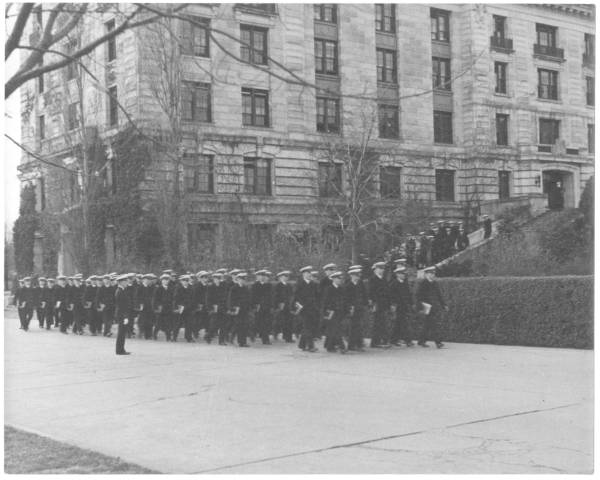
Midshipmen, carrying books, marching to or from some event, are seen here behind a wing of Bancroft Hall about 1938. They are in 'service dress blue' uniforms.
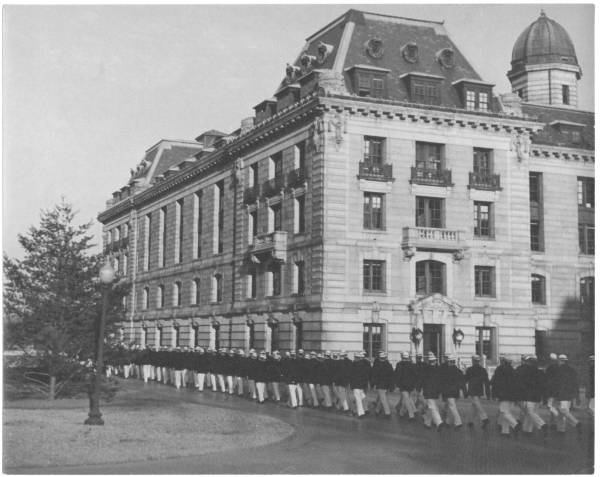
Midshipmen in 'white works' uniform with reefer (jackets), marching to some event, with a wing of Bancroft Hall in the background.
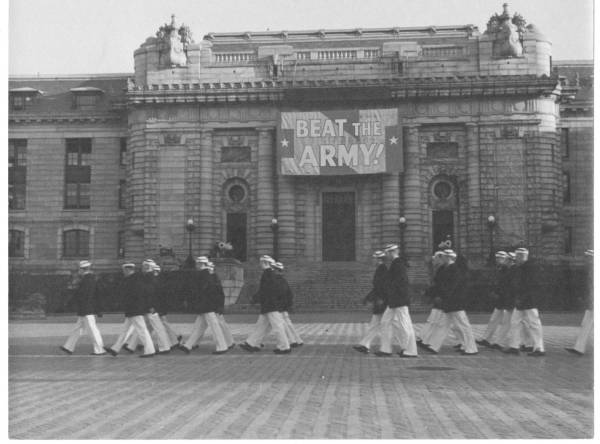
The rotunda entrance of Bancroft Hall at the U.S. Naval Academy about 1938 displays an annual sign.
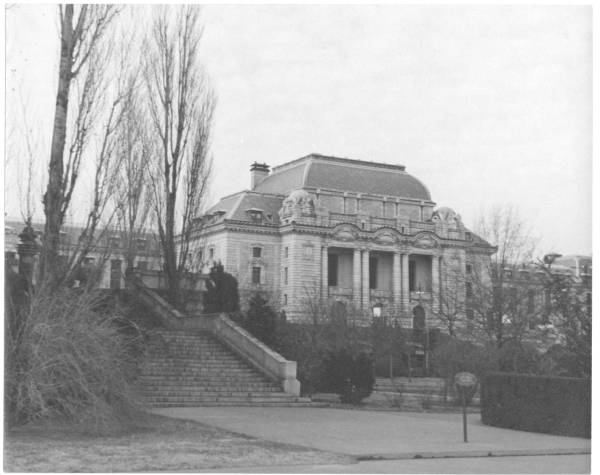
A scene behind Bancroft Hall at the U.S. Naval Academy about 1938. Just to the right, is an area designated as 'smoke park' where midshipmen could smoke in a leisure setting. An upgrade to the Mess Hall which would change this scene was commenced in 1939. Such changes have greatly impacted all of the areas behind Bancroft Hall.
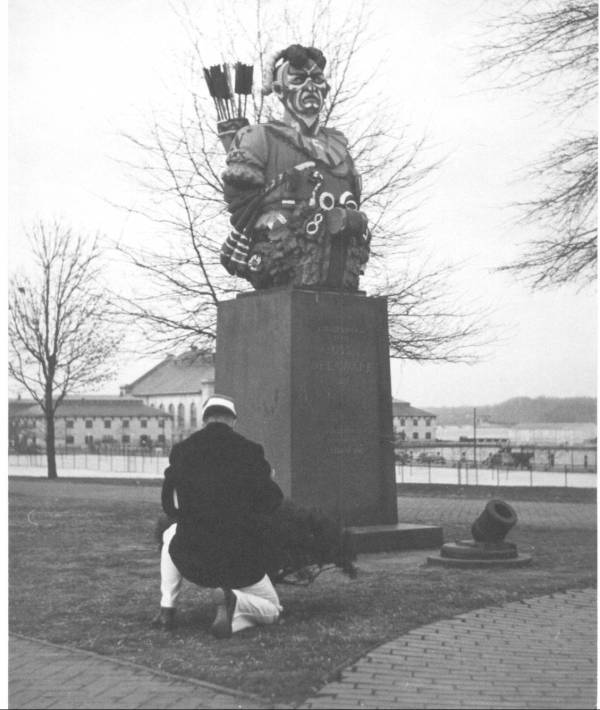
"Tecumseh," the well known replica of the famous Chief, is decorated by midshipmen at the U.S. Naval Academy each year, to build enthusiasm for the fall football schedule.
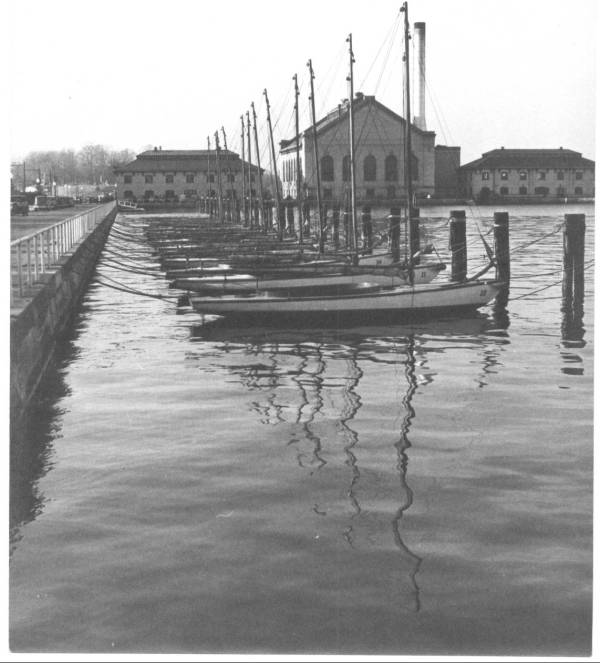
We called these little sailboats 'knockabouts' in my years at the Naval Academy, 1939-42. Along with whaleboats, not pictured, these were used to train 'middies' in sailing,; on Sundays Midshipmen could take out the family or a girlfriend. These photos dating from about 1938 or before show sailboats 'rigged' a little different from the Marconi rigged boats of my time just a year or two later. But free board, cockpit, length at waterline and mast height appear the same.
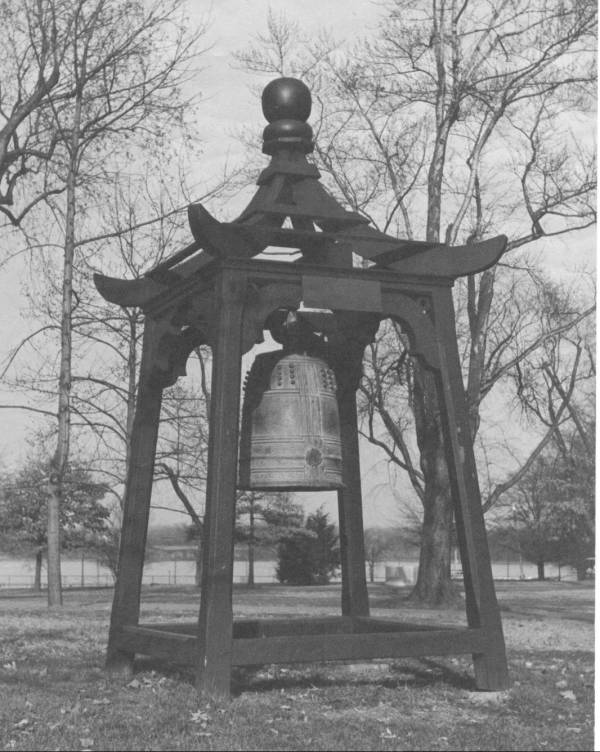
The famous Japanese bell on the U.S. Naval Academy grounds as pictured about 1938. This bell had been brought back to the U.S. by Commo. Mathew Perry from his famous Navy cruise to Japan in the 19th century. This bell was returned to Japan in 1980 and replaced by a careful replica.
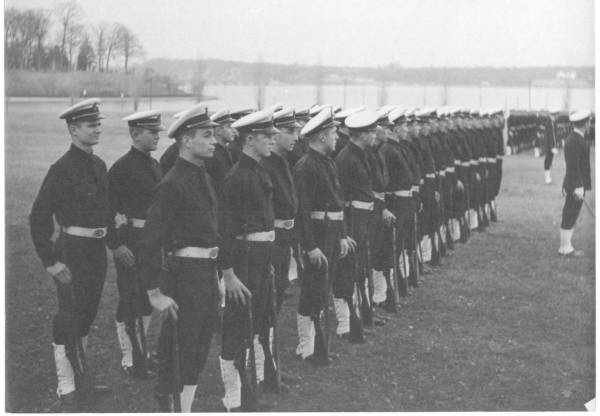
I am guessing, in 2010 with weakened eyes, that the midshipman standing tall at the near end of the rear row is Midshipman Louis Davis, Class of 1941. His brother George Davis was a friend of mine in the Class of 1943. Shortly after I entered the Academy, the close order drill was changed, and we would not see a formation like this one again. The promontory at the top left is the Naval Academy Cemetery.
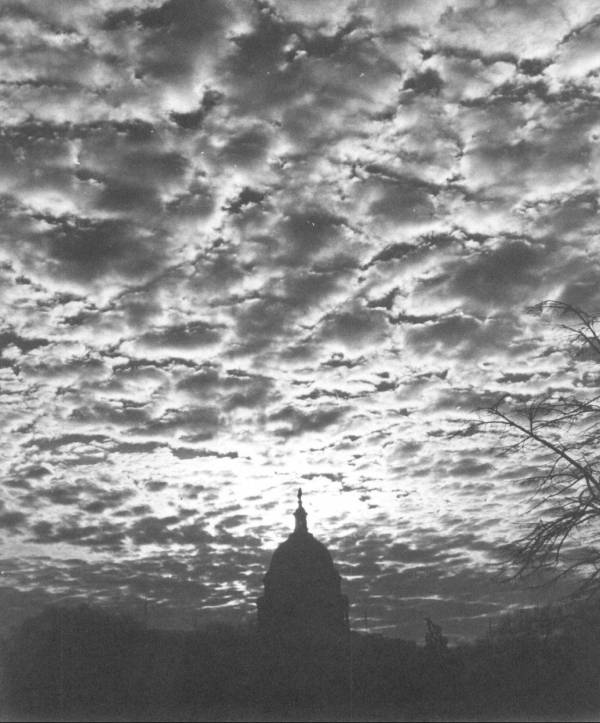
This is the Naval Academy chapel as it appeared before 1939 when additions to the chapel were begun. Below the dome, then and now, is the crypt containing the remains of John Paul Jones
The Midshipman Cruise of 1940 (the last of the prewar cruises)
In 2010, press readers and TV viewers saw an impressive Navy ship, the USS New York, just commissioned, steam proudly up the Hudson River to tie up at a pier for a round of televised ceremonies. The special significance was that its steel came entirely from the steel scrap remains of the twin towers of the World Trade Center, destroyed by the terrorist attacks of September 11, 2001. Putting the name USS New York back into service, reminded me of my 'youngster' cruise summer of 1940 aboard the USS New York, even then an aging battleship, but carrying the colors of the battle squadron of the U.S.Atlantic Fleet. The war in Europe was already in progress, the German armies were ready to breach the Maginot Line and conquer all opposing armies of France and the Low Countries. The exception were the British, who managed an unbelievable evacuation of its armies, emblazoned in history as Dunkirk.
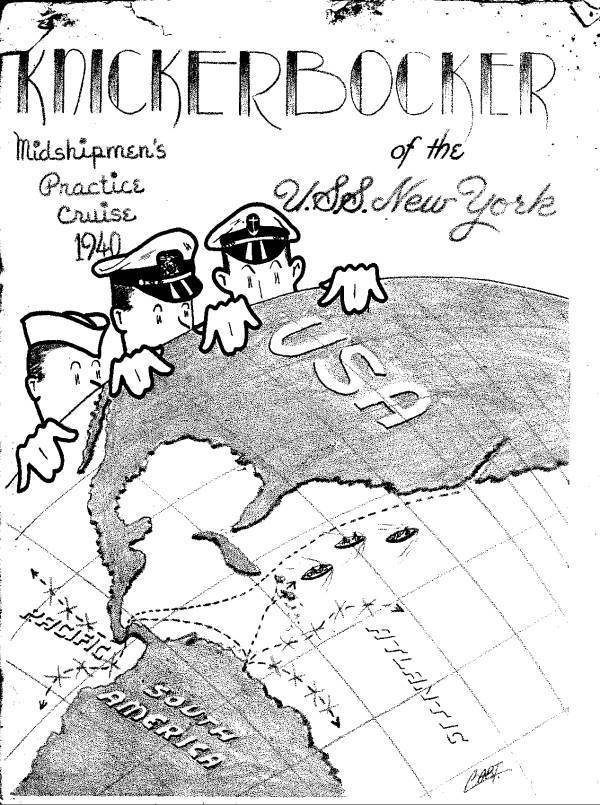
The Naval Academy Midshipmen Cruise of 1940, embarking the entire new First
Class, and Third Class (Youngster) midshipmen, would be rerouted! Instead
of the planned trip to Europe, midshipmen would see the Canal Zone, La Guaira
,Venezuela, New York (and its World's Fair), Newport (RI) and Boston. Professor
Pease, leader of the USNA English Department staff, edited The Knickerbocker,
and here are three pages. First, the inside front cover, Contents
page.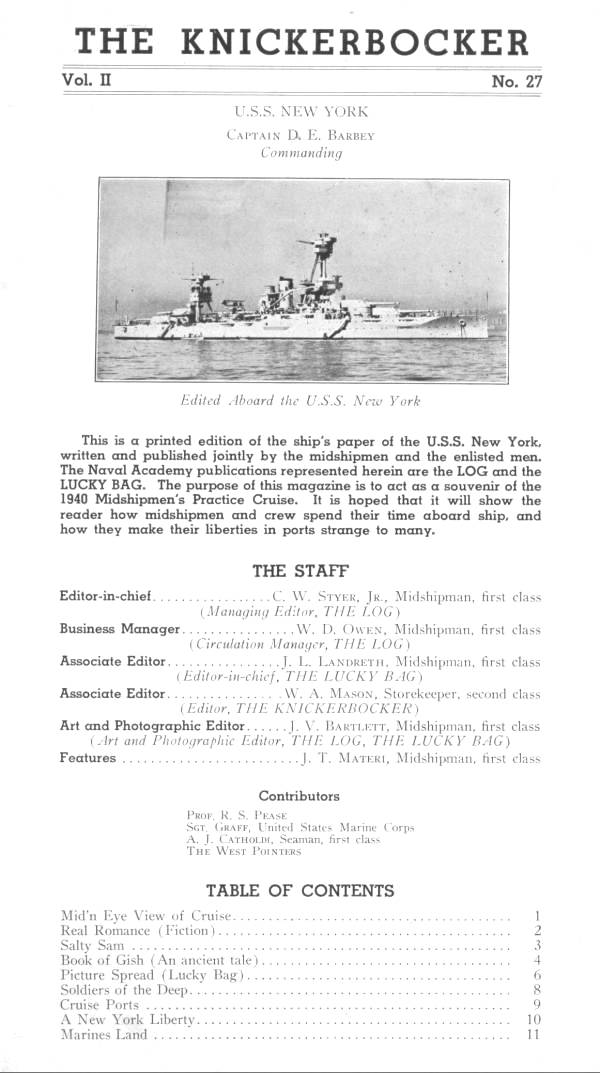
Next the front cover page, showing the sea route of the Midshipmen's Practice Cruise of 1940. There were three battleships in this cruise, the USS New York, the USS Texas and the USS Arkansas. Each took aboard one third of the midshipmen. I was early in the alphabet, and up through about F or G were aboard the USS New York.
Here now, the back cover page of the Knickerbocker, official publication for those midshipmen who boarded the USS New York for the Midshipmen's Practice Cruise of 1940.
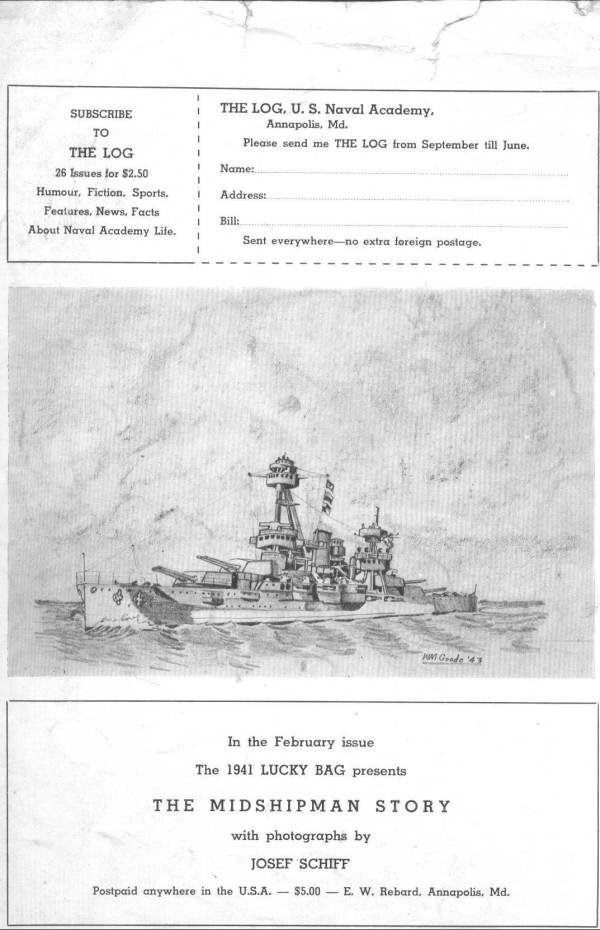
Note the "WMGoode '43'" who 'signed' the sketch above of the battlehship USS New York. He was my classmate. I have looked at every page of this publication and this is the only clue that the Class of 1943 were involved. At USNA we had just concluded our 'plebe' year full of reminders of our lowliness. Boy, just let us get into the second year, called Youngster Year and we would be somebody. Not so fast. Aboard ship we again were the lowliest, unrecognized except for our failings. I was assigned to ring the ship's bell at noon one day. I came up on the bridged and banged out 12 resounding repetitive tones. Wrong! They should be rung out in six pairs and you, Midshipman Dailey were a nautical dolt. So, I was assigned the next day to get it right, and I might say I did it again with a flourish, but right. Anyway, Bill Goode was a fine artist and it is now with a bit of pride that I realize that no First Classman could be found to sketch our ship! (I also detected from reading the Knickerbocker 70 years later that the First Class slept in bunks. We youngsters were issue hammocks. I never could learn to sling a hammock much less sleep in one so I slept on the wooden deck. If those of us sleeping on the deck (I was not alone) heard the Master at Arms the next morning say, "Watch out for the water!" it was too late. We were already wet. With salt water!
A Ship's Story, Enriched by Feedback, Revisited
"Joining the War at Sea 1939-1945." The story portrays a ship's company of yesterday's regulars, reservists, and draftees in a different light. These men fought the USS Edison DD-439 from 1941-1945 and they fought her well. The story is told in a series of episodes, Casablanca, Sicily, Salerno, Anzio, and Southern France. Some are about triumph in the heat of battle. Some are about mistakes that are made when millions of men and women are taken from peaceful lives and thrown together in battle action preceded by a modicum of often just as dangerous training for that action. These folks were in "for the duration." (One Captain told his assembled group of highly talented Chief Petty Officers that none of them would get transferred to 'new construction' until he, the Captain, had been transferred. Self preservation is a powerful trait.)
The actions described in this story center on the USS Edison, DD 439, a destroyer commissioned early in 1941 and decommissioned in 1946 after the end of WW II. The photo below shows the ship in her first "war paint". Although the ship's standard enlisted complement was just over 200 men, in the short span of her service, 940 served aboard her. Her 5" 38 cal. battery was 're-gunned' three times. (Just the barrels. The liners wore out from the thousands of rounds fired.)
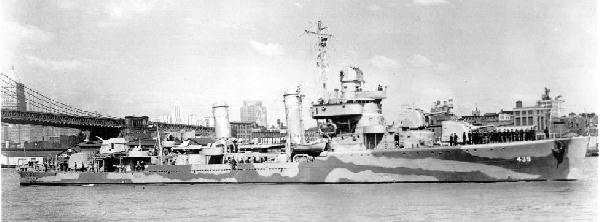
Credit OUR NAVY PHOTO
Several hundred readers have responded with e-mails and letters. These responses have provided the author expanded insights. The nephew of one of those Red Cross nurses plucked from an open lifeboat in the North Atlantic in July of 1941 by the USS Charles F. Hughes has provided a followup on her story. A 457-page paperback incorporating some of those insights is now available in a 4th Edition dated January 2009. The book can be ordered by clicking here.
Here is the "short list" of WWII ships/units that have been heard from via E-mail: Minesweeper USS Pioneer; U.S. destroyers Buck, Benson, Edison, Gleaves, Lansdale, Ludlow, Mayo, Plunkett, Wilkes and Woolsey and from a later destroyer generation, USS Dyess; U.S.cruisers Augusta, Philadelphia, Savannah ,and British cruiser HMS Spartan; troop transports HMTS Rohna, SS Awatea, SS Mallory, SS Santa Elena, SS Santa Margarita, SS Vigrid, U.S. Army Transports Dorchester and USS West Point; supply ship USS Electra; amphibious ship USS Doyen (PA-1); Darby's Rangers. An officer on the staff of Admiral Richmond Kelly Turner commented favorably.
One reader, Mark Henshaw of Hamlin, New York, was so impressed with the book that he developed an Index of the 300 ships that appear in the book. This 8-page index is available free by writing Dailey International Publishers, 500 Laurel Oaks Lane, Alpharetta, GA 30004-4508 or e-mailing, franklyn21@daileyint.com
For quick reference to the Henshaw index, go to 300 warships/transports in "Joining the War at Sea" listed alphabetically
"...going to War?"
A granddaughter interviewed me in 1997 for her high school history term paper. "How did you end up going to War?", was her first question. I must say that the War came to me, rather than my going to War. A 1935 western New York State high school graduate with two years of college credits toward a Chemical Engineering degree ran out of money, went to work, but still wanted to get a college degree. A political Uncle knew the Honorable CarolineO'Day, Congresswoman-At-Large from New York, and he prevailed on her to offer me a Principal Appointment to the U.S. Naval Academy. With no entrance exam required because of the satisfactory college grades, the only remaining obstacle was a physical exam. That was taken June 5-7, 1939 at the U.S. Naval Academy (USNA) at Annapolis, Maryland. An eye condition called farsightedness caused a one day delay but I was sworn in with the Class of 1943, USNA, on June 7, 1939. I was 18. My appointment as Midshipman U.S. Navy was signed by Charles Edison, Acting Secretary of the Navy. Just three years later, I was ordered to report to the USS Edison, a destroyer named after Charles Edison's father, inventor Thomas Alva Edison. For those interested in more on coincidence, the Edison was DD-439. Those numbers were the last three numbers on the Social Security card issued so I could accept employment at Eastman Kodak in Rochester, NY in 1936. It took a very supportive, fact-aware wife, to point these coincidences out to me.
In my early teens, I had been an avid reader of current events but I still thought of my goal as getting an education. The going-to-war sequence did not figure prominently in my thoughts. The new Midshipman uniforms hid a landlubber who could not tell a Chief Petty Officer from a Commissioned Officer. (The appointment available from Congresswoman O'Day was for the Naval Academy. I'm sure that if her available appointment had been to West Point, I would have gone there.) The choices faced later by others, to enlist or be drafted, to get into graduate school or work in a war plant, or to apply for status as a Conscientious Objector, were never before me. I was already there. Patriotism was important to me from early childhood but it was not a factor in how I joined the war at sea.
Hitler's invasion of Poland in 1939, followed by the invasion of Norway, the overrunning of Holland, Belgium, Luxembourg and the defeat of France in 1940 forced a speedup in the USNA schedule. The Class of 1943 was set to be graduated one year early, in June of 1942. The attack by Japan at Pearl Harbor on December 7, 1941 put all midshipmen on armed watches. A classmate used his .45 to commit suicide while on one of those watches.
When I reported aboard Edison as the "junior" Ensign in July 1942, the ship already had acquired some War History and one star on her service ribbon. I would be aboard while she earned five more stars on that ribbon for close-in fire support for amphibious landings at Casablanca, Sicily, Salerno, Anzio and Southern France. A number of other episodes will also be recounted, some tragic, some zany, and some touching. There were no dull days on the Edison.
The Fourth Edition 2009
|
Dutch scholar Pieter Graf was so impressed with his copy of the Third
Edition, that he pursued more research and then added a 44-page Index. This
led to some corrections in spelling of European and North African names of
ships and places, replacing some of my U.S. versions of those that I made
'on the fly' while in service in that theatre 1942-44. The book is available
now as the Fourth Edition, ISBN 0966625153. There has been no increase in
the book's price and scholar Graf's work was contributed with no recompense
other than the satisfaction that future buyers would receive a first class
seawar account of World War II.
Originally entered by Frank Dailey Jr. July 27, 1997; updated and hopefully improved May 2012 |
Home | Joining The War At Sea | Triumph of Instrument Flight