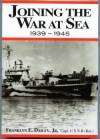
The new Fourth Edition
with 44-page Index Order Book
Joining the War at Sea 1939-1945
- Draftees or Volunteers
- U.S. Military Draft and Pearl Harbor
- Warship Building
- World War 2 U-Boat
- Collision at Sea
- Operation Torch
- Sea-based SG Radar
- Attack Transports Sink
- Assault Landing
- Tiger Tank
- Darby Rangers Setback
- Eisenhower Needed Seaports
- Rohna Sinks; 1000 Soldiers Perish
- Death, Survival, and Leyte Gulf
Rohna Tragedy Tops Transport, Destroyer Toll
300 warships/transports in "Joining the War at Sea" listed alphabetically
World War II U.S. Navy Navy Destroyer Sinking
USS Buck DD420: Official Navy Report by Survivor, Ensign R.J. Kendall USN
plus other survivor reports, and rescue-hip personnel reports with related material
also,details on the life of "Beppo" Lambert, a Buck officer who had introduced this author to shipboard life in World War II
Copyright 2015 Franklyn E. Dailey Jr.
(The links down the left column of the page take you to excerpt experiences from the published book, to which the author has been prifileged to add reader offered historical experiences stimulated by the book. )
A Report of the Sinking of the USS Buck, DD420, on October 9, 1943 near Salerno, Italy
(See Frank Campano's e-mail to the author dated 09/27/2000, comments by survivor Helmuth Timm, by Jack Dacey whose Uncle was lost, and by men who aided in the rescue of survivors, among other informed comments added at the end of this page.
The author was also in direct contact with Bert Lance, whose brother Bob is shown on the bridge of the Buck in a photo in the book, identified on pages 66 and 67, in the new 4th Edition [see cover, top left] of the book. Bob Lance was lost in the sinking and Bert made a memorial pilgrimage back to the sea coordinates where the Buck went down.)
I am privileged to add further background information on another officer in that photo. He is the one most directly facing the camera. He is Lieutenant Commander George "Beppo" Lambert. Again, a family member, Dean Lambert, has added information on a life already full of achievement. Beppo was the Gunnery Officer of the USS Edison, DD-439, when Ijoined that ship out of the Naval Academy in ealry July 1939. He gave me my 'ship's tour" and, though he was a tall well-muscled man, led me through the crawl spaces of the bilges, from which, puffing, I was glad to emerge. The information forwarded by Dean Lambert can be found after the Kendall report and just before the U-boat summaries and the brief information on the loss of another destroyer in my DesRon 13.
The report next below was contributed by Mary D. Kendall, widow of report author, Robert J. Kendall. This "Kenall Report," contains some of the most accessed paragraphs on this website. (I have not been in touch with Mary since she agreed to publication of this report a decade ago. Coment in parens added 06/19/2013)
From: Ensign R. J. Kendall USN ( USS Buck officer who survived the sinking)
To: The Senior Surviving Officer of the U.S.S. Buck
General Quarters sounded about 0030. I was in the wardroom at this time, having just come off watch. I immediately went to my G.Q. station which was in the 40mm gun control aft on the port 40mm director. I was wearing the 15 JY phones (sound powered) and listening to the range come in from the radar contact that we were heading for. The ship was speeding up. It was policy to go to 25 knots when we investigated such contacts. I heard a range near 5000 yards and then felt the ship hesitate as though she had a collision, and at the same instant I saw an explosion on the starboard side near the break in the deck. This was about 0045. I could see this since my station gave me an unobstructed view of the bridge. I was knocked down and felt flying debris and water hit me. There must have been almost a foot of water going over the deck. When I got up, the phones were out and all the men had left their stations and were back on the after deckhouse. I immediately went back to them and called out the order to set all depth charges on safe.
I went back to my station and looked forward to see if I could tell anything. I could see no bridge or stack so I thought the ship must have been cut in two and would surely sink. I know now that there was considerable smoke and steam from the forward fireroom and that it may have kept me from seeing the bridge, but I still believe the stack was gone. By that time Lt. (jg) Cummings had come on deck and was telling the torpedomen to set the depth charges on safe and for everyone to keep cool and not lose their heads. I grabbed a few men and we set about releasing the port life raft which was on the after deckhouse. We had it released and were holding it near the ship when Cummings came back and passed the word to abandon ship.
We all jumped in the water and began swimming away from the ship. I must have been about 50-75 yards from the ship when she went down. Shortly after she went down I felt a terrific shock as a depth charge went off. I was numb from the chest down for about ten minutes. Practically all those who got off near me grouped around the life raft, those with belts getting on and those with belts or jackets clinging to sides or to floating spars. I had an inflated belt at first but it was ruined by the blast and would not hold air so I took a kapok jacket which floated nearby. We must have had 50 or more men around the life raft when we started, but by morning we had only a little more than 30. Others had dropped off, drifted away, or been so injured by the blast that they could not stand the night in the water.
There were three other officers besides myself and we kept the men's spirits up as best we could by keeping the raft headed N.E. which was toward shore. We did not know exactly where we were but we knew our approximate vicinity. When morning came we thought the sun would warm us, but it rained hard and we received no warmth until later in the morning. When the sun finally did come out, the combination of sun, oil, and salt water practically blinded all of us. We thought surely we would be seen soon since we had many planes on previous days over that area but we saw nothing until late in the morning.
The first plane we saw did not see us and flew on, but the second was attracted by dipping an oar in the water and turning it over and over so that it flashed. It flew over us several times to get a good look and then dropped three rubber boats, one to someone I could not see and two to us. Several of us struck out for the boats and boarded them. We had about 10-11 to a boat, but when ours began to leak and half of it deflated completely, a few men went back to the main raft and only seven men stayed on ours. Of these, three men were in the water all the time. I was in better condition than most, so I stayed in the water. Shortly before sunset we found a way to blow up the deflated half of the life raft and all started to climb in to try to keep warm for the night, when someone sighted the destroyer. We had only two things left after the boat capsized, one being 3 pints of water and the other being a Very's pistol in waterproof bag. We broke this out and fired three red flares which the ship saw.
She turned and came to pick us up. We were picked up in a motor whaleboat at about 8:30 p.m. The destroyer was the U.S.S. (name omitted-see commentary below). I was led aft to the showers when I cleaned myself up as best I could. They then got Diesel oil and cut the crust of fuel oil which lay next to my skin. I said I thought I was all right and they gave me some soup and coffee. I then went to sleep. The next morning I had some oatmeal and coffee. The hospital diagnosed my case as Stomach Compression (depth charge explosion effect-F.E. Dailey's paren added) and Exposure from which I have almost completely recovered.
(Signed) R. J. Kendall, Ensign, U.S. Navy
Further commentary on the USS Buck, DD-420, follows from a number of sources. The Buck had been the Squadron flagship for DesRon 13 when I first went to sea on the USS Edison. Additionally, Feorge "Beppo" Lambert was the Gunneruy Officer of the Edison who gave me my detailed ship's indoctrination when I reported aboard the Edison. As Buck's Exec. when she was sunk, he was one of the many casualties.
This further commentary features many photos and some official U-boat tabulations.
:
I have also read the official report made by Lt. (jg) Cummings along with a story about a survivor group consisting of Lieutenant David T. Hedges, Coxswain Anthony Pepponi and Steward Leroy Highe. That story appeared in the Stars and Stripes Weekly issue of November 6, 1943. Those same Very Pistol flares that attracted the first surface rescue vessel also led to the rescue of the Hedges group. I also have a copy of a letter dated March 10, 1997 written to Dean Lambert (half-brother of Lieutenant Commander G. S. Lambert, the XO of the Buck, who did not survive her sinking) by Buck survivor Leon (Red) Roberts who later retired from the Navy as Master Chief Lithographer.
Piecing these communications together, I believe that Bob Kendall was rescued by the destroyer USS Gleaves after about 20 hours in the water. Leon Roberts' GQ station was near Kendall's. Roberts was blown directly into the water by the initial blast and was one of the last to be rescued two days later, by the destroyer USS Plunkett.
Cummings' battle station was in the forward engine room. After securing some live steam leaks and causing the throttle to be closed, Cummings and his men made their way topside. Cummings could see that the forward fire room was ablaze. His report stated that water was coming over the main deck on the port side just aft of the break in the forecastle deck. With the Buck's stern "about 45 degrees in the air" Cummings jumped about 5 feet into the water. With his kapok life jacket on, he swam away from the ship. The depth charge explosion after the stern went under doubled him up and paralyzed his legs. He managed to grab two drifting kapok jackets, putting one on each leg, and then moved toward voices until he came upon a raft with about 50 men clinging to it. The next day this group made it to one of the three air dropped rubber rafts mentioned in Kendall's report. These men were picked up by H.M. LCT #170 about 2000 that evening. The Cummings report and the Roberts letter came to the author in a thoughtfully assembled packet from Jim Lingafelter. Jim is the son-in-law of Helmuth Timm, a Buck survivor who recuperated from his chest down compression injury, due to the depth charge explosion, in a hospital in Palermo, Sicily. Mr. Timm's story is in Chapter Eight of the paperback. It seems quite likely that there were more survivors from the initial blast, but that their injuries weakened their ability to stay alive in the hostile water environment. Then those that might still have made it were further weakened by the depth charge concussion that every survivor experienced. My guess is that a 300 pound depth charge from an after K-gun that was almost immediately under water after the torpedo hit or a stern 600 pounder on the roll-off rack could not be re-set on "safe" simply because these were not accessible. A stern that subsequently rose out of the sea at a 45-degree angle as reported by Lt. (jg) Cummings supports such an inference. (after much thinking over the years, I lean to a K-gun 300-pounder; these were in single mounts and the 600-pounders were in parallel, multiple mounts/F.E. Dailey Jr.)
A group of Buck men on reunion near NOB Norfolk in September 1988 were spotted during a harbor cruise (from their hats, with Buck insignia) by a German expatriate working in the U.S. This man knew the skipper of U-616, the submarine that sank the Buck and was in turn itself later sunk by the U.S. destroyers Rodman and Ellyson. That skipper, in his letter of 11 November 1988 to George L. Brooks of the crew of the Buck, identified himself as Dr. Siegrfried Koitschka. He wrote that his sub fired an early version of the T-5 acoustic torpedo, which fortuitously for the U-boat, had been unconfidently placed in its after torpedo tubes. The sub had no time to develop a fire control solution on the Buck as she found herself running as fast as she could away from the Buck which was coming on at high speed ("black steam came out of her funnel", Koitschka wrote). Firing this acoustic-homing torpedo in which they had little confidence was, in the German skipper's view, a last ditch effort to save his U-boat from a lethal depth charge attack. I am again indebted to Jim Lingafelter for providing copies of this correspondence. And from my first efforts to write my sea story I received encouragement and support from Dean Lambert.
The author received the following e-mail dated 09/27/2000 from Frank A. Campano who served aboard the USS Gleaves (DD423) for four years and was aboard during the rescue operation of the USS Buck personnel. In quotation marks below, that e-mail:
"I served aboard Gleaves four years, I kept a daily Diary. I will quote from a smal booklet I kept with me most of the time. We escorted the first convoy into Naples since it was opened and then resumed patrol without any rest. Oct. 9, while patrolling Salerno harbor, we were ordered out to pick up survivors. We went out several miles and were first there. There were many survivors; we picked up 67 live, 3 dead. DD420 had been torpedoed, and mag exploded the morning before at 0100. She broke in two. (Note: Survivor Helmuth Timm stated that the magazines did not explode but a depth charge which could not be set on safe because it was already underwater did go off, hurting survival chances of those already in the water.) A few officers were saved; most of the survivors had internal injuries from their own DC (Campano's shorthand for depth charges) that were not able to be set on safe. The Plunkett came and picked up 18 live and 7 dead. The Plunkett had the flag. She refused to release us that night to bring the survivors to the hospital for the badly needed treatment that was needed; she released us the following morning. We put 4 boilers on line and speeded for Palermo. On the way 4 died. They might have been saved had they reached the hospital sooner. The crew as a whole did all we could for them. CPM (Chief Pharmacists Mate) assistants, Doctor and many of the crew, did not get any sleep."
"Most of the survivors occupied our bunks. One sailor I was taking care of wanted a smoke. I lit a cigarette and gave it to him. He was in a lower bunk. He took a few puffs and died. I felt bitter toward the command that refused to release us so they could have medical attention hours, hours sooner. On arrival at Palermo, we put the survivors in waiting ambulances and gave over the dead for quick burial.; the dead were not an easy sight. I guess there were 96 (saved) out of a crew of 260. HMS (the British LCT) also picked up survivors, not many, but it was there." End of statement by Frank A. Campano, eyewitness to the rescue of survivors of the USS Buck.
Enemy Submarine Action This next sequence originally appeared in the draft Chapter on Salerno on this website. While reviewing that material, and the sequence above on the USS Buck, in preparation for a 'survivor stories' talk to be given to a college history class in Houston in October 2007, it occurred to me that it would help USS Buck DD-420 families who frequently come to this page, to repeat the Salerno Chapter comments on 'enemy submarine action' here. It helps to bring families together. Franklyn E. Dailey Jr. Sept. 6, 2007. Contact e-mail address is franklyn21@earthlink.net
"The U-boats were not finished with their favorite targets, U.S. destroyers. The USS Buck was patrolling at the north end of the Gulf of Salerno on 8 October. Pursuing an active radar contact, Buck was torpedoed by U-616 forward of her stack (she was a one-stacker). She went down in about four minutes with loss of life exacerbated by depth charge explosions. (Buck's XO was LCDR G. S. Lambert. As Edison's Gunnery Officer, "Beppo" Lambert had been an active proponent of Edison's defined policy to leave depth charges on "safe" except during actual pursuit of a submarine. My belief, therefore, is that Buck's "pattern" was set because she was on an attack run against a submarine.) Obviously, Buck had neither the time nor most likely the personnel or equipment left to send an SOS. Waterlogged survivors welcomed three rafts dropped by an Army transport at mid morning on October 9. The USS Gleaves was attracted by a Very pistol flare late on the 9th. Only 94 out of 260 had survived when the USS Plunkett and a British LCT arrived shortly after."
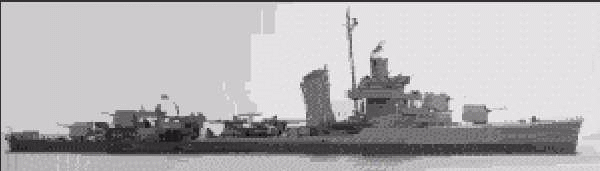
The photo above was furnished by Jack Dacey whose Uncle was lost on the USS Buck.
The following information was furnished in a phone call on 12/28/97 by Helmuth Timm, MM1/c, a survivor of the sinking of the USS Buck.
" It was between 11 p.m. and midnight on 8 October when we were hit. I was in the after engine room. She sank fast. I barely had time to kick my shoes off and get in the water with my life jacket on. The magazines did not go off but a 600 pound depth charge off the rack at the stern did go off as the hull sank, and caused death or severe concussion to men in the water. I watched my Chief Petty Officer, P.U. Baker, sink below the waves. After being in the water a long time, I was picked up late the next night. I was taken to the hospital at Palermo and later to one in North Africa. I was in the hospital about three months. I had a severe concussion and double pneumonia. Dugan, our Chief Water Tender was in the hospital with me. Pete Kielar, MM1/c, another survivor, has been in touch with me. I believe our skipper, LCDR Klein, who was lost in the sinking, received the Navy Cross for the sinking of that Italian submarine."
Mr. Timm recalled a Commander Durgin who was for a time the Squadron Commander of DesRON 13 during early Mediterranean duty but did not recall Captain Heffernan, who was ComDesRON 13 in the earlier North Atlantic convoys described in Chapter Four. It is quite likely that Commodore Heffernan's tour did not overlap Helmuth Timm's. ( E. R. "Eddie" Durgin (not to be confused with his brother Calvin T. Durgin, who was skipper of the USS Ranger at Casablanca), was relieved as ComDesRON 13 by CDR Harry Sanders on September 15, 1943. By this date, the DesRON 13 flag was no longer on the USS Buck but was on the USS Woolsey, DD437.) I found Mr. Timm very alert during our phone conversation but he protested, as do all of us at "our age", that he has difficulty remembering names. Mr. Timm is 82 and spoke from his son-in-law's home. His son-in-law is James Lingafelter, who assisted greatly in making this telephone call possible.
Some achievments in the life of George "Beppo" Lambert, Executive Officer, USS Buck (entered 06/19/2013):
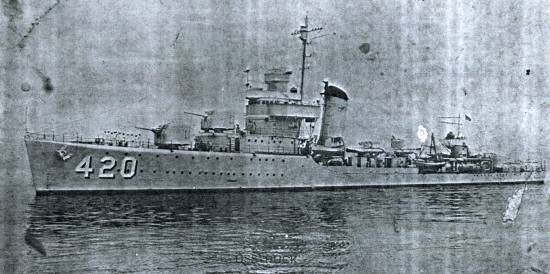
Early photo of USS Buck, DD-420, lost off Naples-Anzio patrol area in World War II.(courtesy of Dean Lambert)
Buck's Executive Officer Had Notable Athletic Career at U.S. Naval Academy
At the time of her sinking, the Executive Officer of the destroyer USS Buck was Lieut. Cmdr. George "Beppo" Lambert. This man had already made quite a name for himself, in the U.S. Navy, and at the United States Naval Academy. In two sports, football and boxing, Lambert's name was closely linked with another famous midshipman, "Slade" Cutter.
One newsclip, no identity or date of publication, contains an upper body photo of Lambert in boxing gear, with his boxing gloves on, and with an identity blurb added near Lambert's head: "CAPT. G.S. LAMBERT 175 pound senior who leads Navy's and Mr. Spike Webb's gladiators tonight in their stand against the Golden Panther warriors at the Oakland Stadium." I am inferring that this was on the Navy boxing team's trip to oppose University of California in an Oakland CA stadium.
(An extra interest here is mention of "Spike Webb, Navy's diminuitive boxing coach. Spike was still at the Academy when I arrived in Annapolis for my entry physical exam on June 5, 1939. We met at Carvel Hall, a southern style hotel in Annapolis, with a bar on the lower floor. Spike liked to gather there with incoming midshipman candidates. 'Beer Barrel Polka" played almost constantly on the jukebox. Spike may have been looking for 'prospects' and engaged middies-to-be readily in conversation. Once we passed our physicals, and were sworn in, Spike Webb and all the coaches were back on the formal terms that staff had to maintain with midshipmen. We would never be on informal terms with Spike Webb again.)
The New London Day, a newspaper in New London, Connecticut, ran an Associated Press feature story on Saturday, March 9, 1935, datelined Annapolis, Maryland. Before getting into some lines to quote from the article, let me note that Lambert and Cutter would be graduating from the U.S. Naval Academy in just two short months after this article appeared ,and would then be Ensigns in the United States Navy, from the USNA Class of 1935. They were both 22 years old. Lambert had come to the Academy from the "fleet," the enlisted Navy, then via the Navy prep school. Cutter had matriculated from Severn Academy, one of many private prep schools that specialized on getting guys into the academies.
Here are a few sentences from articles accompanying photos of two trim, well muscled men in boxing garb. "Boxing garb" in 1935 was something like one piece men's swim suits, with N A V Y in big letters in the chest area. Now, from the 1935 newspaper story:
"They were tackles on the now-famous sailor team when it took the field against Army in Philadelphia last fall......Dreadnaught and destroyer ...Lambert is the light-heavy who climbs through the ropes as team captain. (Slade) Cutter follows him into the ring as the academy's heavyweight entry... Both have played four years of football, including their freshman seasons, and both are concluding their fourth year with the gloves." (Another Class of 1935 player on that team was famed back, 'Buzz' Borries.)
The New London newspaper's headline had been, "FAVORITE TO WIN OVER HARVARD." A subhead to the article suggested "Harder Hitter Than Tunney?" The reason for this article was the Academy's 1935 match with Harvard, just a month before graduation for seniors on the two boxing teams. Another subhead contained the sentence, "Lambert prepped at Robeline (La.) high school....."
Quite a stretch to put George Lambert into a hypothetical ring with heavyweight champion Gene Tunney. The question mark on the subhead showed the editor knew his writer was 'pushing' the story just a bit. Here is an appropriate photo for that story though it actually appeared in another news story.
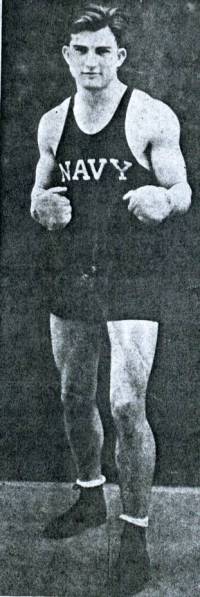
George "Beppo" Lambert. USNA 1935.
George Lambert was a Lieut. Commander USN, and Executive Officer of the USS Buck DD-420, and was lost when that destroyer was sunk by U-616 (see below) off the coast of Italy near Naples in World War II. I knew George "Beppo" Lambert when I reported for duty fresh out of the U.S. Naval Academy in July 1942 . He was then a Lt. USN and Gunnery Officer of my new ship, the USS Edison DD-439. He was assigned to give me my familiarization with the ship. Before or since, I have never had such a thorough familiarization.
The original news materials for the anecdotes on the life of George Lambert were supplied by his brother Dean Lambert, when Dean was police chief in Many, Louisiana. I am grateful for this material. Though I have never met Dean in person, he has become a friend.
/Franklyn E. Dailey Jr./ whose website the reader has accessed.
U-616 (war record)
| Type | VIIC | |
|
Laid down |
20 May 1941 |
Blohm & Voss, Hamburg |
|
Commissioned |
2 April 1942 |
Oblt. Johann Spindlegger |
|
Commanders |
04.42 - 10.42 |
Oblt. Johann Spindlegger |
|
Career |
9 patrols |
04.42 - 12.42
8th Flotilla (Danzig) |
|
Successes |
Sank the US destroyer USS Buck (1,570 tons) |
|
|
Fate |
Sunk 17 May, 1944 in the Mediterranean east of Cartagena, in position 36.46N, 00.52E, by depth charges from the US destroyers USS Nields, Gleaves, Ellyson, Macomb, Hambleton, Rodman and Emmons, and by bombs from 3 British Wellington aircraft (Sqdn. 36), in a 3 day-long action. Entire crew, 53 men, survived in captivity. |
|
Here is a brief on another destroyer in my squadron, DESRON 13. My ship, the destroyer USS Edison DD-439, had operated extensively with the Bristol (below) and the Buck (story above).My book covers much more on these two ships.
On 13 October 1943, while the USS Bristol was escorting a Salerno-bound convoy off Algiers, she was torpedoed by U-371. This hit occurred near the forward stack (she was a two stacker.) and the ship buckled in the middle. Bristol had only detected the torpedo noise on her listening gear for ten seconds before she was hit. Fortunately, Bristol's depth charges were checked on safe by a Torpedoman's mate and Bristol had a little more time before she made her plunge than Buck. Even with the keel broken, if a destroyer is not hit in a magazine, she has a few minutes to abandon ship, a procedure that Navy vessels rehearse. 241 men out of Bristol's complement of 293 were saved by two destroyers. Edison shared many sea and sea combat experiences with both Bristol and Buck.
U-371
| Type | VIIC | |
|
Laid down |
17 Nov 1939 |
Howaldtswerke, Kiel |
|
Commissioned |
15 March 1941 |
Oblt. Heinrich Driver |
|
Commanders |
03.41 - 03.42 |
Kptlt. Heinrich Driver |
|
Career |
|
03.41 - 06.41
1st Flotilla (Kiel) |
|
Successes |
13 ships sunk for a total of 69,899 tons |
|
|
Fate |
Sunk at 0409 hrs on 4 May, 1944 in the Mediterranean north of Constantine, in position 37.49N, 05.39E, by depth charges from the US destroyer escorts USS Pride and Joseph E. Campbell, the French Senegalais and the British destroyer HMS Blankney. 3 dead, 48 survivors in captivity. |
|
The USS Buck,and two of the other destroyers in DesRon 13 in which I served in World War II, were sunk while on duty in that war. Several hundred men did not live out the lives begun in the miracle of birth. This author survived for now a span of 94 years.With deteriorating eyesight, I must face shuttaing down the gift of helping to bring to readers some of what life has offered me.I will try to do this cheerfully.
Home | Joining The War At Sea | Triumph of Instrument Flight