The new Fourth Edition
with 44-page Index
Joining the War at Sea 1939-1945
- Draftees or Volunteers
- U.S. Military Draft and Pearl Harbor
- Warship Building
- World War 2 U-Boat
- Collision at Sea
- Operation Torch
- Sea-based SG Radar
- Attack Transports Sink
- Assault Landing
- Tiger Tank
- Darby Rangers Setback
- Eisenhower Needed Seaports
- Rohna Sinks; 1000 Soldiers Perish
- Death, Survival, and Leyte Gulf
- Annunciator Speaks!
- World War II Sinking
- British Rescue Ship Toward Sunk
- Self Inflicted Wounds
- No Abandon Ship for USS Ingraham
- Rohna Tragedy Tops Transport, Destroyer Toll
- Four Chaplains
- U-73 speaks from the depths
300 warships/transports in "Joining the War at Sea" listed alphabetically
Do-217 glide bomb sinks HMT Rohna: Minnesota Pastor's survival story
Heroic stories from survivors of Mediterranean convoys
USS Pioneer, MV Ruys and MV Marnix van St. Aldegonde, Santa Elena , and an ENSA girl
Copyright 2012 Franklyn E. Dailey Jr.
Beginning on page 344 of the 3rd Edition and on page 409 of the 2nd Edition of my published book, "Joining the War at Sea 1939-1945," the narrative develops the experiences of four WW II convoys that transited the Mediterranean headed east. The first two convoy passages, of convoy KMF-25A and KMF-26 occurred in November 1943, and the last two, UGS-37 and UGS-38, in April 1944. My intention in including those episodes was to show how dramatically the tides of the seawar changed in the Mediterranean between 1943 and 1944. By late 1944, the dramatic lowering of the German threat was still not immediately apparent to the sailors manning ships engaged in the vital transport of men and supplies eastward. Previous attacks had conditioned all Mediterranean war participants to be wary. Readers have been generous in providing further information on these convoy experiences not available to the author when the book was published. Purchasers of any of this author's books are invited to download these shared experiences
I am indebted to Pastor John E. Quam of Minnesota for this next account of the sinking of HMT Rohna. He excerpted this material from his Dad's autobiography. His Dad was Nels Quam, a Rohna survivor of convoy KMF-26. At the end of the Quam account, I have included a link to Sgt. Carl Schoenacker's survivor account from the Rohna tragedy. Following the Rohna addition, insights from the previous convoy, KMF-25A, are covered.
In the following paragraphs, the reader will be introduced to a portion of the World War II experience of Nels Quam. Born in Norway, Quam served the U.S. in World War I and was made a U.S. citizen during Army service. While serving as an Iowa town's Superintendent of Schools, he volunteered at age 49 for World War II service. His years prevented military service so he was accepted by the American Red Cross for overseas assignment. His son, Pastor John E. Quam, forwarded this portion of his father's autobiography, written in 1977. Nels Quam passed on February 14, 1993, in Edgewood, Iowa, at age 99. His autobiography excerpt begins here:
"Hitler had an idea that the German people were a master race and all other nationalities were inferior to the German people. He felt that the master race ought to control the world. He set out to do just that. To begin with, he invaded Poland, Czechoslovakia and Austria. Later he would take France and eventually all of Europe.
"England objected and so did France so the result was that World War II began, which later brought in Italy, Russia, and in l941, the United States. The United States sided with England and France and gave them help with war material. For this reason, Hitler started a submarine campaign against all nations that supported England. Finally, Hitler declared war on the United States.
"Now, we were again in war with Germany. Japan came in and made war on us also. I had served in France in World War I. At that time, I was not a citizen of the United States, and as such, 1 did not have to serve in the war. However, I intended to stay in the United States and this country had given me many advantages. It was only fair that I serve and so I did. While I was in the War, I was made a citizen of the United States with no examination, except that I take an oath to be faithful to this country.
"Now in World War II, I was 49 years of age. What could I do for my country? I was too old to serve in the military. Some of my former students were on the firing line. Could I serve them in anyway? If I could not find them, I could serve other American sailors and soldiers.
"The American Red Cross wrote to superintendents of schools urging them to join. I decided to serve In the American Red Cross for overseas duty. I visited the Red Cross Headquarters in Washington, D.C. I was accepted and was to report back in July. Thora (Nel's wife) made the trip with me. We went back to Randall, Iowa, to finish the year's work and resign the superintendency.
"The community had a farewell party for me. It was held in Elm Church. Many of my former students were present. The high school mixed chorus sang. For their last number "Beautiful Saviour," all former members of the mixed chorus joined in for this farewell nunber. I was given a beautiful wrist watch from the members of the community.
"It was time to return to Washington, D.C. for starting my work with the Red Cross. On Sunday morning, July 4, 1943, 1, with Thora, John and Paul, went to Ames (Iowa) fcr the beginning of my trip to Washington, It was not easy to leave the family and it was not easy for the family to see me go. None of us knew what could be in store for me and the family. It could mean that I may never see them again. It was a sad trip on the train. I could not hold back the tears at times. In Washington, I entered training, with many others. One of these men was Harold Reckseen from Spencer, Iowa. More about him later.
"For additional training, we were sent by train to Camp Po1k, Louisiana on the maneuver area. This was not just theory. It was actual experience in counseling soldiers, loaning them money and establishing contacts with their parents when needed, etc.
"We lived in tents and worked in tents. The soldiers also lived in tents. The soldiers' training was assimilating actual warfare. From the maneuver area the soldiers were sent overseas through East Coast cities.
"I shared a tent with Harold Reckseen. He had a wife and two children in Spencer, Iowa, where he had been teaching in the public schools. Before we left Louisiana for overseas, we had a week's leave. Reckseen had his wife come to Kansas City, where they spent the week together.
"When I received my week's leave, I went home to Randall to be with my wife, Thora, and my two sons, John and Paul. John was twelve years old and Paul nine years old. The family knew that I was coming, but the exact time that I would arrive, they did not know.
"When I walked in the back entrance to our home and into the kitchen, Paul was standing there and when he saw me, he exclaimed, Dad, where did you come from? It was a glorious visit, but all too short. I was thankful that the Red Cross gave me that much of a leave. I wore my summer uniform which was like that of an officer in the Army, except the insignias. With my uniform on, I had my picture taken by a photographer in Ames, Iowa.
"Soon I had to return to Louisiana again. Pastor Bringle took me and my family to Des Moines to see me off on the train. Now came another time to say good-byes. We all were sad this time too. It was not so easy for Thora to be both father and mother while I was away. As they drove back to Randall, Paul never spoke one word. When they reached home, he ran in and stretched out on the davenport. He was lonesome.
"After returning to Louisiana, it was only a few weeks until we would be on our way~ overseas. Before we took the plane to Washington, D.C., I had written Thora that I was on my way overseas and asked her to come to Washington to see me off. I met her at the station and it was so good to see her there. We had a chance to see Washington and we also had a good visit, but that was too short. The time soon came for our group to take the train to the point of embarkation. Thora went with me to the depot. She was fortunate in having a young girl from Randall with her so that after I had gone, she was not alone. This girl was Shirley Nordskog, who had attended Randall Consolidated School whi1e I was the superintendent there. While Thora was with me in Washington, John and Paul were with their grandparents, Mr. and Mrs. John Larsen in Eagle Grove, Iowa.
"In a few days we were on the ship in a convoy in the Atlantic. Everything went well all the way to Oran, North Africa. While we were on this ship, we had our beds in the hold. Most of the food we had was warmed up canned food.
"For one dinner each one of us Red Cross men and the Army officers were invited to the ship captain's table. That was a regular warm dinner with all the trimmings. The Red Cross personnel were considered officers. An assistant field director was the same as a first lieutenant in the Army and a field director was the same as a captain.
"We landed in Oran, North Africa after eighteen days of travel. There we remained ten days before shipping out again. While in Oran, Mr. Zebrak and I took a bus trip south of Oran to visit the French Foreign Legion. That was a most interesting trip.
"On Thanksgiving Day, we boarded an English ship, Rhona, with an East Indies crew that joined a convoy bound for India as our destination. The story of this travel I reported in a letter I wrote from Egypt to my sons, John and Paul. This letter is included as written as it tells the story of the loss of this ship.
Somewhere in Egypt, November 26, 1944
"Dear John and Paul:
A year ago today you and Mother were very much in my thoughts. I was worried lest I would not see you again. Many thoughts went through my mind as I was floating in the water, feeling cold, groping in the dark and hearing agonizing cries for help.
The main thought was about you and Mother, if this particular struggle should turn out in such a way that a telegram would be sent to Mother by the Army - as the one sent to Mrs. Reckseen about her husband.
I thought I could see you standing around Mother as she read the telegram. I knew it would be a very hard blow. One that, you being young, would recover from comparatively soon, but one that would grow on Mother and eventually hit her very hard. Young persons are that way and it is well that it is so.
I want to relate this experience to you without revealing any military secrets which have not been released by the Army, as yet. You know you read about it in the newspapers, but, of course, it was only a small news item. It was not a small news item to those who lost dear ones.
War is that way. It strikes swift blows and it strikes into families that have much money, and it strikes into families that have little money. It brings sorrow to the educated person and to those less educated. It just does not play favorites.
Young men who leave home and families behind them, go into the service willingly drafted or volunteered, knowing that they may not come back -- - but they go regardless.
To you they are heroes. But they do not think of themselves as being heroic. They are willing to take this chance rather than to be forced to live under tyranny as the Jews, the Poles and the Norwegians have been forced to live these last years.
So, too, John and Paul, I was willing to do my share in the hope that you boys could live your 1ives without the constant fear of war.
While we were crossing the Atlantic, we worried about attacks from the U-boats, but when we had entered the Mediterranean and had reached Oran, we felt quite safe. But what we did not know was that we just had entered the hot zone.
We rested in Oran a few days, and on Thanksgiving Day (ed. note-one year earlier) we joined another convoy going east.
Four Red Cross men and an Army officer shared the cabin with me. The three Red Cross men never again will see their wives and children.
It was about four o'clock in the afternoon. One of the Red Cross men and I just had come from the dining room, where we had had our English tea. We were walking on the deck.
Suddenly, we noticed one of the convoying destroyers crossing directly in front of us. It had nearly completed its crossing, when to our astonishment, we saw the ocean rising up in two huge geysers on each side of the destroyer.
The water scarcely had settled back into the ocean when we saw two aft guns of the destroyer blazing away at the German bomber that had just dropped one bomb on each side of the destroyer.
The air alarm of our ship sounded immediately, and, according to previous orders, every one was scurrying below. As we went below, the convoy was setting up a wall of shells around itself. It seemed to me that everything but the boilers was thrown at those jerries.
When I came to our cabin, the others were there. Nothing much was said. I took off my green blouse. I put on a light jacket, my life belt, the water canteen and my helmet.
On the wall was hanging one of my shirts, in the pocket of which I had put a little folder of snapshots of you and Mother. My little book of addresses was also in the pocket. Of course, some of the little nosey fishes of the Mediterranean are looking up those addresses now.
The noise outside was terrific! I just could not resist. This was too good a show. I had to see at least half of it. I looked out of the opened porthole and reported the battle, blow by blow, to the other men.
Bombs ware dropped all over, but so far all were missed. That big destroyer, which I mentioned before, was encircling the convoy and really was throwing some big ones at the bombers. The other protecting ships were weaving back and forth on the outside trying to dodge the bombs and at the same time trying to hit the Germans.
I saw one big bomber crossing over to our left. Only a few seconds later a column of water rose to the right of the ship that was behind us. That was a near hit!
It was quiet in the room. I turned around and saw that the men had left the cabin. I did not leave but kept watching.
Then I saw a destroyer firing on another German bomber. Two shells exploded very near to the plane and it was losing altitude. I wanted to see him dive into the ocean but he passed behind the convoy out of my view.
(Let me interrupt Pastor Quam's survivor story to point the reader to another page for details on the air attack and a look at the plane and weapon that did so much damage. Here is the weapon system that led to death and some amazing survivor stories.
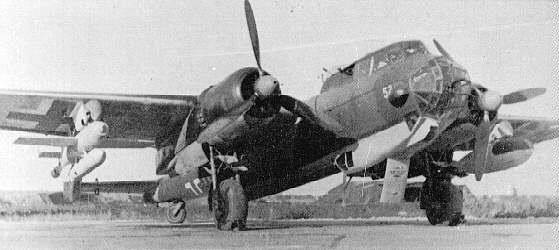
A Do-217 bomber with glide bomb under the right wing. This is the weapon that caused the fatal explosion in HMT Rohna's port side trooper compartment, that led to the sinking of the Rohna and 1100 deaths. See Do-217 glide bomb sinks HMT Rohna; 1100 Soldiers Lost. German Aerial Torpedoes, Glide Bombs, Pierce Well Defended Naval Convoys for a Rohna ship's officer's account of the air attack and details from other ships in this convoy, and the devastating results.. Pastor Quam now resumes his account.)
I then picked up another bomber coming our way. Right there and then, there was a terrifically sharp crash! I was thrown against the porthole so hard that the helmet cut my forehead. The room was pitch dark!
The first thing that I thought about was to get out! When I fumbled around in the dark, I found that the walls of the cabin had fallen down. I crawled out where the wall had been.
Now I smelled smoke and burnt powder!
When I came into the hallway, it was filled with boards, planks and beams. As I crawled over this rubble, I saw a ray of light to my right. I moved toward it and found that a port, used for disposing of refuse, had sprung open.
As I looked down the side of the ship, I saw heads of soldiers sticking out of the portholes. I will never forget the look on the face of that young soldier as he looked up at me and cried, 'For God's sake, help us! We're trapped.'
I doubt very much if they got out. When I moved back into the hallway, 1 saw smoke and flames coming up the gangway.
Then, suddenly, I thought of the flashlight I had in my suitcase. It was an old one that my friend, Reckseen, had given me. The day I left Oran I had gotten batteries for it. At that time, I never thought it would save my life!
It was so dark that I could not locate my cabin. Suddenly I remembered that I had a book of matches in my pocket. I lit a match and saw ONE board standing! And that board had on it, the number of my cabin.
I knew where my bed was. I reached over it, got my suit case, opened it and the first thing my hand touched was my flashlight!
You'll believe me boys when I say I was overjoyed!
With the aid of the flashlight, I managed to get on deck. There Reckseen was the first one to greet me. He asked calmly what we should do. I told him we had better wait for orders to abandon ship.
I saw a mine sweeper standing by some distance from our ship. I was wondering how we could get over to it. Then when I turned around to look for Reckseen, he had disappeared in the crowd and I never saw him again.
I walked over to the railing and I saw the soldiers go down the rope netting, and also, I saw what happened to the soldiers as the life boats hit the water!
I decided it would be safer to go down one of the ropes hanging over the side. Then I'd swim over to the mine sweeper. So I climbed over the railing and went hand over hand down the rope. I soon found out that I was too heavy to go hand over hand, so the rope slid through my hands.
I had gone only a short distance down when the friction of the rope burned my hands, so I let go and dropped twenty feet into the water.
When I hit the water, I really went under! I was so far down that I thought I'd never come to the surface again, and feared I was sucked under the ship.
As soon as I got to the surface, I started to swim against the big waves towards the mine sweeper. A so1dier passed me in the Weismuller fashion. He called out, "How goes it, pop?"
I was out of breath when I got to the mine sweeper, but I thought I could get on board. There was no netting on the side for me to climb up on. There were only a few ropes hanging on the sides.
I was hanging on one of these ropes but I was unable to pull myself up on the deck. Then several soldiers came along and hung onto the same rope. I didn't feel safe with so many trying to hang onto the same rope. I was afraid that I might be pushed under.
I let go and drifted by the bow of the ship.
After floating around for a while, I saw something that looked like a box. I went for it and found it was a raft from the ship. It was one of those that barely floats on top of the water. By the time I reached there, several soldiers were there.
It was now becoming dusk and we drifted away from the ship. We could now see that our ship was burning. We also heard airplanes coming very low towards us. Their machine guns were barking.
More soldiers came to our raft. We were holding onto small ropes and it became very crowded. I was worried lest I would be forced against and under the raft by those who were crowding in. I, therefore, dropped away and let others in. Again I reached for another rope and hung on.
As time went on, I heard less cries for help and saw fewer flashes from flash lights.
Those who were by our raft were a curious group! Some prayed, others cursed. Some crowded in, disregarding every one else; others helped the weak and the exhausted.
In the distance, occasionally we saw a search light beam. Whenever we saw it, cries for help went up all over the water.
Several times this beam seemed to come towards us, but then it went away! As it turned away, many of the soldiers became more discouraged, and that again brought more prayers and more curses.
It was now pitch dark. There was no moon, but the stars were bright. We could not see any of the ships, only a few rafts. Everywhere we could hear cries for help. Here and there we saw flashes from flash lights.
I was feeling very cold now and I started to vomit as I had swallowed so much sea water.
A life boat loaded with soldiers came along side of us. Most of the men from our raft swam for it and attempted to get into it. The struggle ended with the boat turning over!
Those who were not pulled under came to our raft. Again I let them crowd in. It was very difficult to hang on as my hands were very cold and tired!
Every time the searchlight turned away, I wondered if we would be discovered. Then I thought of you and Mother. It seemed so very difficult to let go of you. I wanted to come back to you, but it did not look too promising.
FINALLY, the search light came our way and we could see the ship: It came directly at us and we feared it would run over us. I left the raft because the sea was rough and I feared I would be crushed between the raft and the ship.
All men were helped on board. I was out there alone but I knew they saw me. A rope was thrown me, but when they tried to lift me out of water, I was too weak to hang on. Then they threw me a life buoy and pulled me over to the side of tile ship. When I was half way up, a big wave came and pulled me back into the water!
Now, for the first time, I lost my calmness. I was so weakened from the struggle that I didn't think I would be able to climb the net. Then, too, it seemed that I was drifting to the aft and into the darkness.
Again they threw me a buoy and pulled me into the net. I started to climb again when the waves threatened to wash me back, but now I felt hands on my shoulders and before I knew it, I was on deck!
It was now ten o'clock- five hours since I went down the rope from the stricken ship.
No one will ever know what a feeling of relief comes to a man in a case like this, unless he has had a similar experience. Over and over again I thanked the sailors who pulled me up, and over and over again I thanked God, whose protecting Hand had been over me. Again, John and Paul, I thought of you and Mother.
1 was taken below by the sailors, undressed, dried with big fluffy towels, and tucked into soft, snowy white blankets. Then they gave me hot coffee and sandwiches. Those sailors were marvelous! I shall never forget their kindness!.
Our ship was loaded to capacity, and it headed for the North African coast. We docked at Phillipville at 7:30 in the morning.
Well, boys, that's the whole story - at least most of the details. There must have been Unseen Hands holding me up and giving me strength and courage. Perhaps these Unseen Hands were sent by yours and Mother's prayers. I thought of your folded hands as I was out there, and they were a consolation to me.
So, as you wait for me to come home, pray for my safety, but better than that, pray for yourself and for those whom you hold dear, and even for those who may consider themselves your enemies.
Praying hands are beautiful hands. With love, Your Daddy"
(Having completed the insertion of his1944 letter to his sons, Nels Quam's autobiography excerpt continues...)
On Solid Ground
"The rescue ship which was a minesweeper (Ed. note USS Pioneer AM-105), took us into Phillipville, North Africa in the morning. The wet clothes that we put on that morning we kept on during the day and they dried on our bodies. We were taken to an English camp where we had a meal and also were given an English jacket, somewhat like the Eisenhower jackets. We stayed in a hotel over night. The Red Cross made this available to us.
"During the night while in bed, I started to scratch myself all over. I wondered what could be the trouble. As I arose from the bed and turned on the light and looked under the blankets, I saw the mystery. On the sheet were crawling dozens of big bed bugs. My sleep that night was finished on the floor.
"By this time I met three other Red Cross men who had been rescued from the shipwreck. Mr.Jeff Sparks, Eienstein, and Harrington. Mr. Harrington had been hurt and also was very nervous. He asked to be sent back to the United States. Mr. Sparks had managed to get into a life boat and was rescued. Mr. Eienstein had been floating on an oar until two o'clock in the morning. He was not a swimmer. When he was picked up, he had trouble getting his arms off the oars. He was so cold that he could not straighten his arms.
"From Phillipville we were flown to Algiers and there we contacted the American Red Cross and were fitted out with new uniforms. From there we went to Tunis and Bizerte. There we stayed several days until Mr. Sparks obtained an airplane ride to Sicily. He had heard that the Air Force made regular runs to Cairo for the purpose of bringing back liquor.
"The Air Force must have had an ample supply on hand because no plane was going to Cairo in the near future. One evening while we were there, we went to see a movie and while there the ushers came around and whispered to the spectators, "There is an air attack on the city of Catania." The air field where we were was not bombarded and we had no objection. We had to return to Tunis.
"While we were in Tunis, we met a soldier from North Dakota. We had a conversation with him and found out that he had not received any letters from his folks. Then we asked, "Don't you write to your folks and give them your CPA address?
"He answered, I cannot write because I don't know how to write." We could not understand that a young man born in North Dakota could not write so we inquired about the reason for his inability to write. Well, it was this way. I had to herd sheep on my father's farm so I did only finish third grade.
"I told him, "If you will tell me what to write, I will write your letter to your folks." So I did.
"As I have mentioned previously, we were destined to go to India and we did not want to go by ship from Tunis, because we knew that the German Air Force on the Island of Crete would attack us again and we did not want to get soaked again. So we tried to obtain air transportation to India. Mr. Sparks was our spokesman. He obtained permission to board a plane going to Cairo. We hoped to get transportation in Cairo to India.
"We were off to Cairo in a C-47. This plane stopped in Tripoli where we stayed over night with the English. We were called early the next morning and were offered a spot of tea. If that was typically English tea, then I prefer American tea. The flight was delayed because the pilot did not show up on time. We stopped at Bengasi and Tobruch and finally arrived at the air field thirty miles from Cairo. From there we took the bus to Cairo where we went to Shepherd's hotel for our night's lodging.
"While we were in Cairo, we took a horse drawn taxi to the pyramids for a sightseeing tour and had a ride on a camel. There we met Miss Wisby, a Red Cross girl, from Camp Huckstep on the desert south of Cairo. At the hotel, we net Joe E. Brown, who was entertaining the troops. The next night we slept at Grand hotel that was taken over by the American Red Cross. We also had our meals there and we were treated royally.
"I still was very nervous and had trouble with sleeping - a result of my experience in the Mediterranean. Mr. Sparks told me to see Mr. Bailey of the Red Cross in Cairo who could suggest a doctor I could see. I did as Mr. Sparks advised and met with Mr. Bailey. I told him about my condition. He said, "We can recommend that you return to the States."
"No, I said, "I did not come all the way overseas just to go back to the United States."
"Then he said, "If you wish, you can stay in Egypt. We have a place for you at Camp Huckstep located in the desert south of Cairo." I accepted the offer. The next day I went to Canp Huckstep located in the desert south of Cairo. At the camp I was welcomed by Mr. Buford, the Field Director. I was given a room in one of the officer's barracks. My roommate was a lieutenant who had served in Iceland. He was a very pleasant fellow. I was assigned as assistant field director. The secretary was Hermine Pachemandy, an Armenian, whose father and mother had escaped being murdered by the Russians.
The end of this portion of the Quam autobiography covering service in two wars. For (Army Air Corps') Sgt. Schoenacker's Rohna survivor story, try the following link. (I will put another link at the end of Sgt. Schoenacker's Rohna experience to return to this page.) ../flying/flyingc.htm
I can only add that the minesweeper that rescued over 600 was the USS Pioneer, AM-105. My own experience in the Mediterranean seawar was on a U.S. destroyer, July 1942-October 1944. It is covered in my book, "Joining the War at Sea 1929-1945." In that book, the Rohna disaster is covered with the official report of her 2nd Officer. Pioneer's brave and heroic efforts while under continuous attack, to rescue hundreds of near-to-drowning victims in rolling swells, at night, are an unforgettable tale of World War II. Many persons in my acquaintance (most now deceased), close to the event, tried to obtain Navy recognition for Pioneer's unbelievable story of lifesaving. Their efforts have not been successful. Shame on my Navy for this omission! Franklyn E. Dailey Jr. 06/25/2008
This page continues now with more on convoy KMF-25A.
I received insights via e-mail from two men in passage on transports in KMF 25A, Ron Coward of the Royal Artillery, and Gordon Devey of the Royal Engineers. Let me make just one further clarification before I let the words of those two men take over. In the published book, I emphasized the men and materials aboard the ships that would leave the convoy at some Mediterranean port for re-routing to Naples or Palermo or some "local" destination. I did mention that the ships continuing eastward through Suez provided a slender sea thread to eventually make a port where overland supply movement to the Soviet Union could be effected. I failed to mention the enormous British commitment to CBI, the China-Burma-India theatre of the war.
Two men supplying original eyewitness information in the following paragraphs were headed for the CBI theatre as their tales will make clear.
First, an e-mail received from Ron Coward, on 01/02/2001.
"Dear Mr Dailey
I refer to Joining the War at Sea 1939-1945 which I looked at on the internet.
Then a Lieutenant in the Royal Regiment of Artillery I boarded MV RUYS in the Clyde at Glasgow in October 1943 as part of draft REKOY 16 officers, all gunners. Sailed out to sea in Firth of Clyde, north about Ireland, then half way across the Atlantic in convoy, then south, then east to Straits of Gibraltar. Scuttlebutt as we passed Tangier, 'There is the German consul with his telescope reporting us.'
Below decks, during the aerial attack on KMF-25A on Saturday 6 November 1943, I saw nothing of the action, but heard plenty from my post at the foot of the wide accommodation ladder leading down to the midships troop deck. We were equipped with sidearms, and orders to prevent any troops from going topsides during the rescue operation. The Dutch ships' officers organised taking on board survivors (of the Marnix Van St. Aldegonde) most of whom were bedded down on pailliasses (mattresses: in the British Army, a canvas envelope about six feet long and the width of a human body. These opened across the middle and were closed with tapes. Straw was stuffed in to create the mattress) on the open promenade deck. Troops were forbidden from open decks for fear of causing the ship to capsize if they lined the rail on one side. It was said that the survivors taken on board numbered half as many as the troops already being carried. Master of the RUYS brought his ship alongside in Philippeville to disembark survivors. I witnessed the sinking of the SANTA ELENA a mile or so out to sea. Her stern reared right up in the air and down she went.
RUYS made a dash down the Mediterranean unescorted, relying on her speed and went through the Suez Canal alone en route to Bombay from which I eventually made it to Assam and Burma. RUYS with her sister ships BOISSEVAN and TEGELBERG were all named after the founders of the Royal Packet Co. [K.P.M.], their original owners. All three were notable not only for their accommodation, but as the world's first large triple screw motor ships. Originally operated from Orient as far west as South Africa. Later owned by Royal Interocean Lines, Amsterdam and Hong Kong (Kon. Java-Paketvaart Lijnen, N.V.) Built 1937 by Blohm & Voss, De Schelde, Netherlands S.B. Co. RUYS gross tonnage 14,285 D.W tonnage 11,946; Dimensions 561x72 ft. Draught 30 ft 1 in. Engines Sulzer type diesels. Triple screw. Service speed 17 knots. Passengers 104 first, 2 cabins de-luxe, airconditioned, in other classes 326.
As it happens, I shared the starboard deluxe cabins with 15 others in upper and lower bunk beds. A Royal Navy draft of 16 had the port cabin. All the public rooms had been left untouched for trooping. The troop decks were crammed though.
There has recently been correspondence in Dekho! which is the quarterly journal of the Burma Star Association about this convoy, particularly the MARNIX VAN ST. ALDEGONDE and the rescue of her survivors by the RUYS. I could photocopy them if you want.
Hope this is of some interest to you.
Captain R.A.L.Coward Royal Artillery"
A second e-mail received from Ron Coward 01/02/2001:
"Franklyn
"The British awarded campaign medals in WW2 for service in combat areas e.g. Italy Star, Africa Star, Burma Star etc etc. I hold the Burma Star.
"This is from the journal of the Burma Star Association (issue of Winter 2000), 4 Lower Belgrave Street, London SW1A0LA phone 020 7823 4273. At page 14 of the journal, Bernard A Braeburn of Blackpool wrote:
'Dear Sir
'Replying to the query raised by Eric Lyndon-Moore in the Spring edition, I was in a draft of the Green Howards on board the Marnix Van Ste. Aldegonde. The convoy was attacked by twenty-five German torpedo-carrying aircraft, of which five were shot down. Two other ships were sunk.
'I am not aware of any panic rushing to the deck. In fact after the ship had partially righted itself we looked at each other and said "Cheerio chaps, this is it," shook hands, sat down at our mess tables and started singing. Later in the evening we went on deck; all we could hear was the sound of water coming in below. I went to sleep on deck. The ENSA personnel, WRENS (sic) and nurses were apparently taken off but most of the troops remained on board.
'The following morning we assembled at boat stations where we remained for several hours. An American destroyer tried to come alongside but was prevented by the heavy swell. Eventually we clambered down the scrambling nets and onto rafts. We were picked up by an American destroyer and given a good meal. Afterwards we chatted with some of the crew and exchanged photographs from home. We were then taken to an army base camp near Phillippville.
'After three or four weeks we embarked on a Combined Operations ship which was attacked by enemy aircraft every evening as the sun was going down until we arrived at Port Said. We disembarked at Bombay on Christmas Eve (Ed. 1943) to the strains of Bing Crosby singing White Christmas on a gramophone on the quay and then straight to Deolali. After a few months at Deolali I was posted to the 1st Bn, East Yorkshire Regt and thence to the 17th Ind Div during the race to Rangoon.'
"How about this for a first hand account?
Ron"
A third e-mail from Ron Coward on 01/02/2001.
"Franklyn:
(This on pages 14 and 29 [of the Journal?] is from G Hill of Chesterfield. Apparently Mr. Hill is adding his thoughts to what he had read and was politely correcting a Mr. Wright who may have mis-identified the attacking aircraft.)
'I was particularly pleased to note the resurgence of interest in the Mediterranean convoy attacked by German torpedo carrying planes, (Heinkels, Mr Wright) in early November 1943 occasioned by the article by Mr French, having myself also been aboard the STRATHMORE on this occasion, and being interested in anything connected to this convoy.
'As you know, interest in this convoy was first stimulated by Mr Revell in the Winter 1992 issue, (Revell being) a survivor from the Dutch ship "Marnix van St Aldegonde", which was one of two troopships lost, as was the American destroyer Beatty.
'I am just a little puzzled, however, to note that the accounts I have so far come across of survivors from these sinkings have all been from the Marnix, with not a word from the Santa Elena. Is there no one still out there?
The historically minded might be interested to know of other accounts concerning this convoy, which are contained in:
'1. CHRONOLOGY of WORLD WAR II (compiled by Christopher Argyle) a short factual account of the main details.
2, DISASTER at BARI (Glen Infield - 1971) a non-specific account referring mainly to the use by the Germans of the radio controlled bomb known as 'Fritz X' (Readers of "Joining The War At Sea" will know this as the FX)
3. QUIET HEROINES (Brenda McBryde - 1996) which includes an account by a QAIMNS Nursin Sister, Maureen Ferris, who survived the sinking of the Marnix.
4. BLOOD on the SEA (Robert Sinclair Parkin - 1996) containing a description of the sinking of the Beatty. Any others anybody?
'May I hope the comments of Mr Shaill and Mr Wright (Issue 134) might have finally "put to bed" the misconception of the date on which the above attack took place? It was (underscored) November 6th and not the 5th, and it was (underscored) Saturday not Sunday. (Refer to 1 and 4 above and my diary!).
Finally, may I also tongue in cheek, but totally without malice aforethought, ask Mr French what on earth he was doing in the STRATHMORE just south of Marseilles, when the rest of us were at the same time, just north of Cape Bougaroun, Algeria.
G Hill
Chesterfield'
Ron"
p.s QAIMNS is the acronym for Queen Alexandra's Imperial Military
Nursing Service
The next e-mail is from Gordon Devey, of the Royal Engineers. It is quite short.
(The reader will need to have read Ron Coward's earlier e-mails above. That said, it is very funny as the reader who reads closely will perceive.)
"Franklyn - Thanks for your KMF 25A Jan3/01. I still am unable to be sure of the convoy I was in. I was in the Commodore's ship which was a Strath (the Strathmore I think). We sailed from Liverpool. 'We stopped in Gibraltar to pick up a WREN officer and her tons of luggage and then reformed the convoy.
"Rumour had it that we were escorted by an American AA cruiser as well as other smaller ships which we could see but not recognize. In the attack made at dusk it was rumoured that a ship with ENSA (entertainment people) was hit and sank off Philippeville. I found the attack exciting - lots of fireworks which I stopped to see on my way down to be with my draft of Engineers. That's all I know.
"It would be interesting to read your book, Joining The War At Sea 1939-1945, and the appendices. (Ed. Note. The appendices are also listed at seatoc.htm.)
"The Straths and others were familiar ships as I with other school children from the Rio Tinto Mines in the SW of Spain traveled in them two or three times a year to and from school in England. Gibraltar was very familiar.
Gordon Devey"
It is not surprising that Gordon Devey sailed from Liverpool and Ron Coward from Glasgow. Look at the routing of Coward's original convoy. There were many change offs and opportunities for ships which had not started out together to meet at sea and be joined into another convoy.
Ron Coward has also forwarded for this appendix a Santa Elena survivor's letter. This is a letter to his parents from a 34 year old Canadian medic, Wally Plumpton, who was rescued from the sinking of the Santa Elena. The original is held by Wally's nephew and a copy was given to Ron Coward, who transcibed it for this appendix. Here in that medic's own words:
Attack on SANTA ELENA in Mediterranean convoy KMF 25A 6 November 1943 as told by D-92505 QMS W J PLUMPTON 14 Canadian General Hospital RCAMC Canadian Army CMF in a letter to his parents dated 4 January 1944 (somewhere in Italy)
"D-92505 QMS. W.J. PLUMPTON, 14 Canadian General Hospital, RCAMC Canadian Army, C.M.F,
"4 January 1944
"(somewhere in Italy).
"Letter 5
"Dear Mum and Dad,
"I have no idea how my mail is arriving back there, or for that matter whether it is arriving at all, as I have had no letters for some time. All the other lads are in the same position, although one or two have had fairly recent letters, but they seem to have got over, apart from the main shipment somehow. Everyone who has had any mail from Canada reports that at the time of writing their folks still hadn't heard from them, so I expect you have had a long wait too. I had a letter from Aunt Janie the other day, in which she told me that Joan had been up to see them and had told them that she had received a cable from you saying that you had received her cable, so at least I have the satisfaction of knowing that you received word of my safe arrival sooner than you would have done. I'm particularly glad of that, because from all accounts you have had some pretty lurid reports of our escapades, and you must have been rather worried.
"Now that the affair is common knowledge, I can tell you something about it. Actually we came off very lucky, although of course, we lost everything we possessed, with the exception of the clothes that we had on at the time. I was working in the office when the action started, having just finished supper and a tour round the deck, and as my cabin was some distance from the office, I had no chance to rescue anything. At first I thought it was just another practice alert but when the firing started, I realized it was the real thing. It was safer below decks, so I stayed in the office and tried to get on with my work, to keep my mind off what was happening, but that took some doing! The din was terrific. We could hear planes, and tell when they were getting close by the intensity of the firing. Several times there were loud explosions as bombs hit the water near us, causing the ship to shudder, and my heart to do a couple of flip-flops, but we kept going and I felt sure we would beat off the attack. A couple of times planes roared along the length of the ship and I could hear the chatter of guns as they strafed the deck. What with that, and our own guns blazing at them, it was pretty noisy, and from the sound of things it was very evident that there was a H------ of a fight going on. It wasn't very comfortable having to stay below like that, and get all the action purely from the sound of it, but that that it was safer than being up top in the open. After a couple of particularly vicious bursts of firing, the sound seemed to subside a bit, and I thought they had been driven off. Suddenly the guns seemed to go crazy, and there was an absolute frenzy of firing. I could hear the roar of a plane coming fast and low, the boat seemed to tremble as everything we had blazed away like mad, there was a roar of motors as it swept over us, and then suddenly the most terrific crash I have ever heard and the ship leaped as if it had been hit with a tremendous sledge hammer. The typewriter jumped on the deck, all the lights went out and I could feel the boat heel over and then settle. Flakes of paint and dust were settling on my head, and as the office was pitch dark I had no idea what was happening, except that I could hear people outside the door, which had slammed shut with the explosion, clattering past to their stations. Bill Jones was with me in the office, and I remember him making a dive for the door, and my telling him to take it easy until we found out what was happening.
"The office was right at the foot of the main stairway, and when I opened the door, I found that they had got the emergency lighting on, which gave a dim light, and showed that it would be impossible to get up the stairs for a time, as the Nurses were being cleared from the deck above, and we had to wait until they were out. I could see that the stairs were on quite a slant, and I wondered just how low we were in the water, and whether she was going to go down before we could get above decks. Everyone was standing quietly, waiting for their turn to go up so there was nothing to do but just stand and wait, and believe me, the few minute I had to wait at the bottom of the stairs seemed like hours. I freely admit that I was so scared I didn't even realize it, if that makes sense. The things that went through my mind during those few minutes are very clear still. And I can remember thinking how very quiet it was. Actually it was quiet inside, except for the shuffle of feet on the stairs, yet outside there was still quite a battle going on somewhere. Inside there, though, it seemed to be remote, as if that phase of the affair didn't matter any more, yet at the same time I remember thinking that I hoped they would clear off before I got out on deck, because there would be quite a lot of lead flying around. Eventually the stairs cleared enough for me to get up, and I went up and out on to the promenade deck. It was pitch black out there, because it had been closed in, but there were openings about four feet square every twenty or thirty feet, and it was through these openings that we had to get away from the ship. There were a lot of men on that deck, and we all realized that it would be some time before we could all get off, especially as we had to wait while they put the sisters into lifeboats and lowered them away. I shall never forget how quietly those men stood in the pitch dark, absolutely unable to see a single thing that was going on, and not knowing how far down we were, or whether there was the slightest chance of getting off. It was impossible to see who your neighbor was but the lads just stood and if someone was beside them, chatted as calmly as if they were having an after dinner chat on the deck before going to bed. When I realized that it would be some time before we could go over, I felt my way back to the stairs again, and tried to get down to the cabin to see if there was anything I could save, although I knew I could only get what small things would go in my pockets. However, it was useless, and as the ship was beginning to settle a bit (you could feel it sort of slither underfoot every once in a while) I decided it would be a bit too risky to get away down below decks again, especially as there was no light and I would have to grope my way along in the dark. Just after I went back on deck again some of the bulkheads below water blew in from the pressure with dull shuddering roars, and I thought that the old boat was going to blow up and founder then and there, but she didn't. It was a lucky thing that I came back on deck when I did though.
"It is a funny thing what strange things one will do in a time of strain like that. I can remember feeling in my pocket for something, and finding some candies that I had bought earlier in the day. The silly part of it is that as I waited my turn to go over I methodically stripped the paper off toffee squares and munched on them, and held the sticky paper in my hand because it was too dark to find a trash bin, and I wouldn't think of throwing it on the deck! I think that during the hour or so that I waited in the dark on that deck the thing that I wanted most was a cigarette, but of course, it was impossible to smoke as any light of any kind was forbidden. I'm not going to try to tell you what I thought about all that time, I was nervous, but I don't think I was very badly frightened, after the first initial fright had passed off. Without wishing to appear sanctimonious, I know that while waiting at the foot of the stairs, I said my prayers, and somehow after that I seemed to feel more settled. The planes had gone by this time and it was so very quiet, except for the sound of orders given, in a businesslike way, to lower boats, and the rumble of the pulleys as the boats slid down to the water. As a boat loaded with Sisters went by the opening on our deck, the boys that were against the rail called out wishing the girls luck and the Sisters shouted back again, just as if it were some sort of amusement machine at a fun fair. The last I had seen of Bill was as he was going up the stairs. I got cut off from him, and as I went up I shouted "Good luck Bill" but he didn't hear me. As I stepped into the passageway where the Nurses were coming from, on my way up, I met Frank Jones' sister, Enid, on her way up to the boats. She said "Hullo", as if we were meeting in the street or something, and I said "Hullo Enid, lot's of luck. Up you go", and helped her over the doorstep. She just smiled and said "Cheerio", and went on up to the boats. It is funny how vividly little things like that are retained in the memory afterwards. I didn't see her again until we had been ashore a couple of weeks because she was picked up and taken somewhere else.
"When it finally came my turn to go on the deck I took off my watch and wrapped it in my handkerchief and then folded it tightly in a little leather wallet I had in my pocket, and put the whole thing right inside my shirt next to my skin, in the hope that I would be picked up, or manage to get on a raft, before the water soaked through. Then I kicked off my shoes, climbed over the rail and started down the scramble net. It was very dark, but I could see that the ship was gradually getting lower in the water at one end. Just as I got near the bottom of the net, a big wave washed up and lifted me off the net and against the ship. Golly, that water was cold! As soon as I felt myself free of the net I struck out, because I knew that the one thing to do was to get as far from the ship as I could, in case she went down, and the suction took me with it. I really swam hard for a few minutes, and then, as a wave lifted me into the air I saw a raft a little distance off with some men hanging onto it, so I made for that. It was impossible to get into it, but I looped one arm through the rope along the side and hung on. The waves kept washing us back towards the ship again, and we had to kick like anything to keep ourselves away. Then someone discovered that there were a couple of paddles tied inside, so we worked them loose and took tuns straddling the sides of the raft and paddling like mad until we were far enough away from the ship to feel safe. While two paddled the others held on with one hand and kicked and splashed to help out. I heard someone speaking and thought I recognized the voice, and discovered that Dick Hardy was hanging on the other side. I asked him if he had seen Bill, but the last he had seen of him was getting ready to go down a rope from the forward deck, and he had no idea where he was. We couldn't do very much talking, because every time we opened our mouth we got a mouthful of salt water, and as I already had swallowed more than was good for me when I got my initial ducking, I didn't want any more that I could help, and besides we needed all our breath for maneuvering the raft.
"We had no idea how long we would be in that position, although we knew that there was a boat standing by to pick up what survivors they could. It was so dark, though, and the waves were rather high, and it seemed quite possible that we could easily be missed, as we were in the water up to our necks, and didn't show up very clearly against the sky. After all, heads bobbing round in dark water aren't exactly noticeable from any distance. As the time wore on, I, for one, began to get a bit anxious, because the water was getting colder and colder the longer we were in it, and I was beginning to get very tired. One of the older men slid under, and we had an awful job getting him up on to the raft, where his head would be above the water. He only had his undershirt on and was suffering pretty badly with the cold. A couple of us tried to get our jackets off, but we had lifejackets strapped on, and the knots had tightened up with the water, so it was impossible, especially floating in the water. The life jackets made it easier for us to float, but after a few hours they began to get waterlogged, and it got more difficult to keep up. After a little over four hours I was beginning to feel that I couldn't hang on much longer - the time had seemed four or five times that long - when we heard someone shouting, and as we rose on the crest of a wave we saw a lifeboat silhouetted against the sky. We raised every bit of our breath and let out an awful holler, and in a few minutes they were alongside us. It was a terrible job getting Jack into that boat because he couldn't help himself, and we were all pretty well played out ourselves, but we managed it. I have no idea how I got into it. I know that under ordinary circumstances I could never have done it, but having lasted out so long, I had no intention of giving up then. I just remember someone getting hold of my hand and someone else grabbing the leg of my trousers and hauling me into the boat headfirst. It was too dark to see who else was in the boat but it was pretty well crowded, and all I did was lie in the bottom of the b oat and shiver. It was actually colder in that boat than it was in the water.
"As soon as everyone was hauled aboard they pulled for the ship, and then the fun began. It was quite a big boat and there was a heavy swell running, so that the lifeboat bobbed up and down and the rope ladders they had slung over the side rose and fell about fifteen feet every time the ship rolled in the swell. There was a heavy bar across the bottom of the ladder, and as I crawled forward to make a grab for it, the thing came down across my wonky leg, which was beginning to feel the strain anyway. I hardly felt it at the time but made a grab as the ladder started up again and was literally jerked out of the boat and left dangling by the arms in mid-air. Then I had to scramble like mad to get far enough up the ladder so that when it came down again I wouldn't be dashed against the lifeboat. The first mad scramble was done automatically, but when I started to climb up the ladder I realized how exhausted I was. It took me about twenty minutes to get up the thing, going a rung at a time, and then looping my arm around the rope and just hanging on for a couple of minutes and then going up another one. Near the top I missed my footing and slipped back, but luckily my leg went inside the rope and I caught myself. When I got to the top there were some lads hanging over the rail waiting for me, and as soon as I came within reach they reached down and caught hold of whatever they could get a grip on, and pulled me over the rail, where there were others ready to help me across the deck, and into a cabin, where they stripped the clothes off me, rolled me in blankets and gave me a good rubbing down. Someone else appeared with a bowl of steaming coffee and someone else stuck a cigarette in my mouth and lit it. Those lads were really wonderful. They emptied their bags and took out dry clothing, and took my watch and things out of my pockets and put them away. Everything in my pockets was absolutely sodden, of course, and my watch had stopped long before, but we managed to get the papers separated and a couple of snaps I had in little book straightened out, and they dried out all right. It was after I had been in the cabin for a little while, and got so that I could talk without biting my tongue, or chattering the enamel off my teeth, that I discovered how long I had been in the water. I was very much surprised to learn that it had actually been so short a time, compared to what it had seemed like. One of the boys rolled me in his bunk when I had a couple of cigarettes, and they sat beside me talking until I dropped of the sleep. Those lads were grand, and they did just exactly the right thing by keeping up a running conversation so that I didn't have time to stop and think about anything until I fell asleep. If I had been left alone I would probably have lain awake for hours reviewing the whole thing over and over again in my mind.
"I was worried about Bill and the other boys, and as soon as I could get around the next morning I went looking for everyone I could find. Finally I ran into Bill, wandering along one of the decks, asking everyone he saw if they had seen me. We were pretty glad to see each other, and in comparing notes, discovered that he had been picked up by the same lifeboat that had picked me up. They had picked him up about half an hour earlier, and were searching for whoever else they could find before going back to the ship. They were just about to give up when they heard us shout. He had no idea I was in the boat until he met Dick, who told him that he and I had been picked up together, and he knew that Dick had been in the same lifeboat as he had. The rest of the trip on that boat was pretty nervewracking, because we were all pretty jumpy, and after the first night's sleep, I didn't sleep more than a couple of hours until we were safe ashore. I don't know whether I have told you before, but before we left England, I was seconded for and made Ship's Office Sergeant Major, so although my unit was aboard ship, actually I was in charge of the office of the ship as a whole, and was more or less detached from the unit. There was a lot of work to do, but it was a lot better than being idle during the voyage, and when we got aboard the other ship I had my work cut out trying to get out lists from memory. It was quite a job, but at least it kept me so occupied that I had very little time to worry much about the position that we were in. I can't tell you now about the remainder of the trip, because it wouldn't do to give Jerry any idea of how we outwitted him and gave him the slip, but I can tell you that the final run for it was about the most thrilling experience of the whole trip, as far as sustained suspense was concerned. Keyed up as we were though, we all had a great feeling of pride in the knowledge that we were thumbing our noses at Jerry, and getting to our destination despite his attempt to stop us. It was grand to see the way the boys acted throughout the whole affair, and when we disembarked, although we were far from being the smartly turned out bunch we had been when we left England, there was a swing of pride in the walk of every man, and the pipe band that met us and played as we landed made us all feel that we had earned the right to a few heartfelt cheers. I don't think Mother would have recognized her eldest if she had seen him just then. I had a pair of running shoes that were about four sizes too big, a pair of linen trousers turned up four or five times around the bottom and held up by a length of rope, no hat and a few days growth of beard, but I had rescued my tunic, (which incidentally, had shrunk and wouldn't button), but it still had "Canada" across the shoulders, and somehow that meant a lot to me. Some of our Sisters had been rowed across to the ship that picked us up, so came ashore with us, and we learned later that the others had been picked up by another ship and were all safe. They joined us later.
"I believe the Jerries made some pretty expansive claims about the whole affair, and I was rather worried that perhaps you would hear about it at home, and if you didn't hear from me for a long time, you'd get worried. One of the boys lost his father over it, as a matter of fact. He only heard about it the day before yesterday. It seems his father had been ill, and someone came to the house and said that they had just heard that there had been an attack on a ship and that our unit was aboard and everyone had been lost. It was such a shock that his father dropped dead. I think it is terrible. People should keep their mouths shut until they know what they are talking about. When we first arrived, I didn't know whether the news would get around at home or not, but I knew that Joan would cable you when she heard from me, so I got an air-letter off to her as soon as I could, knowing that it would reach England a lot quicker than a letter to Canada. From the accounts some of the boys have had in their first letters from home it would seem that the affair was given some prominence, and I only hope that you haven't had too much worry over it. Actually, it was a very minor incident, taking the war as a whole, and we were all extremely lucky. It was hard to lose so much of our personal stuff, but things like that can always be replaced.
"Your loving son,
Wally."
Biographical information on Ron Coward.
Born in England in 1922. Part time military training from age 15 to 18 with Ellesmere College contingent of the Officers Training Corps at boarding school. (Called Public School in England); Sgt. Instructor to 3rd Battalion Glamorgan Home Guard 1940. Enlisted in Territorial Army as volunteer 1941 - Royal Artillery, served in 77 HAA Regt. RA (RA) and 79 HAA Regt. RA (RA); Commissioned from 124 OCTU 1942 posted to 149(M) HAA Regt. RA; Draft REKOY to India October 1943; Posted to 1 Mobile Anti-aircraft Regt. RA at Ranchi, India, then, Chindwarra India before posting to 66 (Leeds Rifles) HAA Regt. RA (RA) at Digboi and Tinsukia on the Assam oilfields also near US supply base at Chabua from which supplies were flown to Chunking over the Hump; Staff Captain GSO3 HQ 15 Army Group RA in India 1945; Released 1946; Placed on Z Reserve of Officers recalled during the Cold War for 2 weeks;
Ll.B (London) 1948; admitted to the roll of solicitors 1950; admitted as barrister and solicitor Sakatchewan, 1957; Solicitor-General of Bermuda 1973; now retired in Victoria BC. Ron Coward, e-mail address coward@attcanada.net, has done some research about, and may be a source for information on, KMF-25A, Marnix van St Aldegonde, Santa Elena and Monterey. This is Monterey's first appearance in these lines but as inquiry to Ron Coward would bring forth, Monterey was the ship that successfully conducted one of the greatest open sea rescues of all times.
Biographical information on Gordon Devey:
Father and Mother - both English born - went to British owned Rio Tinto Mines in S.W. Spain in 1921; Father as Chief Electrical Engineer. Father had been in Boer War as boy "Galloper"; in 1914-18 War, Father served at Gallipoli, N. Africa, and France as Major Royal Engineers, Field Companies. Left Spain and Rio Tinto mines in 1940 to escape rumoured German occupation.
My brother was a Wing Cmdr in RAF Coastal Command; was in Gibraltar I/C Squadron during N.African invasion.
My volunteering for a special force was hoping to go to Italy NOT repeat NOT India. Was in 2nd Wingate invasion of Burma - at end was hospitalized for 6 months in India and later returned to U.K. hospital. Then to Germany I/C Stone Quarries in British Zone, then in unit arranging production of light engineering goods for the army in Ruhr. Left Army in 1948, became Chartered Accountant, returned to Spain for 2 years then to Canada and back into Rio Tinto Mines (Uranium and copper). Last 10 years of employment was in S. America in Consulting engineering and Mining projects.
The following narrative is another view of the KMF-25A convoy and the sinking of the Marnix van Ste Aldegonde. It was added with permission of the author who first placed it on a BBC website page. The author was one of the ENSA girls traveling to North Africa on the Marnix van Ste Aldegonde. Her name is Kate Richards and she identifies herself in her story below as 'ensagirl.' I need to credit her son, Nigel Richards, for making the connection for me with his mother. It was Nigel who discovered this website, my story, and the appendix elaborating on Convoy KMF-25A. The 'copy and paste' from the BBC website was made by Franklyn E. Dailey Jr. on January 29, 2006.
"Torpedoed in Ensa!
"By ensagirl
"People in story: Catherine Lovatt
"Location of story: England,Europe,and the Middle East
"I joined ENSA early in 1943 never having played professionally before. It was an organisation assigned to entertain people engaged in the war effort. This involved munition workers, hospitals, WVS, home front and the armed forces. ENSA was short for Entertainments National Service Association though to many who had seen a show it was known as "Every Night Something Awful"! Our headquarters was Drury Lane, and after my audition as a pianist I was sent a letter enclosing travel vouchers to Cheltenham where I was told I was joining a small concert party touring various munitions and aircraft factories.
" Next morning I was introduced to my fellow artistes. The manager was called Nobby Knight and his first question was "what experience have you had?" Promptly I replied I'd got my teacher's diploma, LRAM. On hearing my reply, his language was very disconcerting to the ears of a well brought up young woman. However he had to put up with me and I soon learnt the ropes. From a small child I had always been able to read new music and improvise and I soon blended in as if I'd been with them forever.
" Nobby had a daughter called Doris who joined the Ivy Benson's girl's band after the war and she had a lovely voice and sang the popular tunes of the day, such as "Yours", "You are my sunshine" etc which the audience loved.
" We always opened with a medley of American tunes with Nobby bashing away at the drums and trumpet plus our violinist and me playing on another ropey piano as a rule! We needed to make a noise, as generally the workers were having their lunch and hundreds of knifes and forks made quite a clatter.
" We used to stay one week at a time and visit the various factories then move somewhere else on Sunday. I remember Bristol well as we went to several aeroplane factories,and also,there were two musicians from the LSO staying at our digs who used to sneak me into the Colston Hall to watch the rehearsals conducted by Sir Adrian Boult.
" One of my first questions on arriving at a venue was "What is the piano like"? It really was a lottery.You just never knew what the instrument was like,and of course,anyone could play on it, so a lot of them were treated badly, notes not playing, pedals not working, not to mention various liquids being spilt on and in the piano! However you just had to get on with it and probably nobody noticed except me, because the audiences were so appreciative,which made it all worthwhile.
" We went to one factory in Warrington which produced high explosives and we had to surrender our watches, lighters, hair clips, jewellery and anything that might cause a spark. This particular factory was in Risley which I believe is a prison today.It was very bleak and we had to do two shows at a quarter to two and a quarter to three in the morning for a week,as of course all factories used to work non-stop during the war. It was a pretty weird experience,but even at that unearthly hour the audiences were so enthusiastic.
" One of the best places was Manchester which was and is a very musical city,and to my delight most of the factories had decent pianos. We even went to one place which had a grand piano, and we had lunch in the board room with the managing director.T,was, not always thus – most days it was spam sandwiches in the canteens!
" Mostly we went to small towns where so many peace time factories had been converted to the war effort. But I remember Liverpool,as one evening I went to the Liverpool Repertorie Theatre and saw the young Margot Fonteyn and Robert Helpman dancing together in `Façade' by William Walton.
"After this,we worked our way up country,finally ending in Scotland where we also went to a few army camps and naval bases. As our tour ended we had a chit from Drury Lane asking if any of us were interested in entertaining the troops abroad. I was delighted to accept and shortly afterwards returned to my home in Hampstead.
" We started rehearsal at Drury Lane,and it was a great thrill for me to be playing on the stage at this theatre where I had seen so many shows as a little girl. Ours was a Welsh show called "Taffy's Twelve". The manager was a magician and weight lifter call `Maskar' and his brother Nat was the butt of his gags and told the old chestnuts! We had a father and son who were ex miners from the Rhondda Valley and played the bones,a tenor from Swansea,a soprano from Blaenau Ffestiniog. We had three dancers including my sister Joan and a whistler from Holyhead and a Londoner who played the accordion and sang. She had been in show business most of her life so rather despised the rest of us as amateurs,but we all got on famously.
" After our final dress rehearsal we went for a short tour around the Home Counties and eventually on October the 25th met at Drury Lane and boarded a coach that took us to Euston and hence to Liverpool which took 13 hours.
" We sailed on October the 26th not having the slightest idea where we were going. The ship was called the Marnix van St Aldegonde,a Dutch cruise ship that had been converted into a troop ship. This I learnt long after the war had ended,as of course no one was ever told anything during hostilities. We were shown to our 4 berth cabin on B deck and that evening had one of the most wonderful meals since the beginning of the war.
" There were twelve ENSA parties including variety shows, straight plays and comedy as well as nurses, WAAFS, ATS and Wrens. We had lifeboat drill every day and were shown our lifeboat stations and so we sailed on little guessing what the future had in store.
" In the main lounge there was a lovely piano and I played there most mornings. The weather was dire,and of course we girls had a very good time! I was introduced to the joys of bingo and bridge and most evening we saw one of the shows.
" On the evening of November 6th 1943 we were in our cabin getting ready for dinner, when suddenly the sirens went. There was an almightily bang and the ship keeled right over,all the lights went out,and luckily for all of us the ship righted itself. The emergency lights went on and you could hear planes and gun fire and I have since learnt that the plane that hit us was a Heinkel and it was shot down. Apparently aerial torpedoes are not as lethal as submarine ones,and in fact our ship did not sink for 24 hours. Someone knocked on our door to tell us to put our lifejackets on and go to the lifeboat stations.
" We waited about an hour to get into the lifeboats, there was about eighty of us including a stretcher case who had been operated on for appendicitis a few days before and the doctor who had attended him passed by with his instruments on his back,and some wag called out `got your accordion mate'
" Once we were in the lifeboat, we were lowered and one of the davits got stuck and we were nearly all tipped out,but I was in such a daze by then that it didn't really register.
" There was a terrific swell on the sea and for the first and last time in my life,I was seasick and every time I leant over,the Filipino sailor said `sickee missie'?
" We were nearly five hours in the boat, but every time we approached a troopship it was full up. Eventually we reached a destroyer in the Hunter Class, HMS Croome, and we were taken on board. They dried us off and gave us a cup of tea laced with rum,and a couple of blankets and we were literally rocked on the cradle of the deep for the rest of the night.
" After breakfast next morning we were given a tour of the destroyer as we were not being taken ashore till the evening and we were shown their radar which was quite secret at that time.
" By now we'd learnt that we'd been wrecked off the coast of North Africa and were landed at a place called Philippeville. It was dark,cold,and very wet,and there was a fuss as not everyone had their passports. Eventually we were herded into 3 tonners and taken to a large building, given blankets and slept on the floor. There was no food!
" Next morning a truck arrived with bread and beetroot with which we made sandwiches which tasted marvellous.We were so hungry.
" The Ensa officer turned up later, Brian Reece, who became PC49 in a radio show after the war. We were driven to an old Roman town called Bone, where we were informed that in spite of having no props, costumes or stage makeup we'd be giving a show round the various camps and bases. We were the only ENSA party that didn't go straight to Cairo,as I had all the music in my head.People were so kind to us – the Salvation Army, the church of Scotland and the Catholic Women's League amongst others who gave us toothpaste, soap, pyjamas and when we went to the camps again everyone was so kind especially as there was nothing remotely glamorous about the show. No beautiful dresses no make up and every time our dancers did the splits their flies flew open which brought the house down.
" The audiences were wonderful and we had marvelous receptions and parties afterwards. We were often taken round and about,and I was shown so many Roman ruins that I vowed never to go to one again after the war ended. North Africa was so cold and wet!
" We met lots of reporters and the daily Mirror man took a picture which appeared in the English papers 10 days later. So my mother was not too flabbergasted when she saw her daughters smiling at her in the Sunday newspapers as Drury Lane had informed our loved ones that we'd arrive `safely'.
" As we were a Welsh party it was arranged to give our show to a battery of Royal Welsh Fusiliers and again we had enthusiastic audiences,although one philistine walked out,though he turned up at the party afterwards and made a beeline for my sister!
" We visited Algiers which was very cold and wet but went to several naval camps. It was almost Christmas and we were wondering how soon we could be fitted out. It was very trying living in battle dress but no one seemed to worry unduly.
" Towards Christmas we were moved to Constantine again and told we would be going to Cairo in the New Year. I played for several weddings at this time and on Christmas Day we did 3 shows.At the party in the evening we had a carol sing song and guess who played the piano?
" Later that week we were driven to Tunis and did a show at the Garrison Theatre then were flown to Tripoli and finaly Cairo. I slept all the way. I have never forgotten ... seeing all the lights sparkling and the velvety starry sky. We were put in a beautiful hotel called the "Metropolitan" and my sister and I had a lovely en suite bedroom. Next day,we were at last able to buy dresses and make up and started getting ready for ready for our tour of the Western desert. We were so spoilt. And our bedroom was a mass of flowers and invitations. When we went out in the evening,Joan and I always met up at Shepherd's Hotel where I always played the piano in the lounge. One evening the British ambassador was there with a party,and I kept on getting requests. Finally I got a plaintive note from the night manager saying `His Excellency won't leave until you stop playing". I also went to the British embassy to play to some very badly wounded people who loved piano playing and the car rolled up outside the hotel with the Union Jack on the front and crowns on the doors,so after that,my sister and I were treated like royalty.
" Two days later,we were in the train for Tobruk to start our tour of the Western desert. Wherever we stopped dozens of sellers swarmed onto the train trying to sell us eggs and bread. Tobruk was really battered, naturally, but we had a very warm welcome and the audiences were wonderful even if the pianos weren't. Baths were in very short supply and we were always asking people if we could have a bath. We gradually worked our way up to Benghazi which,as we were a Welsh party,had a really good celebration on St David's day,as the naval commander was Welsh. Finally we reached Tripoli and eventually flew to Cairo to get ready for our tour of Palestine and Syria. Unfortunately we lost two of our dancers including my sister to illness so we were rechristened "Taffy's Ten". We started off at Jerusalem,and visited the Mount of Olives, the Wailing Wall, Gethsemane and the Church of the Holy Sepulchre. It was fascinating driving through so many places I had read about in the Bible. One day we had a swim in the Red Sea.
" On June the 6th we drove to Damascus,where we heard the news of the invasion. At last,it seemed as though the war was nearing its end, but there was very nearly a whole year of bitter fighting before that happened. Syria was such a beautiful country and among places we visited were Tripoli, Beirut and the famous cedars of Lebanon where the mountain warfare troops were training,camouflaged in white suits.
" When this tour finished,we returned to Cairo where Joan had now come out of hospital,and visited naval bases along the Alexandiran Coast. I remember vividly Mersa Matruh. I have never seen such white sands and crystal clear seas. Here we were also taken to the British cemetery at El Alamein,the scene of one of the most famous battles of the war. There were hundreds of plain white wooden crosses.Such a terrible waste of young life.
" Finally,we started to prepare for the voyage home hoping that we would arrive safely which we did. We played bridge most of the time. By now,our Welsh party had disbanded but I started rehearsing for a new show for the troops in the home counties, waiting to go to Europe.We visited mostly Canadian troops,and I remember having to play their national anthem,"The Maple Leaf Forever" after each show. They were so kind and gave us cigarettes and stockings which were hard to obtain. Our people were very weary and wondered how much longer the war would go on but at last on May the 8th, just after we had finished the tour, peace was declared.
" Shortly I was off again this time to Germany. Holland and Belgium, as of course our troops were still out there. We were known as the Grant Andersons, James and Lena who had been acting all their lives doing monologues and sketches and a violinist, cellist and myself playing music jazz and classical. We went all over the place. The devastation was terrible,and we drove everywhere in 3 tonners,as the roads were full of potholes. When we were in Holland we went to Delft,and were billeted on a family for one night.When we arrived back late,there was the whole family waiting up with cherry brandy,with which they insisted on drinking to all of us as liberators into the early hours of the morning. In the morning they gave us a beautiful Delft plate each.
" So eventually,my life in ENSA came to an end,When I got back home,one day the phone rang and it was the philistine who had walked out of our show. He came to lunch one day and since then I've lived happily ever after."
HMS Polruan-related e-mails to Franklyn E. Dailey Jr; This first one came in 2003.
The following message seeking information from a web reader was added here on May 16, 2003, in quotation marks, as follows: "I am researching HMS Polruan for a friend at work, his Uncle Roy Hartley Sutcliffe served on this Mine sweeper and was involved in the rescue of Convoy KMF 25a. We think they rescued survivors from the Santa Elena. I have a Reference from the British Public record office as follows; "Awards to 24 Officers and men for gallantry during sinking of their own ships and for rescue of survivors of other ships in the Mediterranean: HM Ships Atherstone, Barflake, Cromaty, Birmingham, LST 411, Polruan, Clacton, Quail and Marnix Van St Aldegonde 1943-1944"
If anyone has more information on ships assisting in rescue in KMF 25A, particularly on the minesweeper HMS Polruan, e-mail using the link above and I will forward to inquiring party, John Craven.
A second e-mail relating to HMS Polruan was received on 01/27/2006
"Dear Sir,
"I had just sent an email (extract below) to my nephew regarding HMS Polruan when I thought to look it up on the internet and read your first item reporting that a web reader had written "I am researching HMS Polruan for a friend at work,''
If the reader is interested to know more I can send him the attachments I refer to. (Ed. Note: The "attachments" referred to were attachments that M.J. Buckley made to his e-mail to his nephew. These attachments were not contained with M.J.Buckley's e-mail below to Franklyn E. Dailey Jr.)
''My parents named their house 'Polruan' after the first vessel my father commanded in the war. Polruan was a minesweeper and, as I hope you can read from the attachments, in 1941 they picked up five young Frenchmen who were escaping from France to join the Free French Forces in England. They were adrift in an open boat with their engine out of action and no sail and no compass. Two of the attachments show a letter, in French, that they wrote to Monsieur le Commandant to thank him for the British hospitality they received aboard Polruan, 'the most sympathetic of boats.'
"My father's name was Ivor Buckley and his rank was 1st Lieutenant.
"Yours sincerely
M.J. Buckley"
This appendix is not in the published book. It provides more details on the passage of one of the four (KMF-25A) pivotal eastbound Mediterranean convoys highlighted in the published book. The four convoys were KMF-25A and KMF-26 in 1943 and UGS-37 and UGS-38 in 1944. This appendix may be downloaded by book purchasers who wish to have a complete file. Copyright 2011.
Home | Joining The War At Sea | Triumph of Instrument Flight