
The new Fourth Edition with 44-page Index
Joining the War at Sea 1939-1945
- Draftees or Volunteers
- U.S. Military Draft and Pearl Harbor
- Warship Building
- World War 2 U-Boat
- Collision at Sea
- Operation Torch
- Sea-based SG Radar
- Attack Transports Sink
- Assault Landing
- Tiger Tank
- Darby Rangers Setback
- Eisenhower Needed Seaports
- Rohna Sinks; 1000 Soldiers Perish
- Death, Survival, and Leyte Gulf
- Appendices Follow Below
Rohna Tragedy Tops Transport, Destroyer Toll
300 warships/transports in "Joining the War at Sea" listed alphabetically
Convoy AT-20 Orders: Sinking of USS Ingraham DD-444. Fog off Halifax. USS Buck DD-420, USS Chemung AO-30, and SS Awatea damaged.
Much more on the subject above in links "No Abandon Ship for Ingraham" and "Self-inflicted Wounds:" See left margin, lower.
Flashbacks to Pearl Harbor and then to the USS Lexington's search for Amelia Earhart at end of this page under "The Lambert Family; Service to Country." George "Beppo" Lambert, LCDR USN was one of the many who lost their lives in the sinking of the USS Buck by U-boat near Salerno)
Copyright 2012 Franklyn E. Dailey Jr.
Joining the Ship
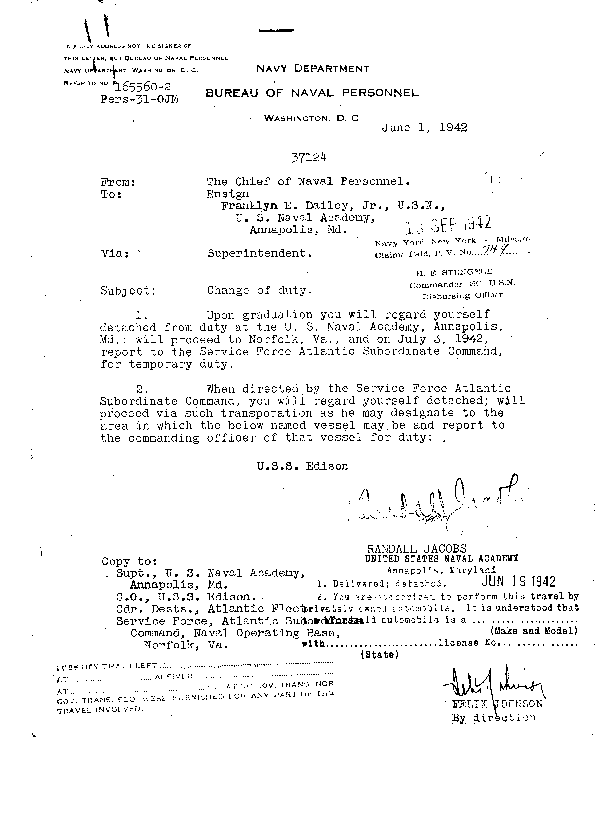
Just before graduating from the United States Naval Academy, as an Ensign USN, on June 19, 1942, I, Franklyn E. Dailey Jr., received orders to report for duty aboard the U.S.S. Edison, DD439.(Reproduction of the orders below, in hard copy edition of the book is much better. /author/)
Some Preliminary Comments: First, on Navy Ordnance, Good and Bad
Most of us have read about this or that military "exercise" being conducted someplace in the world. It turned out to be an exercise for me just to get to the Edison. The original orders directed me to report to the Service Force, Atlantic Fleet Subordinate Command, located at the Naval Operating Base (NOB), Norfolk, Virginia. "Yes", the Edison had been seen there I was told, but "it is not here now." Meanwhile, a week at Firefighters School and then a week at Gunnery School would keep me occupied. Learning to fight fire aboard ship was an important use of time and I made the most of it. The Gunnery School at Dam Neck, Virginia was a hands-on course in firing the U.S. Navy's 1.1 inch rapid fire AA gun. It proved a waste of time insofar as most of us never saw the gun again. On frontline ships, all of the Navy-designed 1.1" guns were soon replaced by Swedish Bofors 40mm AA guns just as the .50 caliber machine guns had already been replaced by Swiss Oerlikon 20mm AA guns. I would soon discover that the only pieces of "ordnance" that we studied at the US Naval Academy relevant to my tour aboard the Edison were in the Edison's gun locker. These were the .45 automatics for boarding party and sentry duty and 30 "ought six" rifles of my midshipman rifle range days. The latter were used mainly to sink moored mines that had been cut loose by the minesweepers and had floated to the surface. While the U.S. Navy's original outfitting of smaller caliber AA guns on its fighting ships needed to be upgraded with ordnance designed outside the U.S., the U.S. designed main battery (on destroyers) of 5"/ 38 caliber Dual Purpose (DP) guns proved to be the envy of all the world's navies. From personal experience, I learned that 5"/38s were especially feared by German armored divisions, infantrymen and airmen.
Don't Expect Your Ship to be at the first Destination on Your Orders. Good advice for those traveling on orders in WWII
The routing of personnel in wartime was, at best, circuitous. There was a general belief among those traveling on orders, whether true or not, that the destinations written into orders for military personnel were designed to "fool the enemy". It often fooled the traveler. I do know that Edison was already at the South Boston (Massachusetts) Navy Yard when I received an endorsement on my original orders in Norfolk to proceed to the Third Naval District at 90 Church Street in New York City. Those orders led me to expect to find the ship at the Brooklyn Navy Yard. At the Federal Building at 90 Church Street, I was immediately given new orders to proceed "without delay" to the First Naval District at the Fargo Building in Boston, Massachusetts. My trip routing from Norfolk to New York was on the Pennsylvania Railroad, beginning with a train ferry to Kiptopeake, Virginia and there to pick up a locomotive that pulled us up the Eastern Shore to join the main line near Baltimore and then on into New York. My Naval Academy-issued Cruise Box traveled in the baggage car. At New York, it was nowhere to be found. After midnight, in a section of the subterranean labyrinth under Manhattan, I found a patient and quite elderly (called back to service) railroad telegrapher who keyed out an "all points bulletin" for the Cruise Box to get it redirected to Boston. It actually came aboard the Edison before we sailed. That box contained my dress blue uniform, service dress whites, and sword. In over 30 years of officer service, I never wore those uniforms and never used the sword. I never even acquired the gold tassel for the sword handle which signified that the midshipman-issue sword was now being worn by a commissioned officer. But I could not see that far ahead, and I was immensely relieved to be intact dress-wise as I reported to the Edison and thankful for the assist given by that kind telegrapher.
On reporting aboard the Edison on July 30, 1942 in the South Boston Navy Yard. I was welcomed at the quarterdeck by Lieutenant (jg) Stanley Craw, USNR, who handed me the Officer-of-the-Deck (OOD) arm brassard, the gun belt and .45 cal. gun and holster, and had me sign the log as his relief as OOD in port. He also said the Executive Officer would see me soon.
It was not long before an "incident" occurred on that watch and I was its focus. Outboard in the "nest" of destroyers at this dock was a destroyer flying the flag of a Division Commander. I must admit that it was not yet indelibly imprinted in my mind that destroyers were organized into divisions (four destroyers) and squadrons (nine destroyers, two divisions of four destroyers plus a destroyer flying the flag of a Squadron Commander) The short title for the Destroyer Squadron to which the Edison was assigned was DesRon 13, and DesRon 13's flagship was the USS Buck. But this nest included destroyers from another division and Edison was inboard alongside the dock. Shortly after I relieved Lt. (jg) Craw on my very first watch, a Division Commander (three gold stripes) started up our gangplank to cross over to his ship. I did know that the protocol involved his saluting the flag, and saluting the quarterdeck to ask "permission to come aboard?" I did not know that the protocol was attenuated in practice to a quick motion which all but compressed two salutes into a single salute, nor did I know that I was to get my hand up in salute to him (a senior officer) as quickly as he or just before he got into the salute. This custom violated the protocol I had been taught but cut down on the amount of saluting and gave the senior officer his due. I returned his salute, thereby violating the "practice" but not the protocol. He sent a complaint to our skipper concerning my exercise of the custom. I was in the first hour of about thirty years of naval duty. My skipper was junior to this Division Commander. My Executive Officer (XO) straightened me out on how it was done, in a very nice way. Later I learned that on direction from the skipper, the XO responded formally to the complaint by telling that Division Commander that Dailey "had done it right and according to the book". And so I met my first wartime Captain and XO. Men who would stick by you.
Alongside a dock near the Edison in South Boston, in early August 1942, was the USS Massachusetts, then a new battleship. An Academy roommate of mine, David Shonerd, had an older brother on the Massachusetts. Dave's father ( a senior naval officer when I was a midshipman) and mother were very kind to me and always included me in the party for Sunday dinner "out in town" in Annapolis when they visited Dave. So, not made bashful by my setback on naval customs at the Edison's gangplank, I got up enough courage to call on Lt. Henry Shonerd, USN aboard Massachusetts. In the course of shipboard duty in my tour aboard Edison, I saw at least a hundred famous warships, destroyers, cruisers and battleships. And I was actually on board a good number of them, both British and our own. The USS Massachusetts is one of just two that I could re-visit today. She is at Fall River, Massachusetts and is maintained for visiting. My USS Edison DD-439 surviving shipmates and families held a reunion on board the USS Massachusetts in 2002. Edison's ship's bell, some of her flag bag flags, and one of her torpedo gyros was accepted in the Museum on the Massachusetts on that occasion.
Two of my first USNA classmates to die in 1942 after our June 19, 1942 graduation from the U.S. Naval Academy, perished in the Coconut Grove nightclub fire on Saturday, Nov. 28, 1942, in Boston, Massachusetts. No enemy action. In 2010 I received an e-mail from a lady whose father was a Navy floatplane pilot who had just participated in the TORCH action that began Nov. 8, 1942 at Casablanca.(Navy floatplanes are discussed in another page on this website, as is the action at Casablanca codenamed TORCH on still another page.) This lady wrote that her father returned to Boston from the successful action at Casablanca and invited his wife to come to Boston. She agreed and got a babysitter to tend to her infant daughter. The reunited couple decided to celebrate with a night out at the Coconut Grove on that fateful evening, and were among the nearly 500 fatalities. That infant daughter was the lady who sent the e-mail telling me of this loss in her life. Margie Searl ,who runs the Memorial Art Gallery in Rochester, New York, told me soon after reading an earlier draft of this page, that her father was one of the men who volunteered to assist after the fire, and gave her a first hand view of its devastation.
Some more on the "no enemy action" theme comes up again on this page.
The first episode in "action" which occurred during my tour aboard Edison involved just two participants, the elements, and our men and machinery. Again, no enemy action. This episode began just before my relief of a midwatch. The date was August 22, 1942 and the scene was Convoy AT-20 out of Halifax, Nova Scotia, bound for Greenock, Scotland. Task Force 37, RAdm Lyal A. Davidson commanding, suffered grievous casualties. Let me set the stage.
Technology and Tactics: The U.S. Still in Catch Up Mode
Until the outfitting of destroyers in late 1942 and early 1943 with Raytheon's SG radar (x-band- with its Plan Position Indicator (PPI) scope on the bridge), fog at sea raised hell for all ships involved in escort of convoy duty, both the escorted merchantmen and their escorts. Until the outfitting of destroyers with SG radar, submarines, particularly in wolfpacks, could maneuver almost with impunity outside the lookout surveillance of the convoy and its escorts. A fast convoy, speed of advance 15 knots or better, had that speed as its best defense. A slow convoy, 8 knots or slower, was extremely vulnerable. The subs had the speed-of-advance advantage as long as they could run on the surface and avoid lookout detection. This enabled them to get into relative positions ahead of the convoy's mean direction of advance. Thus positioned, they then had their choice of closing angle. We saw in the story of ON-67, that with screens deployed ahead, submarine tactics using the quarters for attacks were successful. Their torpedoes, at say 45 knots speed in pressed home attacks, could find a seven or eight knot merchantman, and score hits.
We also saw how Captain Murdaugh's screen, using a relatively new tool, the high frequency radio detection finder, pioneered new tactics to run out on the intercepted radio signal's bearing, and keep the submarines down, where their speed advantage was markedly reduced. Most convoys in mid-1942 did not have the HF/DF equipment on any ship, escort or convoy. Military radio installations based on land also sent information, often based on HF/DF bearings determined from intercepted wolfpack radio traffic, to our ships at sea. These left the seaborne commander a wider area to search as bearing information at these longer ranges simply provided a line on the chart from which the contact could have emanated. But, information that radio traffic from enemy subs at sea was being picked up was always valuable to the embarked forces.
The technology advances for ASW, setting aside high frequency sonar "pinging" and echo detection, which demanded much training and did not serve as a long range search and detection tool, were HF/DF first, SG radar second, and air surveillance for most of the convoy transit, third. I have numbered these in the order of their appearance during the war. In efficacy, the SG radar, was the major advance. The sub did not have to generate radio "traffic" to be detected, it only had to "be". If it surfaced or partly surfaced, SG radar would "see" it. The SG radar provided range, and bearing. Putting these advances in context, with the advantage of hindsight, ON-67's escort screen experience in the application of HF/DF was an important step along the way. All three of these advances meant "seeing beyond the lookouts". Lookouts could see beyond the sonar in reasonable visibility. Consider that, later in the War, we had all three of these technology advances working together. But that time was yet to come.
Even with the advances in technology, weather was always a critical factor in operations. A roiled sea is something that a good surface ship has learned to adapt to, even if a seaborne Commodore might feel "bilious", as ours did in mid-Atlantic on the way to the landings at Fedala, near Casablanca. In roiled waters, submarines do not take to the layer just beneath the surface much better than surface vessels. These rough waters, encountered frequently in the North Atlantic, usually spelled a period of reduced activity for torpedo attacks by enemy submarines. Subs and fog thrive in calm waters. And it needs saying once more, in good weather or bad, the lookouts, whether the first source of warning or confirmation of that source, always served an essential role.
Fog, and the travail of a fast troop convoy to the British Isles
In the fog, a day out of Halifax in August 1942, no screening destroyers and no ships in convoy AT-20 yet had anything like SG radar. The Task Force Commander on the USS Philadelphia did have this remarkable new radar but his position was ahead of Convoy AT-20 and during the crucial period to be described was not in the fog -plagued convoy with ships trying to keep station on a buoy streamed by the ship just ahead. From Theodore Roscoe's "United States Destroyer Operations in World War II", concerning an earlier 1942 operation in these same waters, with screeningdestroyers at battle stations, we quote the following lines:
"The fog was nasty--cotton-thick in patches, but thinning here and there into open spaces ("fog-dogs" in the vernacular) which appeared unexpectedly, like clearings in a misty forest. One minute a ship was plowing blindly through an opalescent cloud. Next minute she was in the clear, exposed."
Now, Convoy AT-20, with troops and supplies bound for Scotland, was, as convoys go, of the "fast" variety, with an expected 15 knots speed of advance. Fog forced the Convoy Commander to slow the convoy and to order the launching of towing spars into the water behind each convoy vessel. Under towing spar conditions, all ships in the convoy close up into a tighter formation so that the conning officer in each ship (except ships in the lead flank) keeps station on the towing spar of the ship ahead. Forward lookouts strain to keep the spar in sight. The helmsman must respond smartly to the conning officer's rudder commands in order to keep the ship in column. The towing spar must not be overrun, yet the vessel must not fall back and lose sight of the spar. The engines are being controlled by "turns", called for over voice tubes and by use of a "turns indicator" from bridge to engine room (ER). Annunciators (a brass mechanical handle-or set of handles, one for each engine/propeller), perched on at waist level on the bridge, transmit fundamental speed changes from bridge to ER which, depending on handle position, call for "slow", standard" or "flank" speed ahead, or "back". The annunciator method of speed control is not precise enough for minute-to-minute use in a formation of ships in fog.
AT-20 was a troop convoy. The Task Force Commander's flag flew on the USS Philadelphia. She was one of three of the new 15-gun (6 inchers) class of light cruisers to serve with distinction in the War in the Atlantic, the other two being her sister ships, Brooklyn and Savannah. I saw enough of these three to observe their excellent sea-keeping qualities. They had big box sterns, and we'll hear more about the stern of Philadelphia in a later chapter on Salerno. The USS New York, my midshipman cruise battleship, was part of TF 37. Since Philadelphia and New York did not run down enemy submarine contacts, it had to be obvious that they were along for another purpose. And that purpose was more than to give an Admiral a comfortable place to ride. Philadelphia and New York both had catapults and deck spaces for scout planes, like the Navy's SOCs or OS/2Us. One might suppose that these would be handy for submarine surveillance. The North Atlantic was not a kind area for deployment of these aircraft. Recovery of them was effected by creating a knuckle in the wake of the "parent" ship to create a smoother place for the seaplane to land, a technique which I had witnessed frequently with the battleships New York, Texas and Arkansas on the midshipman cruise. This maneuver tied up a big ship and plane guard destroyers. The tradeoff rarely seemed acceptable to task force commanders in wartime conditions.
Troopships were generally afforded passage in faster convoys. They also went in convoys that could give an account of themselves against all "threats". The extra hardware, in this instance, Philadelphia and New York, countered surface raider threats from Hitler's Navy. Although the CIC-Combat Information Center had not yet been implemented, the larger warships carried more radio equipment and had larger plotting rooms. The ratio of convoy ships to escorts was also better in the troop convoys, which had eight to fifteen ships in convoy, with escorts numbering nine or more, in addition to the "heavy" stuff represented by a cruiser and a battleship.
By July 1942, the wolfpacks had returned to the North Atlantic. Every merchant convoy in August was attacked, and one convoy, eastbound SC-94 was attacked by two wolfpacks on separate nights. 24 ships went down in August in this area, 28 in September, 25 in October and 29 in November of 1942. Acoustic homing torpedoes were entering the U-boat arsenal. Large supply submarines had begun to replenish the German sub fleet to keep it at sea. With new wolfpack fronts established off South America, in the Caribbean and Gulf, and in mid-Atlantic and North Atlantic, the pressure on the defense to obtain escorts entered a crucial phase. The North Atlantic troop convoys carrying Army units to Britain kept the highest priority. In order to provide modern destroyers of the Benson class for troop convoys, the British Navy and the Canadian Navy re-assumed primary responsibility for the full transit of merchant convoys. There was occasionally an extra detachment of escort ships in Iceland to sally forth on call.
The result was that the fast trans-Atlantic AT troop convoys, heavily escorted, ran the wolfpacks without casualties due to enemy action. Not a ship underwent torpedo attack. Still, submarine attack was paramount in the minds of the escort force commanders and any "trouble" whose source was not immediately apparent had first to be evaluated as potentially submarine-caused. We will return to an August 1942 submarine sinking of the Army transport Chatham, and two other troopships which were sunk in 1943, after seeing what happened to AT-20 which departed Halifax on August 21, 1942.
Screen Commander for AT-20 was Captain John B. Heffernan, ComDesRon 13, with flag on the USS Buck. DesRon 13 was as close to its full complement of assigned destroyers in the AT-20 trip as I would experience in 27 months aboard Edison. I can find references to Ludlow, Woolsey, Edison, Bristol, Wilkes, Swanson, Nicholson and Ingraham participating in the trip. These ships, all of the Benson class, and all initially assigned to DesRon 13, joined active war service in the Atlantic at about the same time.
AT-20's 10-ship troop convoy was pretty well formed up and standing eastward from Halifax by 0600 on 22 August. Just before 1800, troopship Letitia reported a radar contact which Swanson and Ingraham investigated. Sonar noise, possibly porpoises, delayed their return and they were unable to determine the source of the original radar contact. At 2200 fog added to the complexity of a convoy attempting to resume its original alignment, which had been altered during the sweeps by Swanson and Ingraham.
At 2205, CTF 37, RAdm Davidson, used the TBS voice radio to direct the USS Buck to go close aboard Letitia and escort her to her assigned station 1,000 yards on Philadelphia's starboard beam. With visibility now near zero, and with the primary station-keeping resource, the towing spars, streamed, Buck actually had to get into bull horn range of Letitia to help direct her to the assigned position.
Escorts of AT-20 Take Deadly Hits
At 2225, now in a crossing position in a convoy column, a Buck lookout's shout was too late, as the transport Awatea, suddenly visible at 30 yards, rammed Buck's starboard quarter. The steep bow of Awatea nearly severed Buck. A 300 pound depth charge from one of Buck's K-guns dropped over the side and exploded, damaging Buck's port propeller. Buck broke away, badly hurt, and helpless.
Ordered to investigate "collision in the convoy", ( later determined to be the collision of Buck and Awatea) Ingraham, in that same blinding fog as she entered the convoy's path, got athwartship the Navy oiler USS Chemung, whose bow cut Ingraham nearly in two. Lying nearly on her side, Ingraham blew up with an orange flash of such intensity that it cut through the fog and was visible on Edison's bridge. Ensign R.F. (Dick) Hofer, the junior watch officer on Edison's bridge, reported the flash in Edison's log at 2235 by Edison's chronometer. Because I was so new at watch standing underway, I was up on the bridge early to relieve Dick Hofer, and was just getting night-vision adjusted when I too saw the flash.
Ten men and one officer survived on the Ingraham. The officer was my classmate from the Naval Academy, Ensign Melvin Brown. He would have had orders very similar to the orders reproduced on the first page of this chapter. Ensign Brown was in the Ingraham's main gun director when she rolled over. He survived drowning mainly because he was wearing a kapok life jacket with a ring that curled from its vest on the chest up around and behind the neck. This jacket could hold an unconscious man's head out of water. In the late Spring of 1997, just after I had determined that I should contact Mel Brown personally about this experience in my preparation of this story, I read of his death in Shipmate magazine.
The death toll on Ingraham had to be about 250 men. It is not fair to the dead to record such a nominal figure, because each death is a significant loss, and the fact of its occurrence in the defense of one's country especially deserves accurate and specific recognition. Ingraham's manifest, provided on departure from its last port, would furnish the information so that each family could be notified. The pace of death in World War II was so rapid that news articles used the estimated loss figures contained in preliminary Navy or Army service announcements. It was rare that more detailed and accurate follow up got into the press because the next loss to announce would already be at hand. Even in the numbing down that the regularity of loss numbers caused, Ingraham's loss of life came across as very large. There were many more to come. We never got used to them.
While Ingraham was more likely than not to sink, given the catastrophic damage of the collision, it was the explosion which robbed her crew of any chance to save her or themselves. The comment earlier that this class of ships could survive torpedo damage did not make anyone comfortable with the demonstrated vulnerability of destroyer classes to magazine detonation. In the War in the Atlantic, triggers for magazine detonation, in addition to torpedoes, were collision and air attack. Atlantic destroyers demonstrated toughness in seakeeping, and proved themselves effective in handing out punishment. Their proportionately large cargo of high explosives and the large space the explosive materials occupied, was their Achilles' heel.
Too often, their own depth charges punished many a US destroyer. One of the sources consulted in preparing this account commented that after the collision, and rolling over on her side, that Ingraham's own depth charges went into the sea and exploded under her. This account states that it was then that the tell tale blast of magazine detonation occurred.
Not all the damage had yet been done to AT-20. Thankfully, no more destroyers would be used in that dense fog to get the convoy ships on station. Also, patches of clear sea began to emerge from the wreathy fog shortly after midnight. Bristol and Edison were assigned to stay with the damaged ships while the convoy moved on. Edison found the Chemung on fire in her bos'n's stores in the forward hold. Bristol found Buck dead in the water with men trapped in the after steering engine room. The Awatea, a transport with 5,000 soldiers aboard, had disappeared.
Damage Assessments
Let's look first at the Buck's problems. What is an "after steering engine room"? On Edison, as on the Buck, way aft was a hatch that gave personnel access down through the main deck to an after-compartment in which the steel cables came from the bridge to a rudder-turning pulley, in this case a wheel of large diameter. This tiny room was manned by enlisted personnel as one of the regular underway watch stations. Trained personnel could take direct control of the rudder in the event of malfunction between bridge and rudder for whatever cause. Direction for moving the rudder could come via the "sound powered telephones" or if everything else were knocked out, by man-to-man voice relay. For water tight integrity purposes, this space is "dogged down" during action episodes when the ship is at General Quarters. Junior Officers are assigned training watches in the after steering engine room and I can personally attest to the claustrophobia that can overtake anyone during a watch in this space. Dead in the water, with men trapped in the after steering engine room, is how Bristol found the Buck in that eerie calm sea. We will come back to "solutions" to the Buck's dilemma after dealing with Edison's handling of the tanker, the USS Chemung.
Navy tankers differ from the huge sea going tankers like the Exxon Valdez. In WW II, those huge vessels, though not yet as large as their counterparts today, transported a primary cargo of say, bunker fuel oil, or crude oil. Some transported aviation gasoline, which we will shorten to avgas here. The distinction is that, short of some small quantities of other petroleum distillate cargo for their own use, the commercial tanker carries one primary petroleum product. Not so Navy tankers. They have traditionally carried a mixed cargo of bunker fuel oil, avgas, and diesel. They also have extra gear for fueling the "train", like ships in task forces whether cruisers or battleships, or escorts or other Navy auxiliaries like supply ships or attack transports. Each of the classes of Navy ships has different "menu" needs. Some will not need avgas at all-destroyers come to mind. But the destroyer needs the most frequent feedings. I seem to remember that Edison carried just over 140,000 gallons of #6 fuel oil and a few thousand gallons of diesel fuel. The daily fuel report was a "must do" report.
The Chemung, as noted, was on fire in the forward hold. The flammables here were mostly boatswain's stores, ropes and the like. The fact that she was a tanker, and had a mixed cargo of flammable petroleum derivatives, was certainly on the mind of her skipper and our skipper. She was almost dead in the water. We patrolled slowly around her. We were now in a clearing in the fog, and visibility was good, really too good, for we and she, were being illuminated by her fire. We had no idea then of what had gone wrong in the convoy. We had none of the post mortem data contained in the paragraphs above. All Ensign Hofer had told me was that he heard an order over the TBS given to a destroyer to "close the convoy at high speed". Edison personnel could not, therefore, when dealing with the Chemung, even equate the huge ball of orange to the loss of the Ingraham. Submarines were on our mind. The skipper of the Chemung asked the Edison to come close aboard and put out Chemung's fire.
Both Capt. Headden and Executive Officer (XO), LCDR Pearce, were on the Edison's bridge. Both had experience that I had not had, and experience that I did not then know they had. I was kind of dumbstruck by the Chemung's request. I assumed we would probably do what the Chemung asked, and I worried about getting that fire out before it spread to the rest of the Chemung, or to us. Our Exec.,"Hap" Pearce, as he was known, already had a Navy Cross for keeping the Marblehead, a US cruiser, afloat in the South Pacific after Japanese aircraft had scored hits, and then rigging an emergency rudder so that Marblehead could get back to the States, the long way around. Edison's CO and XO conferred briefly. Captain Headden then told the Chemung skipper, in brief, to "get your own fire out, and do it quickly so we can both get underway." That was not what I expected. In my naivete, I expected we would go alongside and push as many fire nozzles as we could into any hole we could find in the forward section of the Chemung.
What Headden and Pearce knew that I did not know, was that ships like the Chemung had more than adequate fire fighting equipment aboard, certainly more than a destroyer had, and that Chemung had men trained to fight even more dangerous fires. I watched in amazement at the reaction on Chemung to Headden's orders. Both her deck crews and her boat crews quickly moved fire fighting equipment and pumping equipment forward and attacked the fire vigorously They had a stubborn type of stores fire under control before dawn. Edison and the Chemung got underway toward Bristol and Buck, not too far away. Edison sailors were always glad to be underway. Both Headden and Pearce, when they served as Edison's Commanding Officers, believed in movement. In addition to movement, and to zig zag patterns as prescribed in MERSIGS, Edison constantly fish tailed along any course, and regularly altered the degree-of-rudder changing signals. Going alongside a dock in a battle area was a "no no". I had heard them talk about that.
I cannot put an exact time on subsequent events, except to try to be accurate about the order in which these events occurred. Buck's difficulty was quite severe and in attempting to overcome it, more tragedy occurred. One propeller shaft had been severed and the screw had gone to the briny deep. The crew in the after steering engine room were in communication with their shipmates but apparently a wall of water surrounded them. Since we arrived with Chemung back in the vicinity of Buck after the second event in their fearsome night, I can only infer that the after main deck had been left under water from her collision with the Awatea. The dogged watertight door on the hatch would keep water out of their compartment but it also meant that their only egress could not be used. There were other courses of action, in retrospect, that might have been taken. But, the "plan" by this time was to get damaged ships back to Halifax. If the just passed events of the night of the 22-23 of August, 1942 had not originated with enemy submarine action, one could still expect submarines to take advantage of distressed ships.
So, Buck made the effort to see if the remaining propeller could be turned over. That proved to make things worse. The partly severed stern vibrated off and plunged into the deep. Not only did this take the after steering engine crew down with it, but the 600 pound roll off charges in the stern racks exploded when they got to their set depth.
Could those charges have been set on "safe"? Even after the collision? Why were they armed in the first place? Were the charges on the Ingraham also set to go off at depth? Every watch on Edison drilled at least once in four hours in setting depth charge patterns and proficiency was recorded by the time to set the pattern, and report the pattern set. It was further a mark of proficiency to get them set back on safe. These drills to set a pattern and then return the settings to "safe" took place in almost all sea conditions and in darkness. I figured out years later, that apparently there was no Destroyers Atlantic Fleet (DesLant) directive on depth charge procedures that all had to follow.
The Awatea, with her 5,000 troops embarked, and bow damaged, did not return to AT-20. Some said she went back to Halifax. Others said she went on her own to Greenock. (I was later informed by a trooper aboard that she made it back to Sydney on Cape Breton ).She was capable of modern liner speeds, and those faster ship's skippers always chafed at convoy speeds, which they felt made them more vulnerable than going it alone. Awatea was not lost this night, thank God. AT-20 losses were already steep.
A mini-convoy was made up, Chemung with Buck in tow, Bristol and Edison screening. Bristol's skipper was Senior Officer Present Afloat (SOPA). Course was set to Halifax, and even with our slow speed of advance, we were back off Halifax in less than two days. Bristol and Edison turned their injured charges over to patrol boats out of Halifax, and made their way back to AT-20 at high speed. Calm seas prevailed, yet it took nearly four days at 25 knots for Edison to resume station in its assigned sector with AT-20. I had mixed emotions after these days, my first at sea in war conditions, and a lot of questions, most of which I kept to myself. Please go to the end of this page to learn another consequence of the USS Buck's damage that relate to Lt. George Lambert USN, Edison's Gunnery officer and my mentor when I reported aboard the USS Edison.
Some troop transports were sunk in North Atlantic waters, though none in the fairly exclusive troop convoys. Still, AT-20 type convoys were not the most effective ways to get soldiers across the Atlantic. Taking another leaf out of the WW I experience, on 2 August 1942, the US and Britain agreed to use big, fast luxury liners to to move troops across the Atlantic without escort vessels. In his Volume I of the History of United States Navy Operations in World War II, Volume 1, The Battle of the Atlantic, Samuel Eliot Morison mentions the French SS Pasteur, Canadian Empress of Scotland, and the Cunard "Queens", Mary and Elizabeth. The American SS Mariposa was used but did not operate under British command. The Queen Mary at 81,000 tons and the Queen Elizabeth at 85,000, could sustain 26.5 knots and make the trip in less than five days. In 1942, these ships made ten eastbound trips and in the first six months of 1943, twenty, all loaded with Canadian and American troops. They were not escorted for the main part of their crossings, never lost a man, and were much more expeditious and cost effective in moving manpower than the best of the escorted troop convoys.
(For more on Convoy AT -20, please also read Appendix D and Appendix E entered on this website from . These links can also be reached from the Table of Contents , from the listings down the left side of this page. These additional pages contain much elaboration on Convoy AT-20 for the night hours of August 22-23 1942 at sea, and have been offered from sources not originally available.
And recall that quickly made up mini-convoy, in which the USS Bristol DD-453 and the USS Edison DD-439 screened the damaged USS Chemung AO-30 towing the USS Buck, DD-420, now shorn of both of her screws, back to Halifax. These Appendices will provide more information on what occurred later to these ships, and to the elusive transport, SS Awatea.)
Other Troop Convoys
Certainly the least effective way to get troops to advanced stations were slow convoys and mixed slow and in my words, "slightly faster than slow" convoys. One such convoy, SG-6 left Sydney, Cape Breton on 25 August 1942. The first and faster group had the USCGC (US Coast Guard Cutter) Mojave escorting the US Army transport, Chatham. The second or slow group, found the cutters Algonquin and Mohawk escorting three merchantmen plus the Navy oiler Laramie, and USS Harjurand, a coal-burning auxiliary with a maximum speed of 7 knots. Cape Breton is north of Nova Scotia. The port of Sydney looks NNW into the Gulf of St. Lawrence or E into the Atlantic Ocean. The route chosen took these ships into the Gulf of St. Lawrence. The "G" in SG indicated a destination of Greenland. Air coverage was available on the 25th and 26th but not on the 27th. At 0915 on the 27th, Chatham was torpedoed, making 9 knots. Most of the crew of 139 men and most of the 430 Canadian and American soldiers were saved by Mojave and a small Canadian patrol boat, helped by two planes spotting survivors. Morison's footnote states that 9 or 10 were killed in the torpedo explosion and 16 or 17 were listed as missing. Mojave went back to Sydney with survivors but failed to radio information on the sinking in the Strait of Belle Isle, or to inform anyone that the probable cause was a submarine torpedo.
The slow group, therefore, received no information on the fate of the "fast group" earlier in the day. They took the same routing and at 2132 on the 27th, close to where Chatham went down, USS Laramie was hit, and the SS Arlyn was sunk, both by torpedoes. According to Morison's account, the Arlyn carried 400 tons of explosives and her crew "rushed to the boats", leaving the Naval Armed Guard to swim. In late January 1943, SG-19 stood out of St. John, Newfoundland for Greenland. There were two merchantmen and the US Army transport Dorchester in the convoy escorted by cutters Tampa, Escanaba and Comanche. Coast Guard Cutters were being equipped with radar only when they went in for overhaul, the argument being that the need for escorts overrode all arguments except the occasion for scheduled ship refitting. Radar had not yet made the list of "essentials" in command thinking. It is like the airplane can fly, so when it can fly no longer, we'll fix the instruments.
On 3 February 1943, at 0355, with Dorchester and convoy just 150 miles from landfall at Cape Farewell, Greenland, making 10 knots, a sub determined that she was the prize of the group and approaching from the starboard quarter, torpedoed her. In frigid waters, with poor discipline (no radio distress call and no effective abandon ship procedure) only 299 of Dorchester's 904 men survived. The sight of hundreds of dead bodies held up by life jackets was sobering to men on the vessels of the Greenland Patrol which came to assist. On 7 February, in convoy SC-118 out of New York for Iceland, troopship SS Mallory with 384 US servicemen, a merchant crew of 77 and an Armed Guard of 34, was torpedoed just south of Greenland. Again, discipline was poor, and with no orders from the bridge, less than half the lifeboats made it into the water. Personnel loss was about 60% of those aboard.
We have made a very brief summary of the troop convoys of 1942 and early 1943. Mallory was the last to go down in this category. These convoys in the Atlantic generally took troops and specialists to stations under our control or to the British Isles. These were build-up forces and in the beginning, defense forces for the areas they manned. Large troop convoys were also part of the initial assault forces for the counter offensives yet to come and these will be dealt with in this narrative as part of those operations.
Merchant cargo shipping continued to take a heavy pounding in Atlantic waters. Some U.S. escorts managed to get some "reverse" lend lease from the RAF in the form of radar equipment which they jury rigged and then nursed, because support for it was not available. It was not officially on board. Edison was not one of those ships. Edison made one more round trip to the British Isles in convoy duty and then prepared for new duties. The culmination of these new duties were the landings in North Africa in November 1942; not many, and certainly not a new Ensign, knew this.
The Author's First Onboard Mentor Lost at Sea
Off watch on the USS Edison, my assigned mentor was the ship's Gunnery Officer, LT G.S. "Beppo" Lambert. Lambert kept me busy diagraming, from close (nose length) observation, every nook and cranny of Edison's hull. I was assigned to the Ordnance Division when I had no duties as First Division Officer. Beppo wanted me to know my ship before touching a piece of her ordnance. I did get to know the magazines, and was terribly embarrassed later by what I let happen to two of them alongside a dock in Bayonne, New Jersey, when yard workmen one day tested the "fire mains". As OOD in port, I met Captain Pearce the next morning at the quarterdeck coming back from his leave, and he immediately noted that we "seemed low in the water". We were. Two after powder magazines (no ammo, thank God, we had lightered it off at Gravesend Bay) were flooded. The workmen had tested the fire mains all too successfully and I had failed to notice that we had settled into the water as a result of the fire mains not being shut off. LCdr Lambert lost his life when, as Executive Officer of the USS Buck, that destroyer was hit by a U-boat torpedo and sank with heavy loss of life. Some details later here and in World War II Sinking.
Another mentor was Lt. (Jg) Craw, who helped me transition from Naval Academy "p-works", exercises in piloting and navigation, to the real thing on Edison. The p in p-works stood for "practical". By the time I left the ship two years later, Craw was my XO. He was the first of the reserve officers on board when I reported for duty to make it to this high position. The Navy no longer had to send for an Academy trained officer for these billets. (That supply was exhausted, anyway.)
I learned that while the training you received to prepare you for shipboard responsibility helped, it was how fast you could profit by experience, which was everywhere at hand, that would determine whether you became a key player. Whether in ASW work in convoys, in shore bombardment or in defending against enemy aircraft, the ability to make each new experience count influenced your next assignment and your performance in it. Improved escort of convoy results came with new technology, of course. But cohesion in effort, between ships in a command and between men and officers on a ship, came as the result of actual experience.
Abe Simon came aboard as an Apprentice Seaman. This man was a successful businessman and family man, yet he could neither read nor write. Deckside aft, underway or in port, his shipmates conducted "school" for Abe. He learned to recognize the key words necessary for his survival, and for his part in the ship's survival. On the bridge, Parris the Signalman, and Davenport the Quartermaster, unselfishly taught me some essentials of communication and navigation. I avoided learning the essentials of card playing from Parris. He was usually the only rich man when we made port. The 8-12 morning watch was a particularly good time for a young watch officer underway. When Captain Headden, and later Captain Pearce, emerged from the skipper's bunk room on the bridge, with a good night's sleep, the conning officer generally gained some new capability. I recall that one morning coming into Portland, Maine (the rocky coast of Maine), Captain Headden let me (insisted that I) con the ship right on into port. He was gentle in remarking on the bearing change of successive buoys, in making sure that I understood which ones were "on my side" and which were in the center of the channel. He let me take Edison much further in than I thought he would let me go, or for that matter, further than I thought I should be trusted to take her.
Learning The Hard Way
Despite the "lessons" of World War I, ASW work in North Atlantic convoys was not a priority peacetime objective of the U.S. Navy in the 1918-1935 period. The naval treaties defining the permissible makeup of the fleets of Britain-US-Japan, in the 5-5-3 ratio for capital ships, absorbed a lot of command, and construction, attention. Sonar, equipment and training, did not in any way anticipate another U-boat offensive. Almost the same could be said for amphibious operations, though some constrained budget exercises had been undertaken and the message from WW I was not so clear as the submarine message. The mystery surrounding the radar early warning contacts made on Japanese aircraft descending on Pearl Harbor, and the breakdown in reporting those contacts to someone who could believe, and act, was in truth, part of a general lack of conviction about radar, particularly among our senior officers in both the Army and the Navy.
There were US technology "believers" in the services, but they achieved little leverage from their convictions; certainly no circle of parties existed who would fan out and spread the word. There was an active US radar development program. We were training people in the use of radar and building radars. Perhaps because the early systems did not have a hand that came up out of the oscilloscope to grab you by the neck, even when the "good stuff" came, we did not quite make it an "all hands" evolution to get it, to use it, and to believe it. We needed the radar and the believer, and the believer had to be someone in a position to stimulate action. Watching traces on the early A-scopes and B-scopes did not recruit missionaries. Not quite overnight, not quite as fast as we would like to have seen with the advantage of hindsight, SG radar turned the trick. The PPI-scope presentation did, in effect, have the hand that reached out and said, "There it is. Go get it!" SG radar did the job operationally, but first it convinced the missionaries to go out and spread the word
I have mentioned the discipline Edison practiced in setting depth charge patterns. I wish I knew who to credit for the decision to leave them on "safe" and train constantly to set the patterns properly under pressure. I do know that the same lookouts Edison depended on to watch for ship's topmasts on the horizon, or periscopes closer aboard, usually set the patterns for the first attack on a submarine contact. Jack Sotis was a torpedoman in charge of the after lookout watch in our watch-in-three rotation. His watch and mine often coincided. Jack Sotis is an example of the type of man who showed constant leadership and the ability to execute. We all learned from Jack. Edison came through almost unscathed because of men like Jack Sotis.
Duty Changes
Lt. (Jg) Lambert had been an Edison plank owner. He was the ship's First Lieutenant at commissioning and later became its Gunnery Officer. When he left the Edison, he became the Executive Officer of the USS Buck. This change of duty occurred after Buck's difficulties in August of 1942, described earlier. Lambert graduated with the Naval Academy Class of 1935, where he was a key player on a famous football team with such names as Slade Cutter and Buzz Bories.
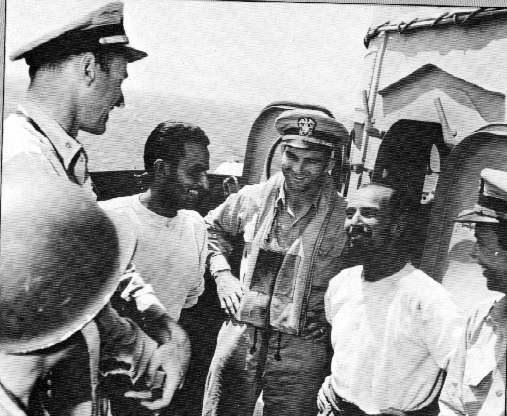
The photograph reproduced below shows Lt. Lambert, in the center, facing the camera. I found it in a book called "Destroyers", by Anthony Preston, published in 1982 by Galahad Books, a division of A&W Publishers, Inc. This is a beautifully illustrated book, and one given to me as a gift in 1982 by Manfred R. Kuehnle, for whom I worked at that time. The discovery of this photo came in 1997 only after I had begun to prepare this chapter. The photo caption is especially compelling as Preston's book covers the loss of the Buck just four pages later. We will cover it in a future chapter. The caption: "An unusually happy scene between the victors and the vanquished as officers of the USS Buck (DD420) interrogate several U-boat survivors."
The Lambert Family: Service to Country
Two Events: The Bombing of Pearl Harbor: The Disappearance of Amelia Earhart:
Here, we return to a family whose son, George "Beppo" Lambert appears in my book, "Joining the War at Sea 1939-1945." George Lambert was in the second of the three Lambert families sired by Tom Lambert of Louisiana. George graduated from the U.S. Naval Academy in 1935 where he won national fame as a member of one of the Academy's greatest football teams; Lambert's team mates included 'Buzz' Borries and 'Slade' Cutter.
I first met Lt. George Lambert, USN, in July 1942, when he was assigned as my mentor on the USS Edison, DD-439, a Livermore class destroyer, commissioned early in 1941. George was Gunnery Officer of the Edison. His indoctrination program for me, a newly commissioned Naval Academy Ensign, had me crawling every accessible below-deck space on the ship, even though I was assigned as First Division Officer, a deck job. Academy graduates in wartime almost always were involved in Gunnery duties soon after reporting. Edison, soon to be manned almost entirely with Reserve Officers, continued this perceived need to assign Academy officers to Ordnance duties. Strange, because the only guns aboard which any of my graduating class had ever seen before, were in the small arms locker, the .45 automatic and the Springfield rifle. Technology was moving much faster than the study program at the Academy, but habits trumped reality.
Lieutenant George Lambert had fully mastered Edison's all-new destroyer armament and had already passed it along to "Jake" Boyd, Class of '38, who was in turn passing it along to Dick Hofer, '42, one Naval Academy class ahead of my '43 class. I had a lot of learning to do, and fine officers to learn from. Rapid progress was a necessity, because war was taking its toll of officers, and new construction was gobbling up the remaining ones. Lambert departed when I had been on board less than six months. He was ordered, now a Lieutenant Commander USN, to the destroyer USS Buck (DD-420) as her Executive Officer. It was on that ship in October 1943, hit and sunk by a submarine-fired torpedo off Salerno, Italy, that George Lambert was lost in the explosion and rapid sinking. He is shown in a photo in my book, on the Buck's bridge, shortly before she was lost.
There were four children from Tom Lambert's marriage to his first wife, four (all boys) from his second marriage, and eight from his third marriage. The Dean Lambert who became my Lambert contact when I covered the loss of the Buck in my book, came from the third family. Dean was the Police Chief of Many, Louisiana, when we began our e-mail friendship about 1999. Dean is now helping once again to revisit that second family of Lamberts. Dean supplies a quote, originating in October of 2009, from the British Daily Mail's story of a British father who sired twin children at the age of 71. "The world's oldest father of twins is recorded as being Tom Lambert of Louisiana who was 78 when his children were born in March 1948." Dean is one of those twins.
Dean Lambert has made a new discovery in papers left behind by his half-brother, George. One of George's three full brothers was Phillip H. Lambert, a career enlistee in the Navy in 1929 at age 17; he was aboard the battleship USS Maryland when that ship was tied up at the dock at Pearl Harbor on December 7, 1941. Dean sends along excerpts from an interview Phillip gave the Sabine Index, a Louisiana paper. This interview reveals some of the Navy life of Phillip Lambert, who left us a hand-drawn chart, representing a unique historical artifact on another event of world interest. Some interview excerpts:
On December 21, 1929, (Phillip) Lambert began an active duty Navy career as a repairman on the (Navy repair ship) USS Medusa in San Pedro, California. He served on the Medusa until June 30, 1932 when he was transferred to the USS Lexington, an aircraft carrier. Lambert served on her until March 31, 1938, when he was transferred to the USS Maryland. Another of Phillip's full brothers was James Clifford Lambert, the Aircraft Radio-man on the USS Maryland and that is why he (Phillip) requested transfer to the Maryland. (Phillip used U.S.S. in his writings, common at the time)
While serving on the USS Maryland, on Dec. 7, 1941, Phillip Lambert recalls explosions and confusion that ripped the Sunday morning peace at Pearl Harbor. "I was sorting out my laundry, when all at once I heard (felt) concussions and explosions going off somewhere. All of a sudden, someone said the Japanese are bombing Ford Island. I could feel the concussion from the torpedoes hitting the USS Oklahoma, a (battle) ship tied (up) next to us," Lambert recalls.
"I looked out the port hole and could see the Japanese planes machine-gunning houses on Ford Island, as the USS Oklahoma had already started rolling over. We were throwing out life-lines and ropes to the survivors on the USS Oklahoma. The entire bombing lasted approximately an hour and a half. There was a lot of confusion naturally, on something like this." (That "confusion" earned Phillip Lambert a Silver Star medal)
(Phillip) Lambert added, "We were lucky we didn't get much damage. Our ship was hit twice in the bow. It was the way the Japanese dropped their torpedoes that kept us from receiving more damage than we did. We were in the right position at the right time. Out of the 1,500 men on the USS Maryland, we sustained only two deaths." Lambert remarked, "It is no fun when someone is shooting at you."
"We then moved to Washington's Navy Yard near Seattle, along with the other damaged ships, for an over-haul, new anti-aircraft guns and shells. We then returned to the South Pacific to the New Hebrides Islands, where we were engaged in several battles sinking many Japanese ships."
Phillip Lambert continued his naval career up until his retirement as Chief Water Tender (CWT), Nov. 15, 1948. He was then put on a retainer list for ten years. In April 1951, Lambert was called to serve his country once more in the Korean War, where he served three years as a trained Naval Recruiter in Bainbridge, Maryland.
When asked why he joined the Navy and if he would do it again, Lambert had this to say, "When I joined at the age of 17, the depression was going on. Good people were looking for jobs everywhere and none to be found. With my parent's signature, I enlisted. It was the only thing to do." In answer to the second question, Lambert said, "If I was 18, I would gladly serve my country again!"
From the interview above, note Phillip Lambert's six-year tour of duty, 1932-38, aboard the USS Lexington. The "Lex" was laid down, along with her sister ship, the USS Saratoga, as a battle cruiser. In mid-construction, the 5-5-3 Treaty was signed with Britain and Japan, and these two hulls would put the U.S. over the treaty limits agreed to for that class of capital ships. So the U.S. converted the two unfinished hulls to aircraft carriers, an isolated twist of good fortune in the many disarmament efforts agreed to by the U.S. What Dean Lambert discovered in George Lambert's papers, in addition to the foregoing newspaper interview given for a Pearl Harbor day observance in 1985, was a hand-drawn chart. See below.
This browned, aged chart almost certainly originated in the Lexington's Navigation Dept. "Pacific Ocean" looks official. It is intelligently detailed. Anyone aware of 20th century aviation history would take immediate notice. I would assess it as a USS Lexington sea chart fragment showing her 1937 transit, in response to orders to find a missing aircraft, the specially configured Electra 10 model, piloted by Amelia Earhart. (A Lockheed Electra 10, and Amelia, are featured, for unrelated reasons, in another of my books, "The Triumph of Instrument Flight: A Retrospective in the Century of U.S. Aviation.")
The short curved segments around Howland Island would represent Lexington's aircraft, launched for intense coverage in a perimeter around the island Earhart was attempting to reach, non-stop, from Lae, 2201 nautical miles away. (First numeral verified on original.) Phillip hand-drew the profile, unmistakably the Lexington. To put dates in context, Amelia's takeoff from Lae was 2 July E. Long.; that would be 1 July in West Longitude.

For the apparent double exposure, Dean Lambert offers: "The only thing I can imagine is that when it was put into the scrap book, after years and years it bled over to an adjoining page, it was removed briefly and put back, and then it bled back onto the original. A little weird, but I cannot imagine anything else. This map has been stuck in this old scrapbook for over 70 years, so a lot of chemical reactions could have occurred." Now, we return to the rapid turnover of Edison's officers as Reservists begin to fill the billets.
Lt. (Jg) James Abner "Jake" Boyd, USNA `38, came aboard in early 1942 and later succeeded Lambert as Edison's Gunnery Officer. When Captain Headden left on 28 February 1943, after the landings in North Africa and the securing of Oran, Algeria and its adjacent port of Mers-El-Kebir, LCDR Hepburn A. Pearce, USNA `31 became CO and Boyd fleeted up to become XO, taking Pearce's place as XO. Dick Hofer, `42, who had reported aboard on 3 January 1942 from graduation of his Naval Academy class in December 1941, succeeded Boyd as Edison's Gunnery Officer. Craw had been performing navigation duties all along and often assisted Boyd when the latter was both XO and Navigator. Craw was that valuable officer who could step in and do almost any job on the ship. When an assigned officer was detached for special, temporary duty, Craw could take over. When there was a gap between a departure and an arrival, Craw could take over. I took all this as ordinary when I was aboard Edison.
I was not privy to the planning for personnel assignments. Enlisted men and officers were coming and going and there was no time to reflect on this gain in personnel or that loss. I can relate that I was confident at all time with the leadership and devotion to duty in Edison's officer and enlisted complement. Possibly 500 of the 940 who served aboard came or went when I was there. Only one incident occurred in my 27 months of duty to mar the record and I will go into that in a later chapter. I presume the CO and XO huddled on personnel matters. I can remember that Bridges, the Chief Radioman, Jackson, the Chief Fire Controlman and Kerns, the Chief Gunner's Mate, all were overdue for transfer at the same time. Captain Pearce made it clear, in a positive way, that these dedicated and highly experienced men would not be getting transferred over his signature, but would only be going after he, Captain Pearce himself, had been transferred. This was an affirmation of Pearce's recognition of their talents. It was also an affirmation of Pearce's instinct for Edison's self-preservation. Sharing the personnel-wealth was not a demonstrated virtue in DesLant destroyer commanders. Each wanted the best men available.
Home | Joining The War At Sea | Triumph of Instrument Flight