-------
.
Read The Triumph of Instrument Flight
- Navy Aerial Reconnaissance
- Warships at Morocco-1942
- Aircraft Carriers for Torch
- Battle for Morocco
- Bridging World Wars
- Supply and Support
- Husky, Palermo, Messina
- Bloody Salerno
- Luftwaffe Standoff Weapons
- Aircraft of World War II-"friendlies"
- Long "slog" at Anzio
- USS West Point AP23 War Cruise-part 1
- USS West Point AP23 War Cruise-part 2
- Singapore, Fateful Stop on "Joan's Journey"
- Update West Point
- Part I, Briggs on Casablanca, Sicily
- Part II, Briggs on Anzio
Bloody Salerno. 36th Division Meets Fierce Resistance at Paestum;Tiger tanks repelled by U.S. Navy Warships
Copyright 2013
Ships and Aircraft of World War II(many photos from U.S. Navy WW 2 Recognition Training Slide Set)
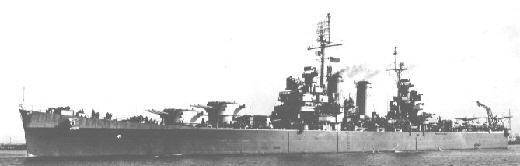
This is the USS Philadelphia, CL-41, in a Navy WW II recognition slide. The monoplanes astern under her crane appear to be OS2U aircraft, a surprise, because the aircraft complement for this class was normally the SOC biplane. Philly participated in TORCH, HUSKY, and is pictured here as the narrative comes to AVALANCHE, the invasion at Salerno, Italy, in World War II.
In the early morning of September 9, 1943, my destroyer, the USS Edison, DD-439, was assigned to support the landings at Paestum, the Southern Attack Force's set of four beaches, just below Salerno. See the lower section of the sketch below. The Edison had four 5" 38 cal. guns, and their barrels would be, not red hot, but white hot by nightfall!
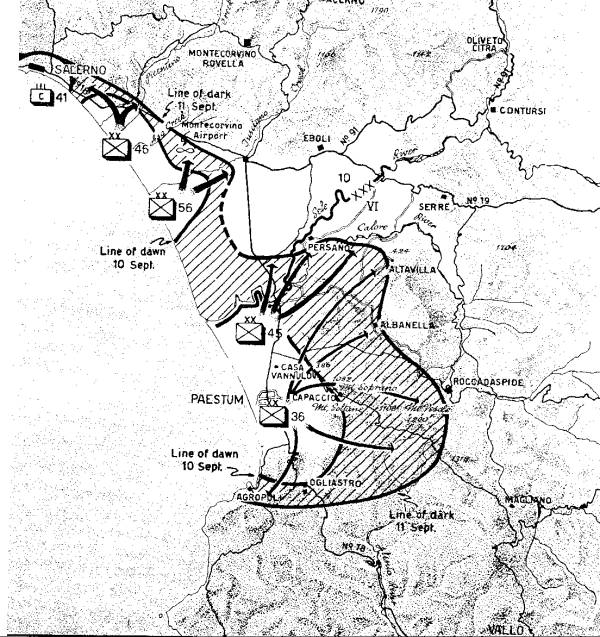
The 36th Division of the U.S. Army was asssigned to take the beaches immediately north and south of Paestum, and move inland. The eventual target after join-up with the Northern Task Force up the coast near Salerno was the huge port of Naples just north of the Gulf of Salerno. The Germans were ready, more than ready. The agreements that the Allies had hastily made with Italy and Marshal Bagdolio after the Italian Armistice were never blessed with certitude. The Germans stepped in, pushed the Italians aside whenever in doubt about the latter's loyaties to their former war partners, and brought Panzer Divisions up from the "boot"of Italy and down from the north. Marshal Kesselring was never in doubt about where the landings would be made and had rimmed the logical beaches at Paestum with guns, troops and tanks. A thick defensive minefield in the Gulf offshore kept the landing craft offload points from their transports much further to sea than desired. This determined where the landing craft formed up for departure to the beach, and it became a pivotal factor.
At mid-morning, it was not going well. RAdm Lyal Davidson USN, with his flag on the Philadelphia, had to go on the TBS (Navy ship to ship voice circuit, 68-72 mc) with a most unusual order. The overworked minesweeping commander had just reported for the fourth or fifth time, that "mines are popping up all over the place," as his flotilla of minesweepers made pass after pass in a dense thicket of well placed, moored, mines. "Sweeping" involved towed paravanes that streamed "cutters" out on the stern quarters of a minesweeper. The cutters would cut the moorings of the mines which would then float to the surface, still lethal if hit, but at least could then be seen.
"Stop those reports," Davidson barked to the sweep commander," and just keep sweeping. We're way behind. Philadelphia is coming through! Our troops are desperate for interdicting artillery." Edison was the closest destroyer to Philly when Davidson announced his intentions. Edison's skipper, Commander "Hap" Pearce USN, gave quick orders to his helmsman, and to his engineers (the "black gang") via the Edison's annunciators. Edison put her bow right up behind Philly's stern. I had never seen the letters, "USS Philadelphia," writ so large. Pearce decided that he would use the biggest minesweeeper in the Mediterranean, an American light cruiser, as Edison's own personal minesweeper.
In the next six hours, Edison provided satisfaction for her cost of construction borne by U.S. taxpayers.
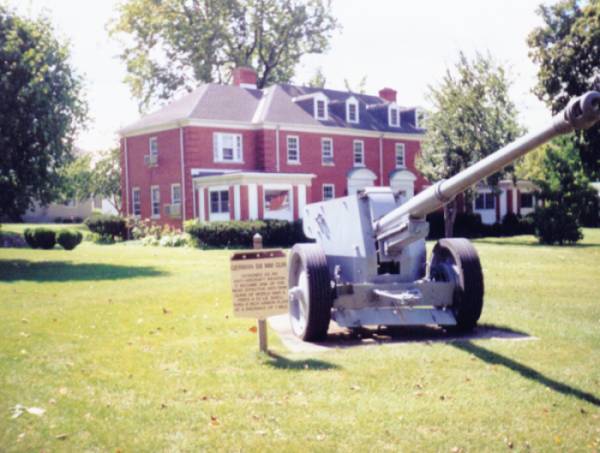
This is a German 88-mm artillery piece. The legend states, "Designed as an anti-aircraft weapon, it became one of the most effective anti-tank guns of World War II. Fired a 22 lb. shell thru 6 inch armor plate at a distance of one mile." The Germans excelled in the use of a basic design for several purposes and the gun was featured in their"Tiger" tank.
A fifty calibre bullet would go right through any destroyer and come out the other side. So an armor piercing 88-mm shell fuze was not likely to detonate if it hit a destroyer like the USS Edison. It could raise a little havoc on the way through.
The 88mm gun, employed in a radar-controlled battery of four, almost nailed us in September of 1944. But this day was September 9, 1943 and it was used against the Edison by Tiger tanks proceeding in column toward the sea down to the beach at Paestum, where the tank column would pivot parallel to the beach, and enfilade our assault waves coming onto the beaches.
Usually, artillery shells give off a fluttering sound and one hears them moments before they hit. But the 88-mm gun had a muzzle velocity higher than the speed of sound. When you heard the shell at close range, and I heard plentyof them, it was like a whistle and it had already passed. And at the ranges we dueled with Tiger tanks at Salerno, the 88-mm trajectory was so flat that "a miss was as good as a mile." We did not really know all that then, and even if we had, it would not have made us less nervous.
Once Edison got inside the minefield, contact was made with the USS Savannah's fire control party on the radio. (Savannah, CL-42, a sister ship of the Philadelphia) was at the time still outside the minefield. Savannah's NLO (Naval Liaison Officer) was ashore with his fire control party, and asked for Edison to respond, fast. The NLO provides coordinates. Edison fires a "ranging salvo" using white phosphorus shells. The NLO observes, and gives our destroyer a 'correction spot, left 2 mils, out 200 yards,' and 'go to rapid fire.' We can see the tanks. We have no tanks ashore and these are Tiger tanks! We catch them in file coming toward us. This is the only time in my 27 months aboard that we can go to direct fire. We fire and fire until our gun-bloomers catch fire. The NLO sends more targets and we fire some more. We cease fire in the late afternoon because every one of our 1800 high capacity 5" shells has been expended. There are only a dozen armor piercing shells left in the magazine. The sea is awash with "brass 5" shell cases." One Edison sailor, named Abe, who could not read at all until tutored by his shipmates, is actually a well to do owner of a big junkyard near Chicago. He is actually crying as we throw all the 5" brass powder casings over the side. We are told to withdraw and USS Trippe takes over for us.
How navigator Stanley Craw, and the exec Jake Boyd, and the skipper Hap Pearce kept us from going aground in that small strip of shallow, mined, water as the engineers supported flank speeds twisting and turning, while the gun boss Dick Hofer and Chief Fire Controlman Jackson and those gun crews kept dealing out the damage, defies description. We trained on ourfive-inch practice shell-loading machine to do 20-rounds per gun per minute! We go out through the minefield with USS Rowan, another DD out of ammo. All that night we are subject to air attacks. Our gun barrels are white hot and we have no way to extinguish them. They look like four glowing marker pencils pointing to the sky to help those Ju88s find us! One drops a torpedo that misses Edison. The gun barrels cool, from white to red to dull glow and die out the next morning.
Next evening we are convoy commander for the first unloaded ships going back to Oran. Not 500 yards from us, destroyer Rowan blows up and sinks quickly. My guess is that she hit one of those floating mines from the day before. Destroyer Bristol , which would herself be sunk in an enemy attack before the campaign is over, picks up survivors.
The USS Trippe, which replaced us on the firing line, forwards to us a dispatch from an Army general.
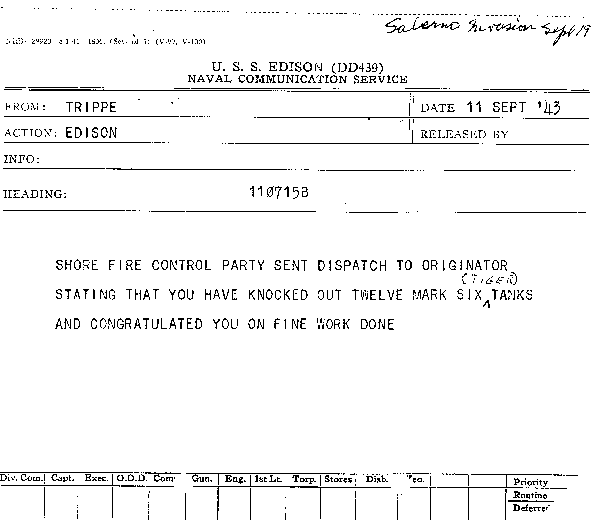
I have a copy of another dispatch like the one above. In it, Brigadier General John Lange, 36th Division Artillery Commander at Salerno, radioed, "Thank God for the fire of the blue-belly Navy ships. Probably could not have stuck out Blue and Yellow beaches. Brave fellows these; tell them so." The copy I have shows that it was forwarded to the USS Edison DD-439 from the USS Ludlow DD-438. This dispatch from General Lange appears in my "Joining the War at Sea" book. My destroyer, the USS Edison DD-439 had its finest day at Salerno.
All this and much more can be found in the book pictured at the top, "Joining the War at Sea 1939-1945." This Gulf of Salerno landing, in the face of superior Tiger Tank defenses, was the turning point in the battles that the U.S. and Britain waged to retake the Mediterranean. Edison fired every available shell save for a few of the new AA 'proximity sensing' shells we carried, some 1800 5"38 cal. shells in all. And a rarety, not indirect fire using spotters ashore, but directly at the Tiger tanks enfilading the beach, and so close we could see them clearly in our gunsights and rangefinders.
As I have already noted, the "bloomers" on our guns that kept water from coming into the gun compartments ,all burned up. The barrels of our four 5" guns were white hot and took the entire next night to cool, first to red, then dull red, and finally dark. These four white pencils in the sky attracted all the German Luftwaffe available that ensuing night.