-------
.
Read The Triumph of Instrument Flight
- Navy Aerial Reconnaissance
- Warships at Morocco-1942
- Aircraft Carriers for Torch
- Battle for Morocco
- Bridging World Wars
- Supply and Support
- Husky, Palermo, Messina
- Bloody Salerno
- Luftwaffe Standoff Weapons
- Aircraft of World War II-"friendlies"
- Long "slog" at Anzio
- USS West Point AP23 War Cruise-part 1
- USS West Point AP23 War Cruise-part 2
- Singapore, Fateful Stop on "Joan's Journey"
- Update West Point
- Part I, Briggs on Casablanca, Sicily
- Part II, Briggs on Anzio
HMT Rohna sunk by Do-217 launched Glide Bomb. USS Savannah survives turret-hit from high altitude Luftwaffe radio control bomb
Copyright 2012
Ships and Aircraft of World War II(many photos from U.S. Navy WW 2 Recognition Training Slide Set)

This is the Do-217 aircraft manufactured by Dornier for the German Luftwaffe in WW II. Under the right wing (on the left in this picture), is a radio controlled glide bomb. This is the weapon that sank HMT Rohna in a Mediterranean convoy with the loss of over 1,000 U.S. soldiers who were enroute to the CBI theatre in World War II. Under the other (left) wing is an external fuel tank. The book "Joining the War at Sea 1939-1945," shown upper left, contains a full account of the Rohna tragedy, including one survivor's close brush with death. The flight path of the glider bomb into the port side of Rohna at water's edge is covered.
This rocket-engine-propelled glide bomb under the right wing of the Do-217 aircraft in the photo above was controllable in level flight, in descent, and in banking left or right. It could be considered a relative of the longer range V-1 buzz bomb that the Germans employed in the Battle of Britain. U.S. fighter pilots flying out of the UK reported that by getting above the V-1 they could dive and keep up with it long enough to give it some prop wash to knock it off course. No such defense was available in dusk attacks on convoys in the Mediterranean. At Salerno, I watched in awe as one of the glide bombs flew just above sea level toward a combat-loaded LST. The control operator in the mother plane gave his weapon a "down elevator" signal just a moment too late and it exploded in the water just yards beyond the targeted LST.
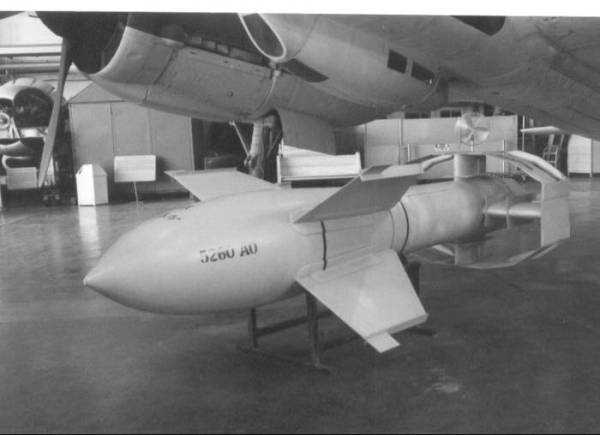
This is a close-in photo of the radio controlled bomb that hit the USS Savannah at Salerno. (Each of the radio-controlled Luftwaffe standoff weapons was equipped with a bright colored flare so that the control operator in the mother plane could correct the trajectory.) Unlike the glide bomb shown in the upper photo, the Fritz X was a ballistic bomb dropped from high altitude. Called the Fritz-X 1400, or FX-1400, and radio-controlled from a high altitude 'mother' plane, this weapon hit turret three of the USS Savannah off Salerno during Operation AVALANCHE, and exploded in the magazine. This weapon had no propulsion except gravity but her tail fins were controllable from the mother plane to correct her trajectory toward the target. The damage from this perfect hit was grievous. Savannah's Commanding Officer was asked if he wanted assisting ships to come near so that he could abandon ship. Captain Cary responded that the surviving crew would keep her afloat and Savannah made it to drydock in Malta. When my ship made port in Malta for Christmas 1943, some of us went over to look at Savannah and her damage. We marveled that she had not sunk right near the spot off Salerno where she was hit. My classmate Hugh Hamilton at the U.S. Naval Academy was the turret officer of turret #3 and along with all members of that turret crew, was killed instantly. This is also covered in more detail in "Joining the War at Sea 1939-1945." My destroyer had alread;y fired all of her ammunition at the Paestum landings at Salerno and was outside the close in gunfire support area when Savannah was hit.
Facing no defensive night fighters, and night fighters were in their infancy in 1943, a mother plane with the rocket powered, guided, glide bomb would hide in the dark side of sunset and use the flares to illuminate their prey. Launch might be from an altitude like 4000 feet toward a ship in convoy.
The Allies only defense against the German aircraft carrying the radio-controlled FX-1400 weapon at high altitude at Salerno was the British Spitfire aircraft. These wonderful aircraft provided the only high altitude cover at Salerno. Coming from the newly acquired airfields in Sicily, the "spits" had limited time on station so British and U.S. ships at Salerno did not have continuous air cover.
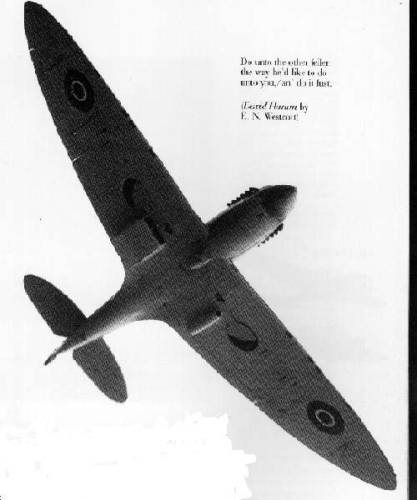
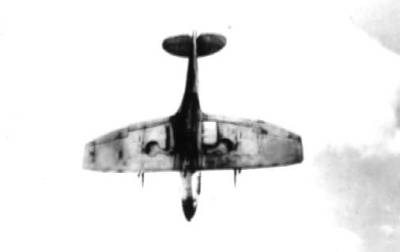
Above, the famed Spitfire with her prominent elliptical wing. Below, is another version, known as the "clipped wing" Spitfire.
As the Allies moved toward the heartland of Europe, we in the surface Navy began to see more and more aircraft. And, more and more of them were "friendlies." In the next installment, we take a pause in war to examine a few more of these.